

Options market structure
Most disagreements about what options data means are really disagreements about market structure: who clears the trade, who is obliged to hedge it, and what the public tape does and does not carry. These pages cover the mechanics underneath the analytics, and separate the terms that describe real datasets from the ones that are marketing.
- Pages on this topic
- 27
- Where to start
- Start with the option chain and how trades clear, then sweeps versus blocks, then the pages separating dark-pool and smart-money language from listed options data.
- Applies to
- US-listed stock and ETF options
- Purpose
- Independent research and education
Popular labels versus actual datasets
Dark pool activity is an equity-market concept: those are off-exchange share trades, not options. Smart money and whale flow describe trade size, because no public options feed identifies the account behind a print. Sweeps and blocks are real, defined order types and are genuinely informative about urgency and negotiation.
Read the supporting context
Knowing which is which is what stops an impressive-sounding label from doing work that the underlying data cannot support.
Concept guides
- Call options vs put optionsA call option gives its buyer the right, not the obligation, to buy 100 shares of the underlying at the strike price on or before expiration.
- Buy calls or puts: a decision framework, not a recommendationNo page, dataset or dashboard can tell you whether to buy calls or puts, because the answer depends on a view about direction, timing and volatility that only you hold, and on a financial situation that a website cannot see.
- Options trading strategies, organised by what they expressAn options trading strategy is a defined combination of long and short calls and puts chosen to express one specific view, with a maximum loss and a maximum gain that can be calculated before entry.
- Option finder tools: what each 'finder' query actually meansOption finder is not one product.
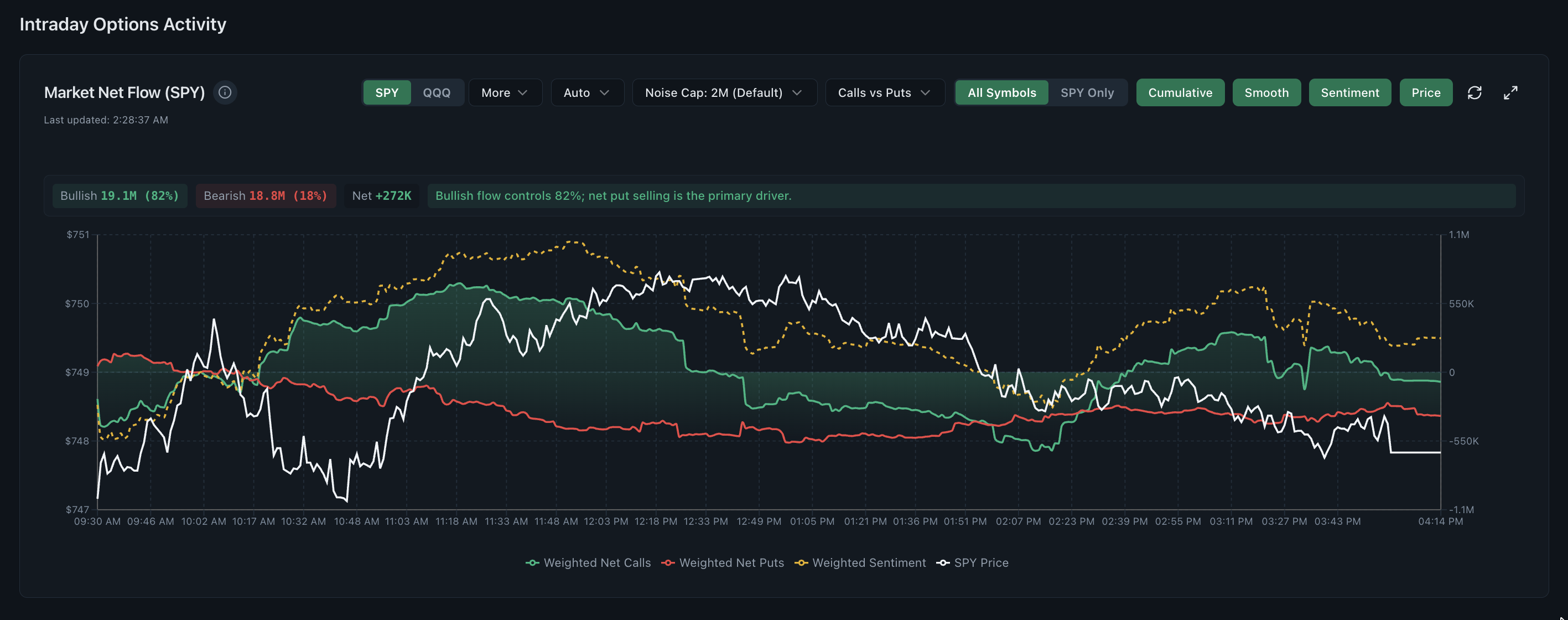
- What is options flow?Options flow is the record of executed options trades organized to show where contract activity and premium are concentrating.
- Options sweeps versus blocksAn options sweep is an order filled rapidly across multiple venues or price levels, while a block is a large transaction executed as one reported print or negotiated package.
- Gamma exposure (GEX) explainedGamma exposure, often shortened to GEX, is an estimate of how aggregate option delta may change as the underlying price moves.
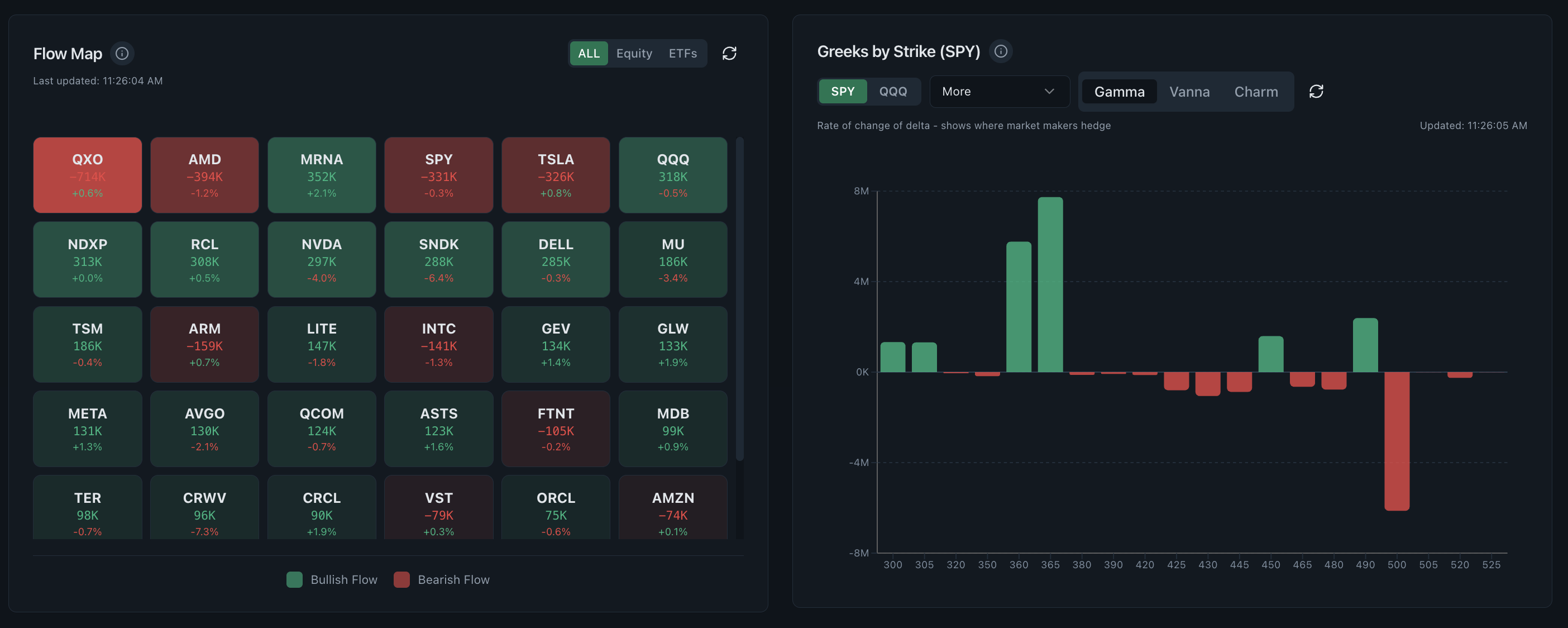
- Options Greeks by strikeOptions Greeks by strike group model-derived sensitivities at each exercise price so a researcher can see where delta may respond to price, volatility and time.
- How to read an option chainAn option chain lists available call and put contracts for an underlying across strikes and expiration dates.
- Dark pool data versus options flowDark-pool data and options flow describe different markets.
- Smart money options flow without the certainty mythSmart money options flow is a marketing label for large, unusual or aggressively executed options activity that may involve professional participants.
- Best options flow data tools for trading decisionsThe best options flow data tool is the one that matches your research job and exposes enough context to challenge its own alerts.
Screens, tools and comparisons
- Real time options dataReal time options data usually means current trades and quotes for listed contracts, plus intraday volume and analytics derived from them.
- Real time options quotesReal time options quotes show the current bid and ask for an option contract.
- Realtime Options Public API v1Realtime Options Pro includes authenticated, read-only Public API v1 access to four aggregated analytics endpoints: Buy/Sell Pressure, Algo Flow, 0DTE Flow & Gamma Exposure, and Greeks by Strike.
- What trading analytics should you monitor in real time?Nine, and the order matters more than the list.
- Call wall and put wall explainedA call wall is the strike above the current price holding the most call open interest.
- Options trading platform or options analytics platform?An options trading platform is where you place orders through a broker such as Tastytrade, thinkorswim, Interactive Brokers, Schwab, Robinhood or Webull.
- Free options trading platform: four different meanings of freeA free options trading platform usually means one of four things: a commission-free broker whose revenue comes from payment for order flow, interest and other fees rather than a per-trade commission; a free tier of paid software with delayed or reduced data; analytics bundled into a brokerage account you have already funded; or a time-limited trial.
- Free options tools and data sources, checked August 2026Genuinely free options tools fall into four groups: public market data published by the OCC and Cboe, free education from the Options Industry Council and FINRA, analytics bundled into a funded brokerage account, and free calculators or delayed chain views published by vendors.
Dashboard guides
- Market News Context dashboardThe Market News Context dashboard filters recent headlines by ticker, source and category so options activity can be checked against reported catalysts.
- Premium EdgePremium Edge compares the move implied by an expiry's option pricing with the underlying's observed movement across comparable historical windows.
Applied workflows and method posts
- 0DTE options research: same-day gamma and same-day risk0DTE options research studies contracts expiring the same trading day, where gamma concentrates tightly around the current price and the entire position resolves within hours.
- Earnings options flow: reading positioning before the printPre-earnings options flow shows that market participants are positioning around a scheduled event; it does not show that anyone knows the result.
- What the 0DTE share of volume actually meansThe 0DTE share of volume is the proportion of options contracts traded in a period that expire the same day.
- Premium versus contract countPremium is a more honest measure of options activity than contract count because contracts are not comparable units.
- How to read sector options flowSector options flow groups executed options activity by market sector, then compares call- and put-side premium across the group and its active tickers.
Common questions
Do options have dark pools?
Not in the equity sense. Listed options trade on exchanges and clear through the OCC. Large options trades can be negotiated off the screen and printed as blocks, which is a different mechanism from an equity dark pool.
What is the difference between a sweep and a block?
A sweep is split across multiple exchanges to fill quickly, which suggests urgency. A block is a single large negotiated trade. Both are size and execution facts; neither identifies the trader or the intent.