

Buy calls or puts: a decision framework, not a recommendation
No page, dataset or dashboard can tell you whether to buy calls or puts, because the answer depends on a view about direction, timing and volatility that only you hold, and on a financial situation that a website cannot see. Realtime Options is research and education software; it is not a broker-dealer, not a registered investment adviser and does not provide personalized investment advice. What can be set out honestly is the arithmetic each side requires, the forces working against every option buyer, and the specific things options flow data can and cannot reveal about what other participants are doing.
- Direct answer
- Nobody can decide this for you, and this site does not try
- Long call needs
- Underlying above strike plus premium, before expiration
- Long put needs
- Underlying below strike minus premium, before expiration
- Working against both
- Time decay and any fall in implied volatility
- Maximum loss
- 100% of the premium paid, which is a common outcome
- This platform
- Analytics only: no advice, no signals, no order entry
Why nobody can answer this for you
The question of whether to buy calls or puts is advice-seeking, and answering it requires facts about you that no publisher has: your directional view, your confidence in the timing of that view, your tax and account situation, your options approval level and how much of a total loss you can absorb without consequence. Any page that answers it directly is guessing on your behalf.
Read the supporting context
There is also a market-structure reason. A call and a put are not two options on the same question. They are two different bets on price, timing and volatility simultaneously, and being right about only the first of those three is frequently enough to lose the entire premium.
- Your directional view and, separately, how confident you are in when it plays out.
- Whether the position would be speculation or a hedge on something you already hold.
- Where implied volatility sits relative to that specific ticker's own history.
- Whether a scheduled catalyst such as earnings falls inside the expiration you are considering.
- Your account's options approval level, which determines which positions are even available to you.
- Whether a 100% loss on the position would change your financial situation.
What has to be true for each side to pay
A long call pays at expiration only if the underlying finishes above the strike plus the premium paid. A long put pays only if it finishes below the strike minus the premium. Both statements ignore fees, and both contain a deadline that is easy to overlook when reasoning about direction alone.
Read the supporting context
Written side by side, the two positions are more symmetric than most comparisons suggest. The maximum loss is identical in structure, and the differences sit in the maximum gain and in the timing problem each one faces.
| Requirement | Long call versus long put |
|---|---|
| Direction | Call needs the underlying higher; put needs it lower |
| Breakeven at expiration | Call: strike plus premium. Put: strike minus premium |
| Timing | Both need the move before expiration, not eventually |
| Volatility | Both lose value if implied volatility falls after entry |
| Maximum loss | The premium paid, on either side |
| Maximum gain | Call: unbounded in theory. Put: strike minus premium, if the stock reaches zero |
Time decay and implied volatility work against the buyer
Every long option is a wasting asset. The extrinsic portion of its price decays toward zero as expiration approaches, and that decay accelerates in the final weeks. A buyer therefore needs the underlying to move enough, and quickly enough, to outrun the erosion.
Read the supporting context
Implied volatility is the second problem. Buying an option when implied volatility is elevated for that ticker, often the case immediately before earnings, means paying for expected movement that may be repriced sharply lower once the event passes, even when the direction was correct.
- Theta is normally negative for both long calls and long puts, so time passing costs the buyer either way.
- Vega is positive for both, so a drop in implied volatility reduces the value of both.
- Being right on direction but late on timing can still produce a total loss.
- Buying into a scheduled event and holding through it exposes the position to a post-event volatility decline.
- Shorter-dated contracts decay faster; 0DTE positions can lose their entire value within a single session.
Position size, total loss and the expiration reality
The defining feature of buying an option is that the whole premium is at risk and expiring worthless is an ordinary result, not a rare accident. Sizing a long option position as if it were a stock position, where a decline is usually partial and recoverable, misstates the risk by a wide margin.
Read the supporting context
None of the following is advice on how much to allocate. It is a description of the structure so that whatever you decide is decided against accurate information.
- The premium paid is the maximum loss and should be treated as fully at risk from the moment of entry.
- Out-of-the-money options that finish out of the money return nothing at all, not a reduced amount.
- Multiple small losing premiums accumulate faster than an equivalent stock drawdown for the same capital.
- Exercising an in-the-money contract requires the capital or margin to take on 100 shares per contract.
- Selling options instead of buying them removes the decay problem and replaces it with obligation and, for uncovered calls, theoretically unlimited loss.
What options flow can and cannot tell you about what others are doing
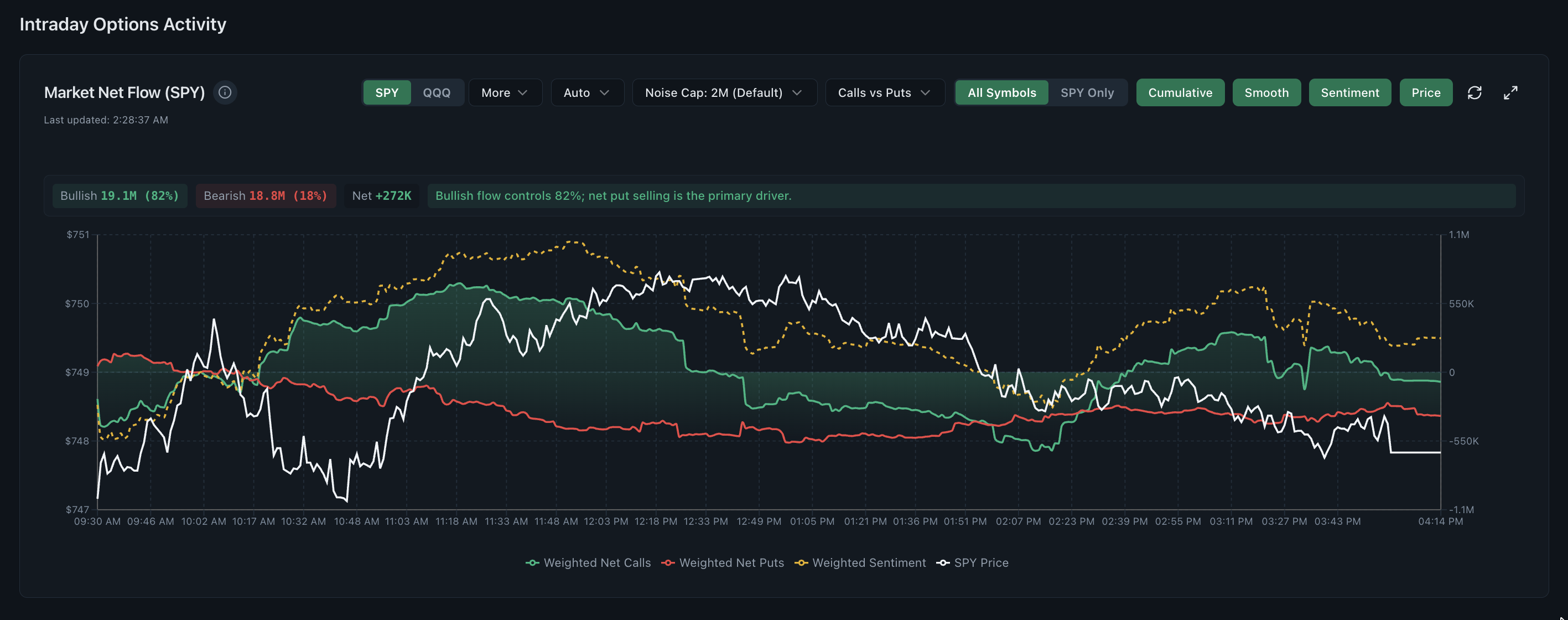
Options flow answers a narrow question well: where contract activity and premium concentrated, in which tickers, at which strikes and expiries, and roughly how aggressively those trades were executed. That is genuinely useful context, and it is the entire scope of what Realtime Options provides.
Read the supporting context
Flow cannot make the decision for you. It does not identify the parties, separate a hedge from a directional bet with certainty or establish what happens next. Following a large print without context substitutes somebody else's unknown position for your own reasoning.
- Can show: premium and contract concentration by ticker, strike and expiry.
- Can show: how a print sat relative to the bid and ask, as an estimate of aggressor side.
- Can show: the latest published open interest, updated once daily after the close by OCC.
- Cannot show: the identity of the trader or the rest of that trader's portfolio.
- Cannot show: whether a print opened or closed a position, or was one leg of a spread.
- Cannot show: the future price of the underlying, under any conditions.
Risk disclosure and where an actual answer comes from
Options involve significant risk and are not suitable for all investors. You can lose the entire premium paid on a long call or a long put. Selling uncovered calls carries theoretically unlimited risk, and selling puts obliges you to buy shares at the strike regardless of where the market has moved. Read the OCC's Characteristics and Risks of Standardized Options before trading any option.
Read the supporting context
If you want an answer specific to your circumstances, the place to get it is a licensed professional who can see those circumstances and is accountable for the recommendation. FINRA and the SEC's investor.gov publish free, neutral material on options risk that is worth reading before that conversation.
- Read the Options Disclosure Document from OCC before opening any options position.
- Confirm your broker's options approval level and what it permits.
- Consider speaking with a qualified, licensed financial professional about your own situation.
- Treat any source that names a specific contract to buy as marketing rather than analysis.
- Realtime Options publishes no win rates, no backtested returns and no performance claims of any kind.
Common questions
Should I buy calls or puts?
This site does not answer that question, and no responsible source will answer it without knowing your circumstances. What can be stated is the structure: a long call needs the underlying above the strike plus premium before expiration, a long put needs it below the strike minus premium, and both lose value to time decay and falling implied volatility. The decision belongs to you or to a licensed professional advising you.
Are calls or puts better for beginners?
Neither is a beginner instrument. Both carry the risk of losing the entire premium, both require correct timing rather than only correct direction, and both require an options approval level from your broker. FINRA and OCC investor material is the appropriate starting point before either is considered.
Is buying a call safer than buying a put?
The maximum loss is identical in structure: the premium paid. The practical difference is the timing problem. Equity markets have historically drifted upward over long horizons and declined quickly over short ones, which tends to make put timing harder and put premium more expensive because of persistent volatility skew.
Can I lose all the money I put into a call or a put?
Yes. If the contract finishes out of the money it expires worthless and the entire premium is lost. This is an ordinary outcome for long options rather than an unusual one, which is why position sizing for a long option should not be modelled on how a stock position behaves.
Does heavy call flow mean I should buy calls?
No. Flow data records transactions, not positioning or intent. A large call print can be a hedge against short stock, a roll of an expiring contract, one leg of a spread or dealer inventory management. Treating observed activity as an instruction to trade in the same direction substitutes an unknown position for your own reasoning.
How do I decide between a call and a put with no strong directional view?
Without a directional view, neither long position has anything to express, and buying one anyway means paying premium and decay for a coin flip. A more useful next step is research: what implied volatility looks like relative to that ticker's own history, whether a scheduled catalyst falls inside the expiry, and where activity is concentrating in the chain.
What do I need before I can trade options at all?
An approved options account at a broker, which involves an application and an assigned approval level, and receipt of the Options Disclosure Document, Characteristics and Risks of Standardized Options, from OCC. Requirements and permitted strategies vary by firm and by approval tier.