

Put options explained
A put option gives its buyer the right, not the obligation, to sell 100 shares of the underlying at a fixed strike price on or before expiration; the seller takes the matching obligation to buy those shares if assigned. The most important thing to know about put data is that heavy put buying is frequently protection on shares already owned rather than a directional bet against the stock, and put volume alone cannot tell you which of the two it was.
- Contract size
- 100 shares per standard US equity or ETF put
- Buyer's maximum loss
- The premium paid
- Cash-secured seller
- Obliged to buy 100 shares at the strike if assigned
- Common non-bearish use
- Protective puts against shares already held
- Put volume
- Counts contracts; it does not identify buyers, sellers or intent
- Ratio caution
- Earnings hedging and expiration rolls distort daily readings
What a put option gives the buyer
A put option buyer holds the right to sell 100 shares of the underlying at the strike price up to expiration. The buyer pays a premium for that right and can walk away from it; the put simply expires if it is worthless at the end.
Read the supporting context
Because the underlying cannot fall below zero, a long put has a defined maximum gain: the strike price minus the premium paid, per contract. That is the structural difference from a long call, whose theoretical upside is unbounded.
- Underlying ticker, strike price and expiration define the exact contract.
- Multiplier: 100 shares, so a put quoted at $3.10 costs $310 per contract before fees.
- Maximum loss for the buyer: the premium paid, and total loss is a routine outcome.
- Maximum gain for the buyer: strike minus premium, reached only if the underlying goes to zero.
- Standard US equity and ETF puts are physically settled; many index puts are cash-settled instead.
Protective puts: why put buying is often not bearish
A protective put is a put bought against shares already owned, functioning as insurance rather than as a directional trade. The buyer of that put is long the stock and expects to stay long; the put exists so that a decline has a floor. Nothing about the transaction expresses a view that the stock will fall.
Read the supporting context
This is the single most common misreading in options data. When a fund hedges a large equity position, it prints large put volume while remaining net long the underlying. Routine hedging ahead of earnings does the same thing on a smaller scale across thousands of tickers, which inflates put activity for reasons that carry no sentiment content at all.
- Protective put: long stock plus long put; caps downside, costs premium, keeps upside minus that premium.
- Collar: long stock, long put and short call; the short call finances the put and caps the upside.
- Portfolio hedging with index puts: prints heavy SPY or QQQ put volume from investors who remain long equities.
- Pre-earnings hedging: raises a ticker's put activity into the event and typically mean-reverts afterwards.
- Tail hedging: persistent far out-of-the-money put buying that is budgeted, not opportunistic.
Selling puts: cash-secured puts, assignment and obligation
Selling a put creates an obligation to buy 100 shares at the strike if assigned. A cash-secured put sets aside the cash required to meet that obligation; an uncovered put does not, and carries a margin requirement instead. Either way, the seller has taken on downside exposure that resembles owning the shares below the strike.
Read the supporting context
Put selling is, in economic terms, closer to a bullish or neutral position than a bearish one. It also adds to put volume in exactly the same way that put buying does, which is why a put-heavy tape cannot be read as pessimism without further evidence.
| Put position | Obligation and risk |
|---|---|
| Long put, speculative | No obligation; loss limited to the premium paid |
| Long put, protective | No obligation; insurance cost on shares already owned |
| Short put, cash-secured | Must buy 100 shares at the strike if assigned; cash set aside |
| Short put, uncovered | Same obligation with margin instead of cash; loss up to strike minus premium |
Why put volume is not a directional signal
Put volume counts contracts that changed hands. It does not record who initiated, whether the trade opened or closed a position, whether it was one leg of a spread, or whether the counterparty was a dealer managing inventory. Those four unknowns are enough to break any direct mapping from put volume to bearishness.
Read the supporting context
The put/call ratio inherits every one of those limitations, plus a set of mechanical distortions. Practitioners generally smooth it over five or ten sessions rather than reading a single day's print, and treat it as one input among several rather than as a sentiment reading.
- Put buying and put selling add identically to put volume, and express close to opposite views.
- Earnings hedging inflates put activity ahead of a scheduled event with no directional content.
- Expiration Fridays spike volume with closes and rolls rather than new positioning.
- Thin, wide-spread single names can have their ratio moved by a handful of trades and are effectively meaningless.
- Early-exercise order flow distorts equity put/call ratios, which Cboe has documented in its own research.
- A single day's unsmoothed print is noisier than the same series read over five or ten sessions.
Why puts usually cost more than equidistant calls
Equity and index option surfaces have carried a persistent negative skew since the October 1987 crash: a put a given distance below the money typically trades at a higher implied volatility than a call the same distance above it. The main drivers are steady, relatively price-insensitive institutional hedging demand and the asymmetry of price behaviour, where sharp declines happen faster than comparable rallies.
Read the supporting context
The nuance that most explainers omit is that this skew is permanent. Its existence is not a live bearish signal, because it is present in calm markets too. What can carry information is a change in skew relative to that ticker's own recent history, and even that is an observation about pricing rather than a forecast of direction.
- Skew is a structural feature of the surface, not a daily sentiment reading.
- A put and a call equidistant from spot are usually not priced at the same implied volatility.
- Buying a put therefore often means paying a higher implied volatility than the equivalent call.
- Comparisons are only meaningful against the same ticker's own history, not across different names.
- Realtime Options does not screen or rank contracts by implied volatility rank or percentile.
How put flow reads in the data, and where it stops
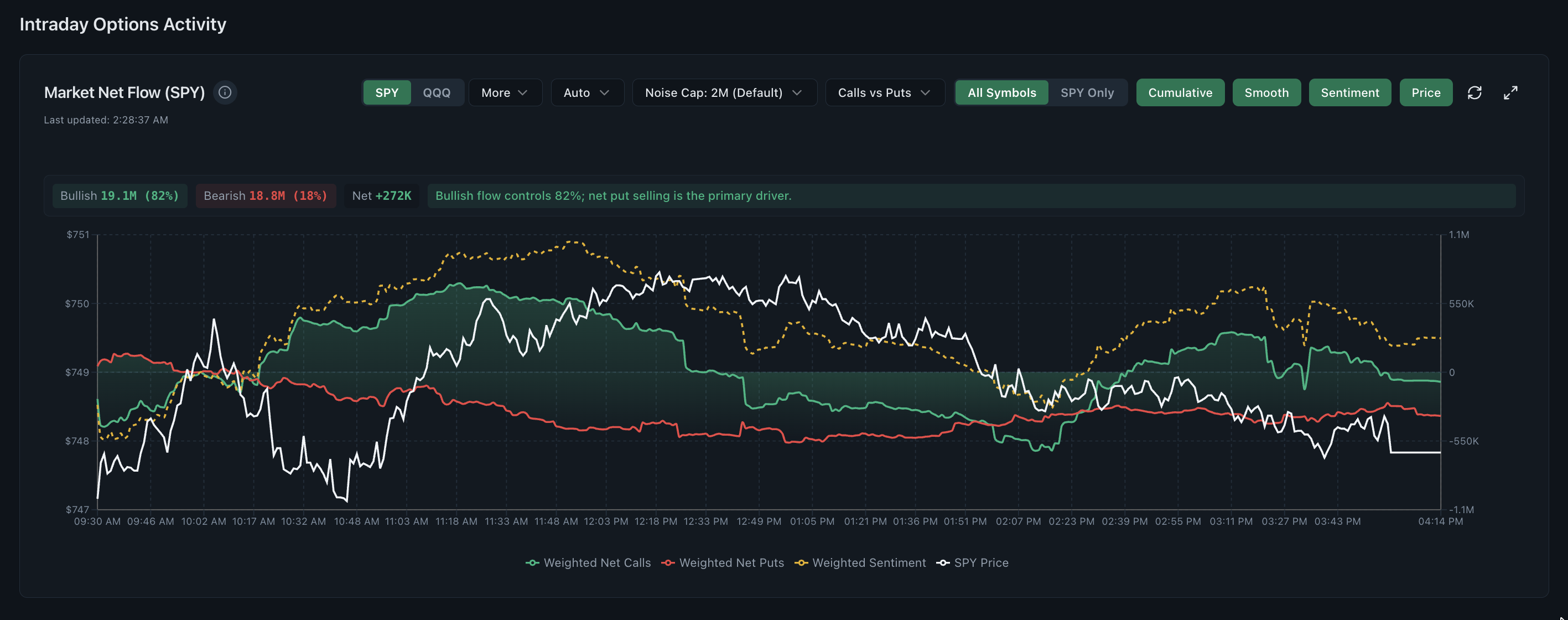
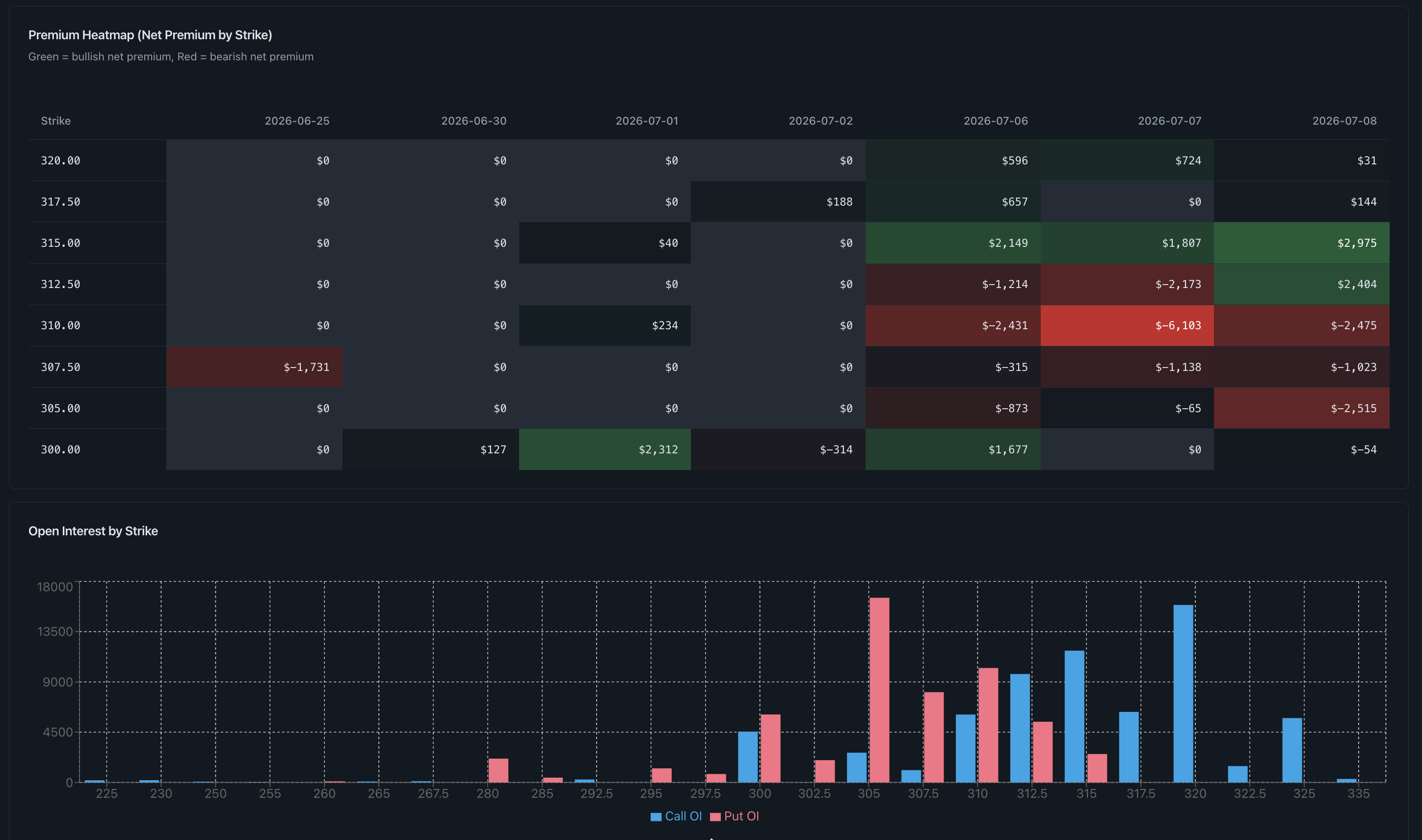
Realtime Options presents put activity as premium and contract concentrations by strike and expiry, plotted beside call activity, the underlying price, the latest published open interest and timestamped news. Put pressure is displayed as its own series rather than folded into a single bullish or bearish score, so a heavy put session can be examined instead of interpreted automatically.
Read the supporting context
The boundaries are explicit. Aggressor side is estimated from where a trade printed relative to the bid and ask. Open interest arrives once daily after the close from OCC, so intraday you cannot confirm whether put volume created new positioning. Gamma exposure figures are model outputs, not guaranteed price levels. None of it is a recommendation, and the platform has no order entry.
- Compare put premium with call premium rather than reading either in isolation.
- Check whether the put activity sits in one strike and expiry or is spread across the chain.
- Wait for the next open-interest update before describing put volume as new positioning.
- Check the news timeline for a scheduled catalyst that would explain routine hedging.
- Record the interpretation as unresolved when the evidence cannot separate a hedge from a directional bet.
Common questions
What is a put option in simple terms?
A put option is a contract that lets its buyer sell 100 shares of a stock or ETF at a set strike price until a set expiration date. The buyer pays a premium for that right; the seller receives the premium and must buy the shares at the strike if assigned.
Does heavy put buying mean the market expects a decline?
Not reliably. A large share of put buying is protection on shares already owned, and portfolio and pre-earnings hedging print exactly like speculative bets in volume data. Put volume records contracts, not intent, so heavy put activity is a prompt to look at strike, expiry, open interest and the news calendar rather than a bearish reading.
What is a protective put?
A protective put is a put bought against 100 shares already held per contract. It sets a floor under the position for the life of the contract in exchange for the premium paid. The holder remains long the stock, which is why this trade is not a bearish position despite appearing in put volume.
Is selling a put a bullish trade?
Selling a put is generally a neutral to bullish position: the seller keeps the premium if the stock stays above the strike and must buy the shares at the strike if assigned. It adds to put volume identically to put buying, which is one reason a put-heavy tape cannot be equated with pessimism.
Why are puts more expensive than calls at the same distance from the money?
Because of negative volatility skew, a structural feature of equity option surfaces since 1987 driven by persistent hedging demand and the fact that declines tend to be faster than rallies. Since the skew is always present, it is not a current bearish signal; only a change relative to the ticker's own history is informative.
What happens if my put expires in the money?
An in-the-money put is generally subject to automatic exercise under clearing procedures unless you instruct otherwise, which means selling 100 shares per contract at the strike. If you do not hold the shares, exercise creates a short stock position. Confirm your broker's threshold, cut-off time and margin requirements before expiration.
When is the put/call ratio unreliable?
Around scheduled earnings, on expiration Fridays when rolls and closes dominate, in thin or wide-spread single names where a few trades move the number, when early-exercise flow distorts equity totals, and whenever a single unsmoothed daily print is read on its own. Five- or ten-session smoothing reduces but does not remove the problem.