

Cash-secured put screener: collateral, yield and assignment
A cash-secured put screener ranks put options you could sell while holding the full strike value in cash, usually by premium, return on that collateral, an annualised equivalent and the effective purchase price if you are assigned. The arithmetic is fixed: collateral is the strike times 100 per contract, the effective purchase price is the strike minus the premium per share, and the maximum loss is that effective purchase price if the shares fall to zero. Realtime Options does not screen cash-secured puts by yield; it shows open interest and premium concentration by strike, and it explains why put volume on its own is not a bearish reading.
- Collateral per contract
- Strike price multiplied by 100, held in cash
- Effective purchase price
- Strike minus premium per share, if assigned
- Maximum loss
- Effective purchase price per share, if the shares reach zero
- Screened fields
- Premium, return on collateral, annualised, delta, liquidity
- Not in Realtime Options
- Yield screening, assignment probability, payoff diagrams
- What this platform adds
- Strike-level open interest and premium concentration
What a cash-secured put is, and the arithmetic that defines it
A cash-secured put is a short put option backed by enough cash to buy the shares if the option is exercised. Selling the put collects premium immediately and creates an obligation to buy 100 shares per contract at the strike price, whatever the market price is at the time. The cash is what makes the put cash-secured; a short put in a margin account without that cash set aside is a different, more leveraged position.
Read the supporting context
Every figure a screener shows you is derived from four inputs: the strike, the premium, the days to expiration and the collateral. Working the arithmetic once by hand makes the screener's columns readable. Options carry significant risk and are not suitable for every investor; read the OCC options disclosure document before trading, and treat this page as education rather than advice.
| Quantity | How it is calculated |
|---|---|
| Collateral per contract | Strike price multiplied by 100 |
| Net capital committed | Collateral minus the premium received |
| Return on collateral | Premium divided by the collateral committed |
| Annualised equivalent | Return on collateral scaled by 365 divided by days to expiration |
| Effective purchase price | Strike price minus premium per share |
| Break-even at expiration | The same effective purchase price |
| Maximum loss | Effective purchase price per share, if the shares go to zero |
What a cash-secured put screener screens for
A cash-secured put screener filters a chain snapshot for puts you could sell and computes the return figures above for each one. Like every screener it works from quoted prices at a point in time rather than from executed trades, so free tiers running on delayed data are usable at 30 to 45 days to expiration and unreliable at very short expiries.
Read the supporting context
The fields worth reading are the ones that describe the obligation you are taking on, not only the income. Composite scores that combine several of them into one number should be treated as filter weights with an undisclosed method.
- Premium and return on collateral: the income and the capital it is earned against.
- Annualised equivalent: a comparison unit, computed by scaling the period return to a year.
- Effective purchase price and the discount to the current share price: what assignment actually costs you.
- Delta or moneyness: how close the strike is to the money, which is not a probability of assignment.
- Implied volatility, and IV rank or percentile against that name's own history.
- Earnings date inside the expiry: often the entire reason the premium looks attractive.
- Ex-dividend date inside the expiry: it changes the early-exercise incentives on the other side.
- Open interest and bid-ask width: whether you can close the position without giving back the premium.
Reading the return numbers honestly
Return on collateral is the only figure with a stable meaning, and even it depends on the denominator. Some tools divide premium by the strike, some by the strike minus premium, and some by the broker's actual margin requirement, which for an uncovered put is far smaller than the full strike value and produces a much larger percentage for the same trade. Comparing two screeners without checking the denominator compares two different things.
Read the supporting context
The annualised figure carries the same caveat as it does for covered calls: it assumes the trade repeats at the same terms for a year, that you are never assigned early, and that you never have to close at a loss or roll down. Premium is received at the outset but is not realised until the position expires or is bought back, so an unrealised premium and a profit are not the same thing.
- Check whether the return is computed on strike, on strike minus premium, or on margin requirement.
- Treat annualised return as a per-unit-of-time comparison, never as an expected yearly outcome.
- Remember that premium received is cash in hand but the obligation stays open until the position closes.
- A large discount to the current price usually reflects a large expected move, not a bargain.
- In a margin account a short put may not be cash-secured at all; the label describes the collateral, not the contract.
'I wanted to own it anyway' is the sentence that hides the risk
The standard justification for a cash-secured put is that assignment is acceptable because you wanted the shares at that price. It is a reasonable sentence and it is also where most of the risk goes unexamined, because it converts a position-sizing decision into a feeling. The structural problem is adverse selection: you are assigned when the thesis is going wrong, not when it is going right. If the shares rise, you keep a small premium; if they fall hard, you buy them, and the price you paid is capped at a discount equal to the premium while the decline is not capped at all.
Read the supporting context
Five tests turn the sentence into something checkable. None of them tells you whether to place the trade, and none of them is investment advice; they simply expose whether the justification is doing any work.
- Would you buy 100 shares at that strike today, with that cash, if no option existed?
- Is the cash genuinely reserved and uninvested, or is the position secured only by margin?
- How many contracts would you be assigned at once, and is that a position size you chose deliberately?
- Are your open puts in correlated names or one sector? Several such positions are one trade, not diversification.
- If assigned mid-decline, would you still want the shares at the effective purchase price, or only at the lower price you imagined?
Assignment, earnings and dividend timing
American-style equity options can be exercised on any business day, so a short put can be assigned before expiration. OCC assigns exercise notices to clearing members using a random procedure, and each member firm then allocates to customer accounts by its own approved method, typically random selection or first-in-first-out. You cannot predict whether your account is the one selected.
Read the supporting context
The Options Industry Council notes that assignment risk rises as time premium disappears and as an option moves deeper in the money, and that for short puts the risk is elevated just after the ex-dividend date. OIC also notes that around 7% of options are exercised overall, with most exercises occurring near expiration. That statistic describes exercise frequency across the market and says nothing about any individual position.
Timing around events is the part a yield column omits entirely. An expiry that contains a scheduled earnings report carries a larger premium because the market prices a wider range of outcomes across that date, so screening by yield systematically surfaces those expiries first.
- Early assignment is possible on any business day the put is short.
- Short puts face elevated assignment risk just after the ex-dividend date.
- Assignment delivers 100 shares per contract and consumes the reserved cash immediately.
- An expiry spanning earnings pays more because the event is priced, not because the trade is better.
- Rolling a losing put extends the obligation; it does not remove the loss already embedded in the position.
What Realtime Options does not do here, and what does
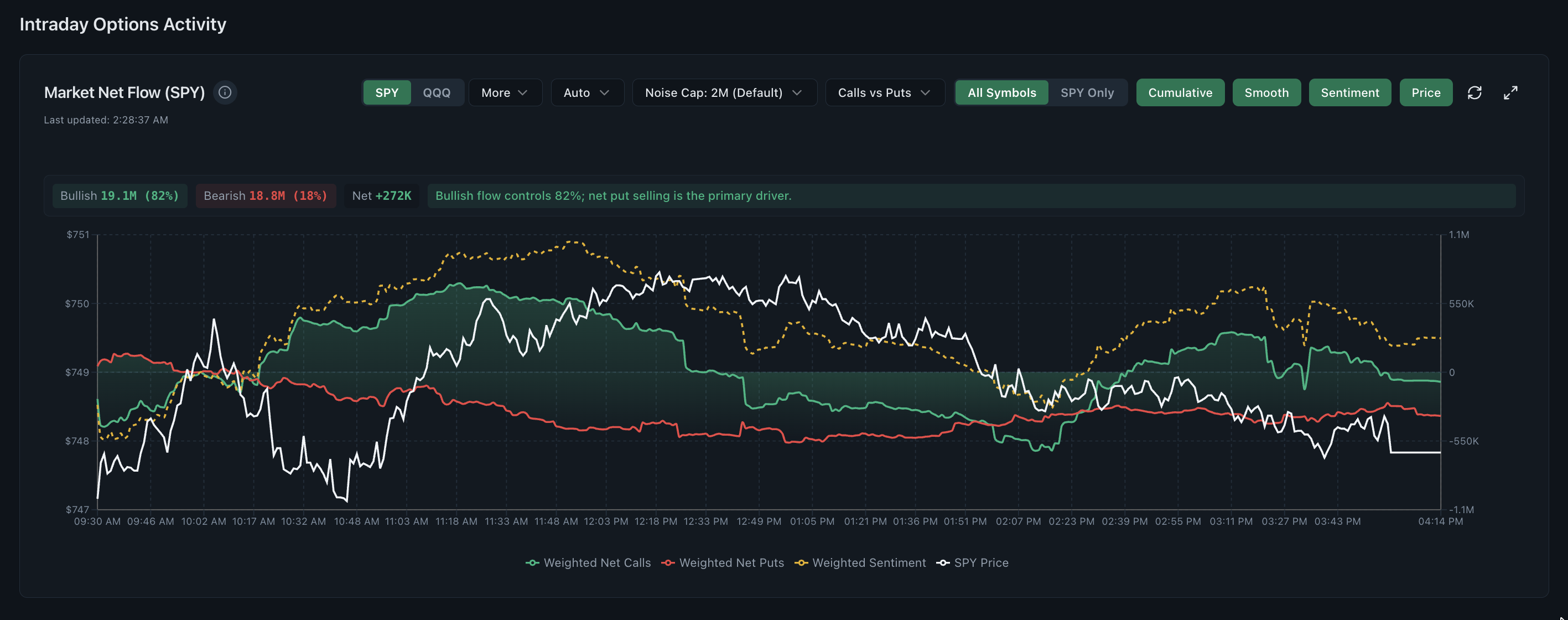
Realtime Options does not screen cash-secured puts. There is no yield or premium ranking, no annualised return column, no effective-purchase-price calculator, no assignment-probability estimate, no IV rank or percentile screening and no broker connection, so the platform does not know your cash balance or your positions. It is research and analytics software, not a broker-dealer or a registered investment adviser, and it produces no recommendations.
Read the supporting context
The screeners that do this job are specific and mostly small independents. Pick on data freshness, filter transparency and whether the free tier is genuinely usable, and be wary of any tool that labels its output as picks or best trades rather than as a filtered data view.
| What you need | Where to do it |
|---|---|
| Yield-ranked cash-secured put candidates | Barchart's naked put screener, free tier on delayed data |
| Deeper filters and historical comparison | Market Chameleon's naked put screener, paid |
| Screening inside the account holding the cash | Your broker: Fidelity, Schwab thinkorswim or Interactive Brokers |
| Wheel-focused ranking and scoring | Independents such as optionDash, tiblio or Option Samurai |
| Where a put strike is crowded and how flow behaved there | Realtime Options |
Put volume is not a bearish reading, and you are the reason why
A cash-secured put seller and a bearish put buyer add identically to put volume. Nothing in the printed record distinguishes them, which means every wheel-strategy seller makes someone else's put-flow chart look more bearish than the underlying view of the market actually is. This matters directly to you: it is the clearest example of why flow is observed activity and why the side and intent behind a trade are estimates rather than facts.
Read the supporting context
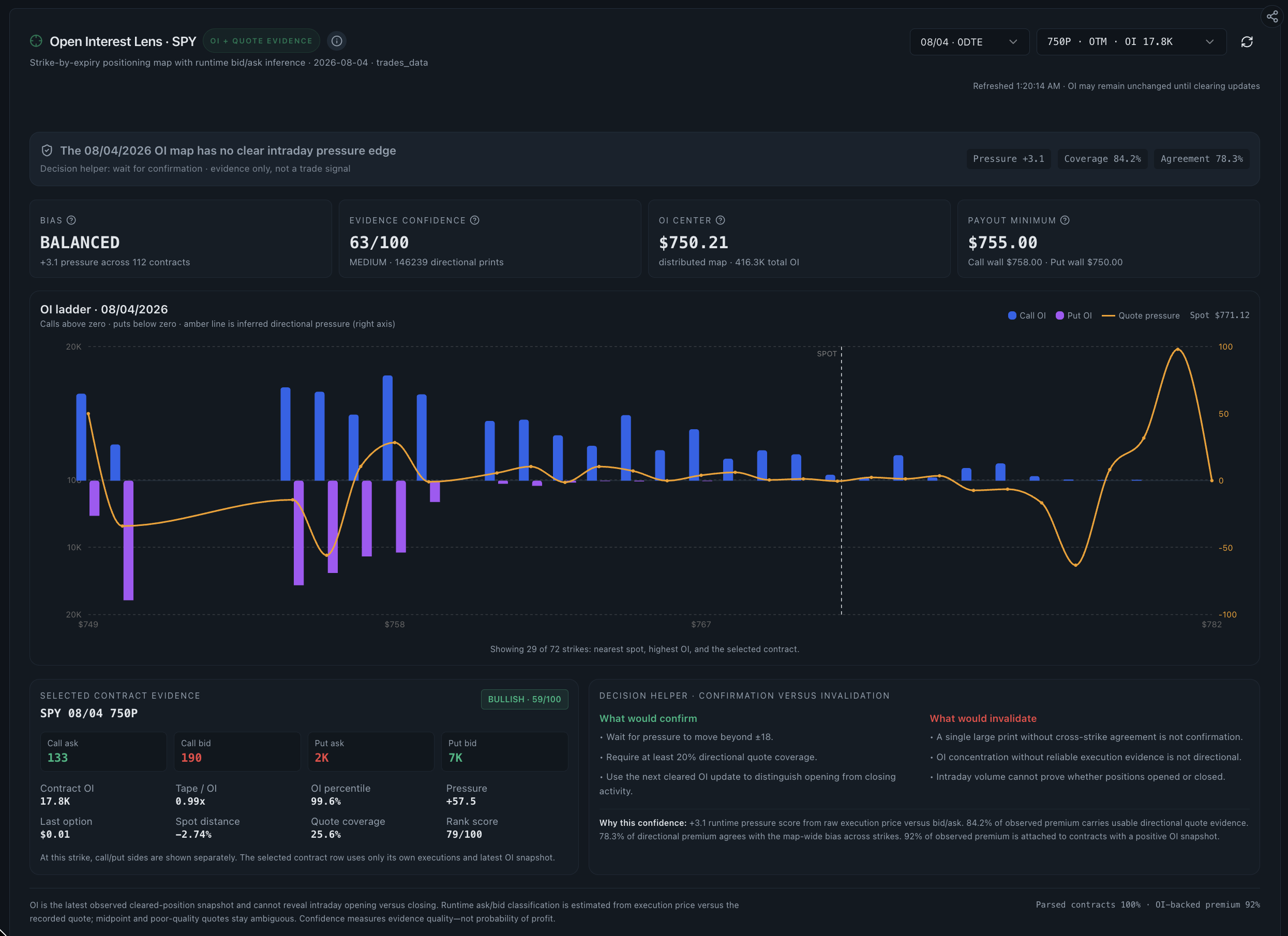
What Realtime Options contributes after a screener has produced a shortlist is strike-level context. Open interest by strike shows whether the put you are considering is widely held or thin, which is a liquidity question you will care about if you ever want to close early. Premium concentration by strike and expiry shows where money actually went during the session. Historical flow analysis shows whether that strike has been persistently active or was busy for one day.
The limits are firm. Open interest arrives once daily after the close through OCC and is never intraday from any vendor, so it describes yesterday's positioning. Gamma exposure and magnet-style views are model outputs, not guaranteed levels. Crowding at a strike describes participation, not direction and not outcome. Access is one plan: a 3-day free trial with no card on 15-minute delayed data, then $29 per month for near-real-time analytics, cancel anytime.
- Open interest by strike: whether your candidate put is widely held or thinly traded.
- Premium concentration by strike and expiry: where session money clustered on the chain.
- Historical flow: whether the strike is persistently active or a single-session artefact.
- Keep in mind: put volume mixes bearish buyers, income sellers, hedgers and dealer inventory.
Common questions
What is a cash-secured put screener?
A cash-secured put screener filters a snapshot of the option chain for puts you could sell with the full strike value reserved in cash, and computes figures such as premium, return on collateral, an annualised equivalent and the effective purchase price if assigned. It produces a research shortlist, not a recommendation.
How do I calculate the return on a cash-secured put?
Divide the premium received by the collateral committed, which is the strike price multiplied by 100 per contract, optionally less the premium. To annualise, multiply that figure by 365 divided by the days to expiration. The annualised number assumes the trade repeats at the same terms all year, which is a comparison convention rather than a forecast.
What is the effective purchase price if I am assigned?
The strike price minus the premium received per share. If you sell a $50 strike put for $1.50, assignment leaves you owning shares at an effective $48.50 each, which is also the break-even at expiration and the point below which the position loses money one-for-one with the stock.
Can I be assigned early on a cash-secured put?
Yes. American-style equity options can be exercised on any business day. OCC allocates exercise notices to clearing members randomly and firms then allocate to accounts by their own approved method. The Options Industry Council notes that assignment risk rises as time premium decays, as the option moves deeper in the money, and for short puts just after the ex-dividend date.
Is selling a put the same as placing a limit buy order?
No. A limit order can be cancelled at any time and only fills at your price, whereas a short put is an obligation that persists until it expires or you buy it back, possibly at a loss. You are also paid to accept that difference, which is the premium, and you can be assigned at a strike well above the market price during a fast decline.
Does Realtime Options have a cash-secured put screener?
No. There is no premium-yield screening, no annualised return calculation, no assignment-probability estimate and no covered-call or cash-secured-put ranking of any kind. Realtime Options analyses executed US options flow, open interest and strike-level context across 10 core dashboards and 8 specialist research views.
Which cash-secured put screeners are free?
Barchart's naked put screener has a free tier on delayed data, and broker screeners at Fidelity, Schwab thinkorswim and Interactive Brokers are free with a funded account. Market Chameleon, Option Samurai and several wheel-focused independents are trial-then-paid. Confirm the data delay and the filter set before relying on any free tier.