

Option finder tools: what each 'finder' query actually means
Option finder is not one product. In US listed options it usually means a strategy finder: you supply a price target and a date, and the tool returns contracts or spreads that fit that view. Optionsscheinfinder is a German search tool for bank-issued covered warrants, which are a different instrument with issuer credit risk and no OCC clearing. SFI option finder almost always refers to the UK Sustainable Farming Incentive rather than options trading. Option Strength Viewer is one named third-party product, not a generic feature. Realtime Options is none of these: it is an options flow analytics dashboard with no strategy finder and no payoff-diagram builder.
- Most common meaning
- A strategy finder driven by a price target and a date
- Optionsschein
- German covered warrant, not a US listed option
- SFI option finder
- UK farming scheme term, not options trading
- Option Strength Viewer
- A named third-party product, not a generic category
- Realtime Options
- Flow analytics; no strategy finder, no payoff builder
What an option finder usually means in US listed options
In US listed options, an option finder is normally a strategy finder: you enter an underlying, a price you expect it to reach and a date by which you expect it, and the tool searches the chain and returns the contracts or multi-leg structures whose modelled payoff fits that view. It is the inverse of a payoff calculator, which prices a structure you have already chosen.
Read the supporting context
Working examples include the Option Finder on optionsprofitcalculator.com, which takes a symbol, a target price, a target date, an optional budget and a list of permitted structures and returns ranked candidates; TradingView's options strategy finder, which ranks spreads by reward-to-risk against a stated view; and the trade finder on optionistics.com. OptionStrat and similar toolkits combine the same idea with a payoff diagram.
Every one of these tools produces a modelled result. The ranking is arithmetic applied to your assumption, so the output inherits whatever is wrong with the assumption. A finder cannot tell you whether the price target is realistic, and none of them observes actual traded flow.
- Inputs are user-supplied: underlying, price target, date, capital limit and permitted structures.
- Outputs are modelled payoffs at the assumed price and date, not forecasts.
- Rankings usually use reward-to-risk, modelled probability of profit, or return at target.
- Chain data behind free finders is often delayed, which matters most at short expiries.
- None of these tools tells you who traded, in what size, or on which side of the quote.
Why 'optionsfinder' and 'options finder tool' return mixed results
Typed as one word, optionsfinder does not belong to a single well-known product, so search results mix strategy finders, broker chain filters and general screeners. The plural and spaced variants behave the same way. Treat the phrase as a description of a job rather than the name of a thing, and identify which of four jobs you actually need.
Read the supporting context
The four jobs are genuinely different, and a tool built for one is usually poor at the others. Naming the job first is faster than testing products.
| What you want to do | The tool category that does it |
|---|---|
| Turn a price target into candidate contracts | Strategy finder or payoff modelling tool |
| Filter a chain snapshot by delta, DTE, IV or yield | Option-chain screener |
| See which contracts are trading right now, and in what size | Options flow scanner |
| Look up quotes and place an order | Your broker's chain and order ticket |
| Search bank-issued warrants by issuer and strike | A German Optionsscheinfinder, not a US options tool |
Optionsscheinfinder is a warrant search tool, not an options screener
An Optionsscheinfinder is a German-language search tool for Optionsscheine, which are covered warrants issued by banks rather than standardised exchange-listed options. Free finders are run by comdirect, onvista and Boerse Stuttgart, and they filter by underlying, call or put, strike, remaining term, issuer and figures such as omega, delta and implied volatility. The universes are very large: comdirect lists roughly 863,000 warrants and onvista roughly 518,000 as of July 2026.
Read the supporting context
The instrument is the important difference, not the interface. A covered warrant is a claim on the issuing bank. BaFin, the German regulator, states the point plainly for leveraged certificates and warrants: if the issuer becomes insolvent, a total loss is possible, independent of how the underlying performed. A US listed option is a standardised contract cleared by OCC, so the buyer's counterparty is the clearing house rather than a single bank.
This is why a US options analytics product is not a substitute. Realtime Options covers US-listed stock and ETF options only. It has no coverage of Optionsscheine, no issuer data, and nothing that would help you compare one bank's warrant terms with another's.
| Feature | US listed option versus German Optionsschein |
|---|---|
| Who is on the other side | OCC clearing versus the issuing bank |
| Credit risk | Central clearing versus issuer insolvency risk |
| Contract terms | Standardised series versus issuer-defined terms |
| Who quotes it | Multiple exchange market makers versus mainly the issuer |
| Where it trades | US options exchanges versus German exchanges and issuer platforms |
| Covered by this site | Yes for US options; no for Optionsscheine |
SFI option finder is almost certainly not about options trading
SFI option finder is, on the available evidence, an agriculture query rather than a markets query. SFI is the Sustainable Farming Incentive, the Defra agri-environment scheme in England under which land managers select scheme items and receive payments. The 2026 offer publishes its items as SFI26 actions; the earlier Countryside Stewardship scheme used the word options, and practitioners still use both terms, which is why third-party tools with names such as SFI Option Checker exist alongside the official 'Find funding for land or farms' search on GOV.UK.
Read the supporting context
A second, weaker reading is a misspelling of SoFi, the US brokerage, which offers options trading inside its own app. Neither reading points to an options analytics dashboard, and Realtime Options is not the answer to either. Saying so is more useful than pretending the query is ambiguous in our favour.
- SFI in a UK farming context: Sustainable Farming Incentive scheme items, searched on GOV.UK.
- SFI as a typo for SoFi: a US brokerage where options are traded, not researched market-wide.
- SFI as a ticker or fund abbreviation: verify the exact issuer before assuming anything.
- In none of these readings is a US options flow dashboard the correct destination.
Option Strength Viewer is a product name, not a category
Option Strength Viewer is a specific third-party product published at optionstrengthviewer.com, with a free tier and a paid tier, and an active presence on YouTube and community groups. Its own site states that the data is provided for informational purposes only and is not intended for trading or investing purposes. It is a brand, so a search for it is navigational: the person wants that site, not a category of software.
Read the supporting context
Its public pages do not state clearly which market's option chain it covers, so confirm the instrument coverage before assuming it maps to US listings. If you arrived here searching for a generic idea of option strength rather than that brand, the phrase usually means one of three measurable things, and each is answered by different data.
- Relative call versus put pressure: measured from executed premium, not from a strength score.
- Where positioning is concentrated: measured from open interest by strike, updated once daily after the close.
- Where money is concentrated today: measured from premium by strike and expiry during the session.
- A single composite strength number hides which of those three it is; ask what the input was.
Which finder fits which question
Match the tool to the question rather than to the word in the query. The table below is deliberately blunt about the cases where Realtime Options is the wrong answer, because a finder query and a flow query are not the same research job.
| Question you are asking | Where it is answered |
|---|---|
| Which contract fits my price target and date? | A strategy finder; Realtime Options has none |
| What is the payoff diagram for this spread? | A payoff builder; Realtime Options has none |
| Which contracts traded, at what premium and strike? | Options flow analytics, including Realtime Options |
| Where is open interest concentrated on this chain? | Open interest by strike, including Realtime Options |
| What are the live bid and ask on this contract? | Your broker; Realtime Options has no quote screen |
| Which warrant issuer has the better terms? | A German Optionsscheinfinder, not this site |
What Realtime Options does instead of finding a strategy
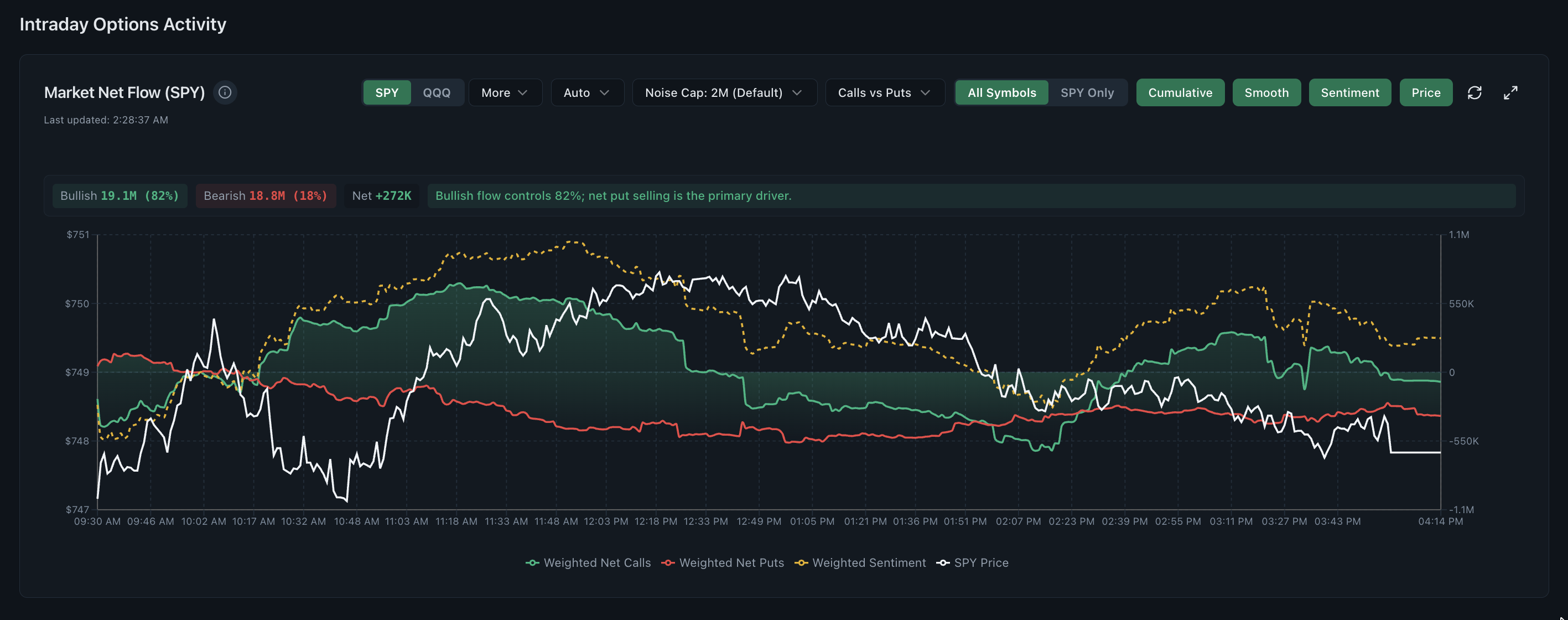
Realtime Options is near-real-time options flow analytics for US-listed stock and ETF options, built on licensed third-party market data rather than a direct exchange feed. It shows where premium and contract activity are concentrating by ticker, strike and expiry, and it keeps open interest, gamma exposure, price and news beside that activity so a single dramatic print is easy to contradict.
Read the supporting context
The limits are part of the product, not a footnote. Flow is observed activity; the side and the intent behind a print are estimates, not facts. Open interest updates once daily after the close through OCC and is never intraday from any vendor. Gamma exposure is a model output, not a guaranteed level. There are no buy or sell signals, no order entry and no backtesting; Pro API access is limited to read-only aggregated Buy/Sell Pressure, Algo Flow, 0DTE Flow & Gamma Exposure, and Greeks by Strike analytics.
Access is one plan: a 3-day free trial with no credit card on 15-minute delayed data, then $29 per month for near-real-time analytics, cancel anytime.
- 10 core dashboards plus 8 specialist research views, all in the browser; there is no mobile app.
- Market-wide, sector and ticker flow views for narrowing a watchlist.
- Strike and expiry views for premium, open interest and Greeks context.
- Historical flow analysis for checking whether today's activity is unusual for that name.
Common questions
What is an option finder?
In US listed options, an option finder is normally a strategy finder. You give it an underlying, an expected price and a date, and it returns contracts or spreads whose modelled payoff fits that view, usually ranked by reward-to-risk or modelled probability of profit. The result is arithmetic applied to your assumption, not a forecast.
Is optionsfinder a specific website?
No single well-known product owns the one-word spelling, which is why results for it mix strategy finders, broker chain filters and general screeners. Decide first whether you want to model a payoff, filter a chain snapshot, or watch executed trades, because those are three different tool categories.
What is an Optionsscheinfinder?
It is a German search tool for Optionsscheine, meaning covered warrants issued by banks. Free versions are run by comdirect, onvista and Boerse Stuttgart, filtering hundreds of thousands of warrants by underlying, strike, remaining term, issuer and figures such as delta and omega.
Can I use a US options tool to research Optionsscheine?
No. A covered warrant is issued by a bank and carries that issuer's credit risk, and BaFin states that issuer insolvency can mean a total loss regardless of the underlying. A US listed option is a standardised contract cleared by OCC. Realtime Options covers US-listed stock and ETF options only and has no warrant or issuer data.
What does SFI option finder refer to?
Most likely the Sustainable Farming Incentive, the Defra agri-environment scheme in England, whose scheme items are published as SFI26 actions and searched through the GOV.UK funding finder. A weaker reading is a misspelling of SoFi, the US brokerage. Neither is answered by an options flow dashboard.
Is Option Strength Viewer the same as Realtime Options?
No. Option Strength Viewer is a separate third-party product at optionstrengthviewer.com with its own free and paid tiers. Its own pages describe the data as informational and not intended for trading purposes, and they do not clearly state which market's chain it covers. Confirm instrument coverage on its site before comparing it with anything.
Does Realtime Options have an option finder or a strategy builder?
No. There is no strategy finder, no payoff-diagram builder, no raw option-chain quote screen and no order entry. Realtime Options analyses executed US options flow, open interest and strike-level context, and it does not produce trade recommendations.