

Options trading and analysis tools, organized by job
The options research toolkit divides into seven jobs: reading the chain and quotes, tracking flow and unusual activity, mapping positioning and dealer exposure, measuring volatility, modelling a strategy's payoff, following news and the calendar, and reviewing your own past decisions. No single product covers all seven well, and a tool list is only useful once it is organized by job rather than by vendor. Realtime Options covers three of the seven fully and two partially; for the other two a broker platform, a dedicated strategy builder or a journal is the right tool.
- Jobs in the toolkit
- 7 distinct research tasks
- Covered fully
- Flow, positioning and exposure, news context
- Covered partially
- Chain-level context and volatility reading
- Not covered
- Strategy payoff builder, trade journal, order entry
- Product surface
- 10 core dashboards and 8 specialist research views
- Price
- $29/month after a 3-day no-card trial
The seven jobs an options toolkit has to cover
Tool lists usually fail because they are organized by product name. Organized by job, the picture is stable: the same seven tasks recur regardless of which vendor is in fashion, and a gap in one of them is a gap no amount of overlap elsewhere fills.
Read the supporting context
The list below is the frame for the rest of this page. Nothing on it is optional in the sense of being irrelevant; the question is only whether you already have the job covered somewhere else.
- Chain and quotes: strikes, expiries, bid and ask, volume and open interest for one name.
- Flow and unusual activity: what actually printed today, at what size and premium.
- Positioning and exposure: where open interest sits and what gamma and vanna concentration implies.
- Volatility: implied versus realised, term structure and skew relative to a name's own history.
- Strategy modelling: payoff, breakevens and Greeks for a multi-leg structure before you place it.
- News and calendar: earnings dates, scheduled events and headlines that explain activity.
- Journal and review: what you did, why, and what the evidence looked like at the time.
Chain and quotes: partial here, better at your broker
The chain job is a per-name view: every listed strike and expiry with quotes, volume, open interest and Greeks. Realtime Options does not provide a raw option-chain quote screen. It provides strike-level analytical views, which is a different thing and does not replace a chain.
Read the supporting context
For the chain itself, the tool already in front of most people is the right one: a funded broker account gives entitled real-time quotes and a full chain at no extra cost. Free public chain pages exist as well, generally with a 15- to 30-minute delay.
- Realtime Options provides: premium heat by strike and expiry, Greeks by strike, open-interest overlays.
- Realtime Options does not provide: a raw chain quote screen or per-contract order-book depth.
- Better tool for the job: your broker's option chain, or a delayed public chain for casual checks.
- Limit worth remembering: open interest updates once daily after the close, from the OCC, at every vendor.
Flow and unusual activity: covered here
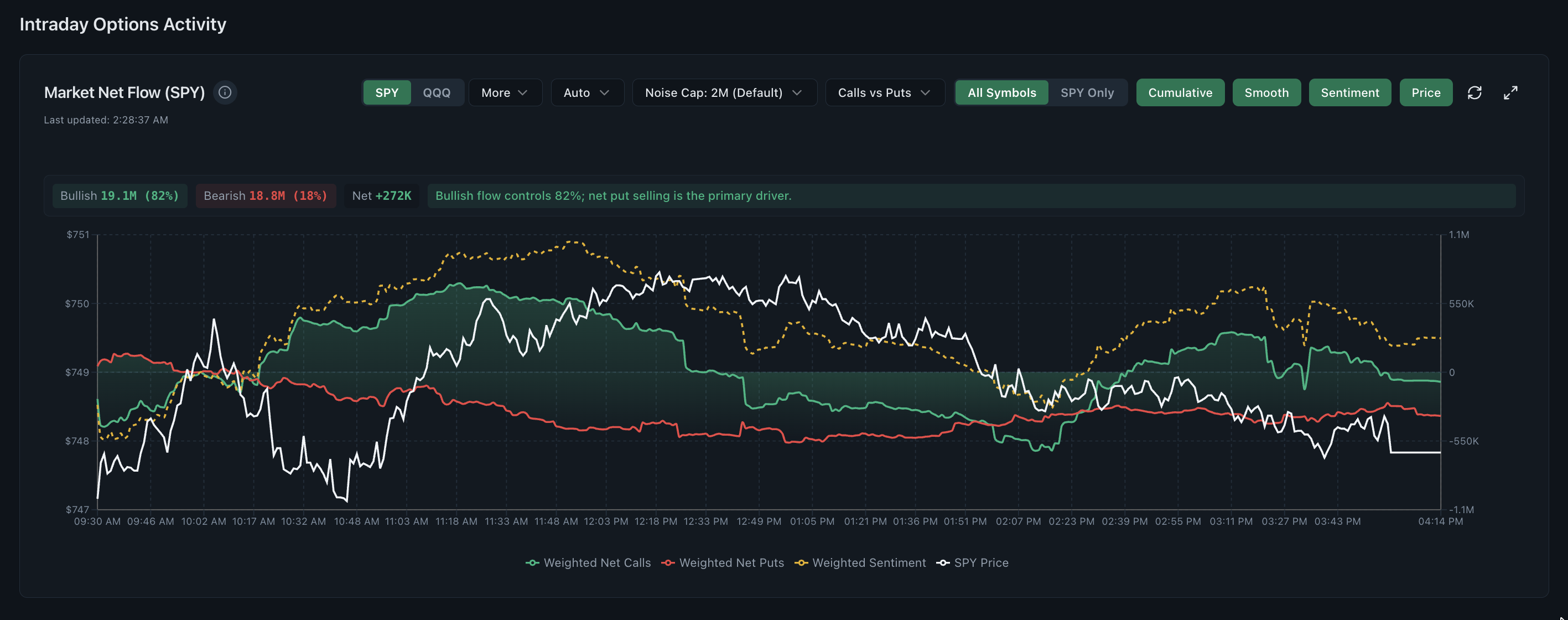
The flow job asks what actually traded. A flow tool takes executed options transactions and organizes them by ticker, call or put, strike, expiry, size, premium and where the trade printed relative to the bid and ask. Realtime Options is built primarily for this job.
Read the supporting context
The limit belongs next to the method, not in a footnote. Flow is observed activity. Which side initiated a trade is estimated from execution location, and that estimate can be wrong when the print is one leg of a spread, a roll, a hedge against stock, or a closing trade. Size is not intent, and no flow tool can identify the owner of a position.
- Weighted net flow across the market, with the underlying price on the same axis.
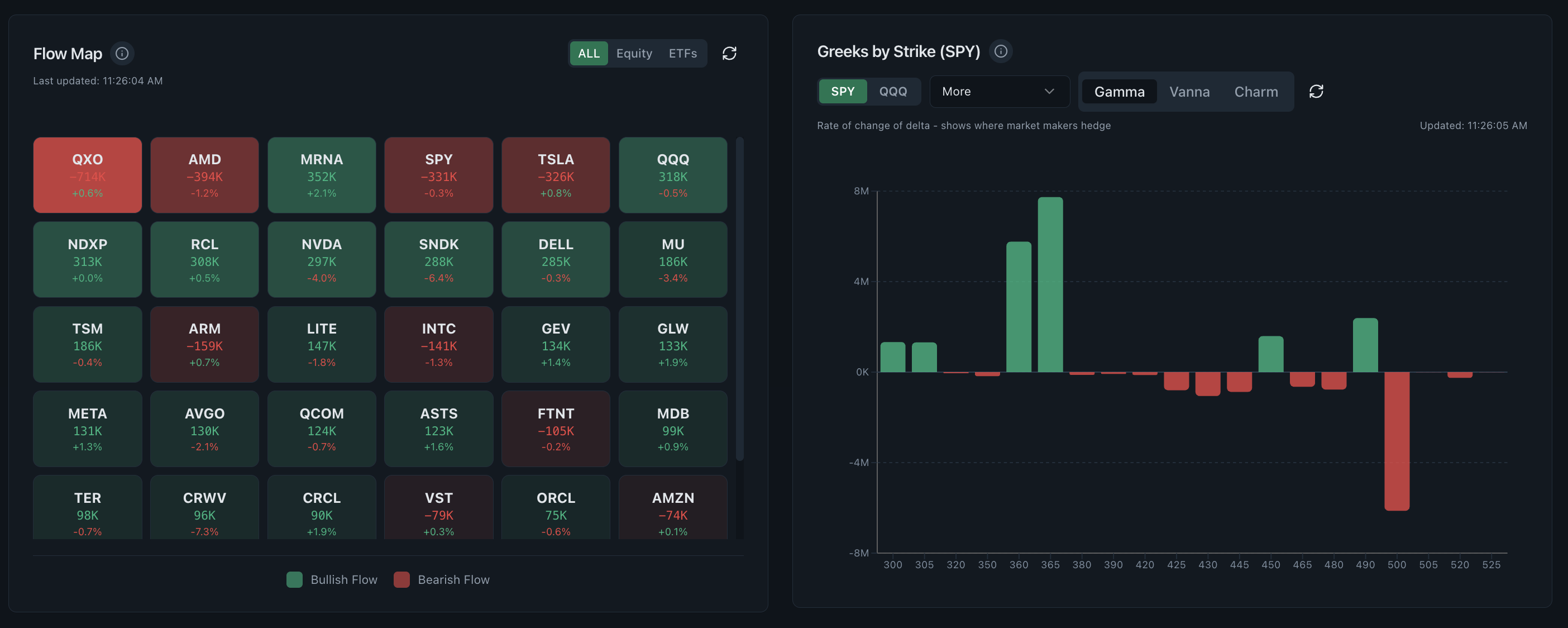
- Sector and ticker rankings that show where premium is concentrating.
- Volume-change scanning for bullish- and bearish-classified activity.
- Contract-level premium development on the ask, mid and bid over time.
- Historical flow analysis for comparing a session against the recent distribution.
Positioning and exposure: covered here, with model caveats
Positioning tools answer a slower question than flow: where do outstanding contracts sit, and what sensitivity does that create around particular strikes? Realtime Options covers this with open-interest views, premium-and-open-interest overlays, Greeks by strike, 0DTE gamma exposure and gamma magnet levels.
Read the supporting context
Gamma exposure is a model output, not a measured quantity. It rests on assumptions about who is short or long which contracts, and those assumptions are not observable. Treat a computed level as a place where the model expects sensitivity to change, not as support or resistance the market has agreed to honour.
| Positioning question | Where it is answered |
|---|---|
| Where is open interest concentrated by strike? | Open Interest Lens and premium-and-open-interest overlay |
| Did today's volume actually add positions? | Volume change beside next-day open interest |
| Where is same-day gamma concentrated around spot? | 0DTE GEX view |
| Which strikes are modelled as gamma magnets? | Magnet Levels, as a model estimate |
| How do gamma, vanna and charm vary across the chain? | Greeks-by-strike flow map |
Volatility, strategy modelling, news and review
The remaining four jobs are where an honest inventory matters most, because two of them are not covered here at all. Realtime Options does not screen by IV rank or IV percentile, does not build payoff diagrams, and does not keep a trade journal.
Read the supporting context
Naming those gaps is more useful than papering over them. If strategy modelling is your central need, a payoff-diagram builder is the product to buy and this is not it.
- Volatility: partial. Priced-movement context is available; there is no IV rank or IV percentile screen.
- Strategy modelling: not offered. Use a dedicated payoff-diagram builder such as OptionStrat, OptionCreator or your broker's analysis tab.
- News and calendar: covered. Market news sits beside the flow views so a spike can be checked against a catalyst.
- Journal and review: not offered. A spreadsheet or a dedicated journal product covers it; historical flow views can supply the evidence you attach to an entry.
The whole toolkit in one table
This is the same seven jobs with a single honest verdict on each, plus where to go when the answer is no. It is the summary to read if you are deciding whether one subscription closes your gap or the wrong one.
| Research job | Realtime Options coverage, and the alternative when it is not |
|---|---|
| Chain and quotes | Partial. Strike-level analytics only; use your broker's chain for quotes |
| Flow and unusual activity | Yes. Market-wide and contract-level, with side treated as an estimate |
| Positioning and exposure | Yes. Open interest, Greeks by strike and GEX, all as model context |
| Volatility | Partial. Priced-movement context; no IV rank or percentile screening |
| Strategy modelling | No. Use a dedicated payoff-diagram builder |
| News and calendar | Yes. Market news presented alongside flow |
| Journal and review | No. Use a journal or spreadsheet; export the context from historical views |
How the tools chain together in a single session
Owning the right tools is less than half the problem. The sequence matters more, because the order you look at things in determines how easy it is to find evidence that contradicts an appealing first impression.
Read the supporting context
The sequence below is deliberately slow. It puts the context checks after the interesting print rather than before, so that a large trade has to survive three questions before it becomes a view.
- Start market-wide: is weighted flow call-led, put-led or mixed today?
- Narrow by sector and ticker ranking to a short watchlist.
- Inspect strike and expiry concentration inside those names.
- Check open interest, price behaviour and any scheduled catalyst.
- Compare with historical flow for the same ticker before calling the session unusual.
- Record what would falsify the reading, then decide whether any action is warranted at all.
Common questions
What tools does an options researcher actually need?
Seven jobs need covering: chain and quotes, flow and unusual activity, positioning and exposure, volatility, strategy modelling, news and calendar, and journal and review. Most people already have two or three covered by their broker without realising it, so the useful question is which job is genuinely uncovered.
What is the difference between options trading tools and options analysis tools?
Trading tools are the execution surface: order tickets, routing, position and margin management, all of which live at a broker. Analysis tools describe market activity so you can study it before deciding anything. Realtime Options is entirely in the second group and has no order entry.
Does Realtime Options include an options strategy builder?
No. There is no payoff-diagram builder and no multi-leg strategy modelling in the product. Dedicated builders such as OptionStrat and OptionCreator, or the analysis tab inside a broker platform, cover that job properly.
Can I screen the option chain by delta, IV rank or days to expiry?
No. Realtime Options does not screen contract attributes such as delta, IV rank or IV percentile. That is a chain screener's job, and a chain screener is a different product from a flow analytics platform.
Are free options analysis tools good enough?
For several jobs, yes. Broker-bundled chains and scanners, OCC and Cboe public statistics and the Options Industry Council's education material cover the chain, calendar and learning jobs at no cost. Where free tends to run out is continuous market-wide flow and strike-level history, because that data is licensed.
Does Realtime Options have an API or a mobile app?
Realtime Options Pro includes an authenticated, read-only Public API v1 for aggregated Buy/Sell Pressure, Algo Flow, 0DTE Flow & Gamma Exposure, and Greeks by Strike analytics. It does not have a native mobile application; the product is responsive web only. The API is not a raw or unrestricted options-data feed.
Which tool tells me what a trade means?
None of them, and any tool claiming otherwise is overreaching. Tools show what printed, where it sits in the chain and what the surrounding context looked like. Intent, ownership and outcome are not visible in public options data, and Realtime Options does not issue signals or recommendations.