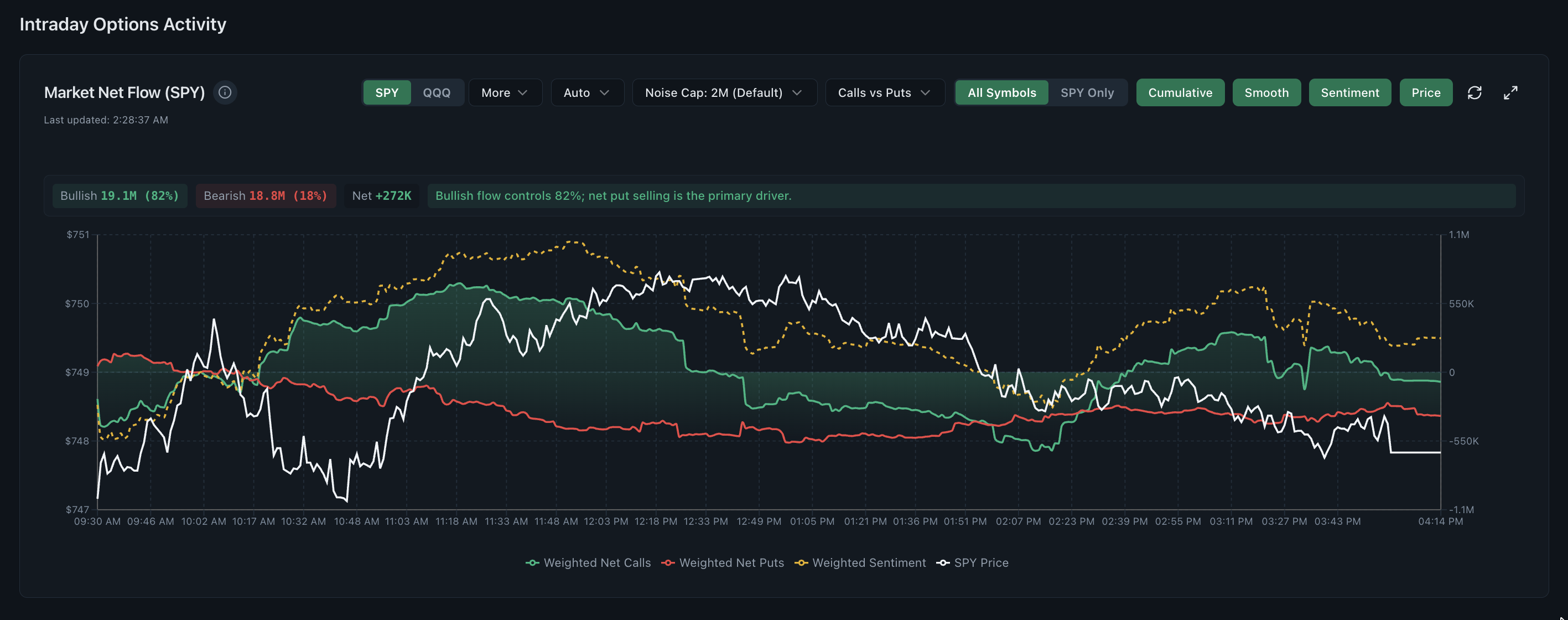


Options research use cases and workflows
A use case is a repeatable research routine that explains which dashboard to open, in what order and where the evidence stops. This section covers five routines: intraday, multi-session swing, same-day expiry, earnings and index flow. Each ends with a recorded observation, not a trade instruction.
- Routines documented
- Five, each with a stated sequence
- Built on
- 10 core dashboards and 8 specialist research views
- Data timing
- Near-real-time on Pro; 15-minute delayed during the trial
- Output of every routine
- A written observation, never a trade instruction
- Not included
- Order entry, backtesting, strategy builder or raw data API
What a use case means here
A use case is the workflow layer between concepts and screens. The Learn guides explain what options flow, open interest and gamma exposure are; the Tools guides explain what each dashboard displays. A use case joins them into a routine you can run again next week and compare against what you wrote down last week.
Read the supporting context
Each page therefore reads as a sequence rather than a feature list. It names the screen, the reason for opening it at that point, the question it can answer, the checkpoint that decides whether to continue, and the specific things the routine cannot establish no matter how much data is on screen.
- The trigger: what makes this routine worth running on a given day.
- The sequence: which dashboards, in which order, and why that order.
- The checkpoints: the point at which the evidence either continues or stops the review.
- The record: the observation written down, including the conditions that would contradict it.
- The boundary: what the routine cannot tell you about side, intent, ownership or outcome.
Which routine suits which reader
The five routines differ mainly in holding horizon and in how much weight the evidence can carry. Short horizons rely more on activity that is still developing; longer horizons rely more on positioning that has already cleared. Neither is always more reliable. They fail in different ways.
| Routine | Suits a reader who |
|---|---|
| Day trading options flow | Reviews intraday activity in defined session windows and accepts that flow analytics is research, not an execution feed |
| Swing trading options | Wants positioning that builds across several sessions rather than a single dramatic print |
| 0DTE options research | Studies same-day gamma concentration around spot and understands how quickly a same-day option can go to zero |
| Earnings options flow | Reads pre-event positioning while accepting that nobody in the data knows the result |
| SPY and QQQ index flow | Uses index and ETF activity as market backdrop before opening any single-stock name |
The order every routine follows
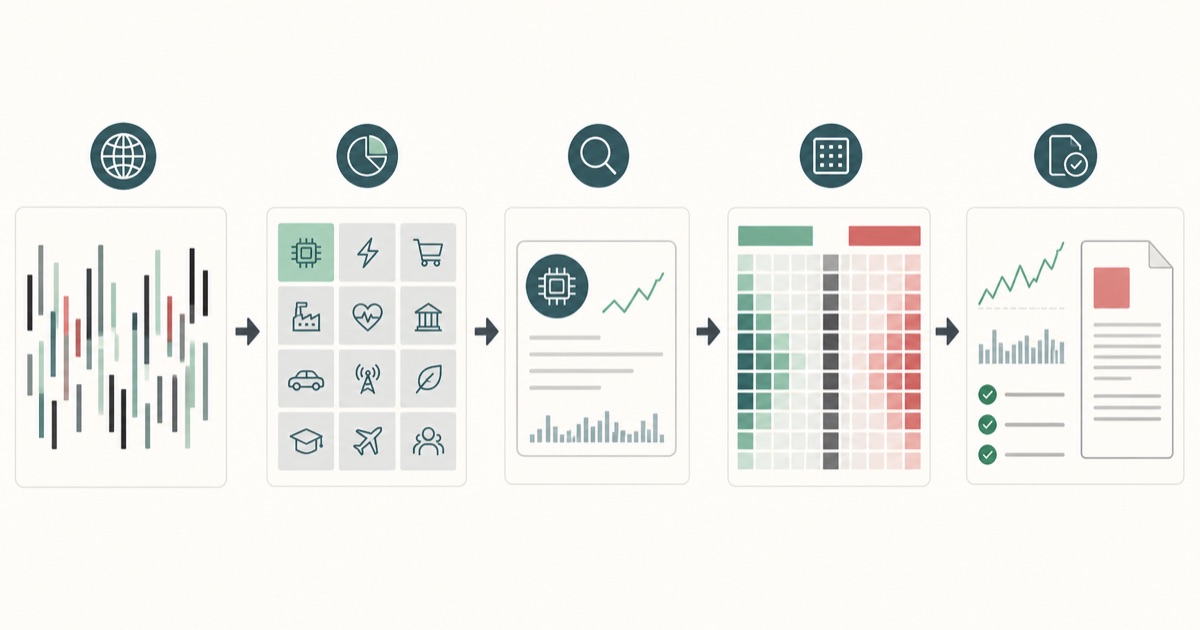
All five routines run market to ticker to contract to contradiction. The order matters because it puts the least specific evidence first, when it is cheapest to be wrong, and puts the contract-level detail last, when a story has already had a chance to form.
Read the supporting context
Reversing the order is what produces confident readings of single prints. Starting from an unusual contract makes every later screen a search for support rather than a test.
- Market backdrop: weighted net flow, sector breadth and index positioning.
- Ticker narrowing: top-ticker rankings, classified volume change and sector concentration.
- Chain location: strike and expiry concentration, open interest and modeled exposure.
- Contradiction: price structure, catalyst news and history, specifically looking for the evidence that disagrees.
What all five routines share
Every routine separates three categories of information and refuses to blur them. Observed facts are exchange-reported: the contract, the size, the price, the timestamp. Estimates are analytics layered on top: aggressor side, classification as bullish or bearish, modeled dealer gamma. Unknowns stay unknown: who traded, why, and whether the position still exists.
Read the supporting context
That separation is the reason the same screens can support research without supporting a recommendation. An estimate that is labelled as an estimate can be argued with; an estimate presented as a signal cannot.
- Observed: ticker, call or put, strike, expiry, contracts, premium, timestamp, execution location.
- Estimated: aggressor side, sentiment classification, dealer gamma, expected movement, conviction scores.
- Unknown: identity, purpose, hedge status, the other legs of a spread, and any future price.
- Recorded: the observation plus the condition that would falsify it.
Data timing and what it costs each routine
The trial runs on 15-minute delayed market data with no card required; the $29 per month Pro plan runs near-real-time. Near-real-time is not an exchange feed and is not order-entry infrastructure. The delay affects the five routines very unevenly, so it is worth knowing which ones a trial can honestly test.
| Routine | Effect of a 15-minute delay |
|---|---|
| Day trading options flow | Substantial: session windows shift, so the trial tests the process rather than the timing |
| Swing trading options | Minimal: the evidence is measured in sessions, not minutes |
| 0DTE options research | Substantial: same-day exposure changes fastest late in the session |
| Earnings options flow | Modest: pre-event positioning accumulates over days |
| SPY and QQQ index flow | Moderate: the backdrop read survives a delay; same-day index gamma does not |
What none of these routines can do
Realtime Options is research and education software. It is not a broker-dealer, not a registered investment adviser, and it does not provide personalised investment advice. No routine on this site produces a buy or sell instruction, a price target, an entry, an exit or a position size.
Read the supporting context
There are also concrete product boundaries worth stating before you spend a trial on the wrong expectation. Several of the things people assume a flow platform includes are not part of this one.
- No order entry and no broker connectivity: the platform never touches an order.
- No raw exchange feed or data redistribution: Pro API access is limited to authenticated, read-only aggregated Buy/Sell Pressure, Algo Flow, 0DTE Flow & Gamma Exposure, and Greeks by Strike analytics.
- No backtesting engine and no published win rates, hit rates or track records.
- No options strategy builder or payoff-diagram tool, and no dark-pool equity data.
- No mobile application: the dashboards are responsive web only.
- Open interest updates once daily after the close from OCC, so no routine can read it intraday.
How this section connects to Learn and Tools
Use the three layers in sequence when a routine mentions something unfamiliar. The concept guides define the term, the tool guides show the screen with a real screenshot, and the use case explains when in the routine it belongs.
- Concept first: the Learn hub covers flow, volume against open interest, gamma exposure and 0DTE.
- Screen second: the Tools hub documents all 18 dashboards and specialist views with captured screenshots.
- Routine third: these five pages place those screens in a session or multi-session order.
- Boundaries throughout: the risk disclaimer and pricing pages state the commercial and compliance limits in full.
Common questions
What is the difference between a use case and a tool guide?
A tool guide documents one dashboard: what it displays, how to read it and what it cannot establish. A use case is a routine that opens several dashboards in a defined order for a specific research horizon, such as an intraday session or a multi-day swing review.
Do I need all 18 dashboards to run a routine?
No. Each routine names three to six screens. All 18 are included in the single $29 per month plan and in the 3-day trial, but no routine requires opening every one of them.
Can I test these routines during the free trial?
Yes, on 15-minute delayed market data with no credit card. The swing and earnings routines survive that delay almost intact. The intraday and 0DTE routines can be practised for process during the trial, but their timing cannot be assessed on delayed data.
Do any of these workflows tell me what to trade?
No. Every routine ends with a written observation and a stated condition that would contradict it. Realtime Options does not issue signals, recommendations, price targets or position sizes, and it is not a registered investment adviser or broker-dealer.
Which routine should a newer options researcher start with?
The swing routine is the most forgiving because its evidence accumulates over sessions and can be reviewed calmly after the close. The 0DTE routine is the least forgiving because same-day contracts can lose their entire value within hours.
Why does every page list things the platform cannot do?
Because the limits determine whether the workflow is useful to you. Flow data records transactions, not positions or intentions, and stating that clearly is more useful than implying a certainty the data does not contain.
Are these routines suitable for options beginners?
They assume you already understand calls, puts, strikes, expiration and assignment. Read the OCC Characteristics and Risks of Standardized Options document and the FINRA options basics before using analytics of any kind. Options involve significant risk and are not suitable for every investor.