

Day trading options flow: an intraday research routine
An intraday options flow routine divides the session into four windows: pre-open context, the opening 30 minutes, midday and the closing hour. Each window has a specific dashboard and question. Realtime Options provides near-real-time flow analytics on Pro and 15-minute delayed data during the trial. It is a research process, not an execution feed, and it cannot tell you who traded or why.
- Session windows
- Four: pre-open, first 30 minutes, midday, closing hour
- Primary screens
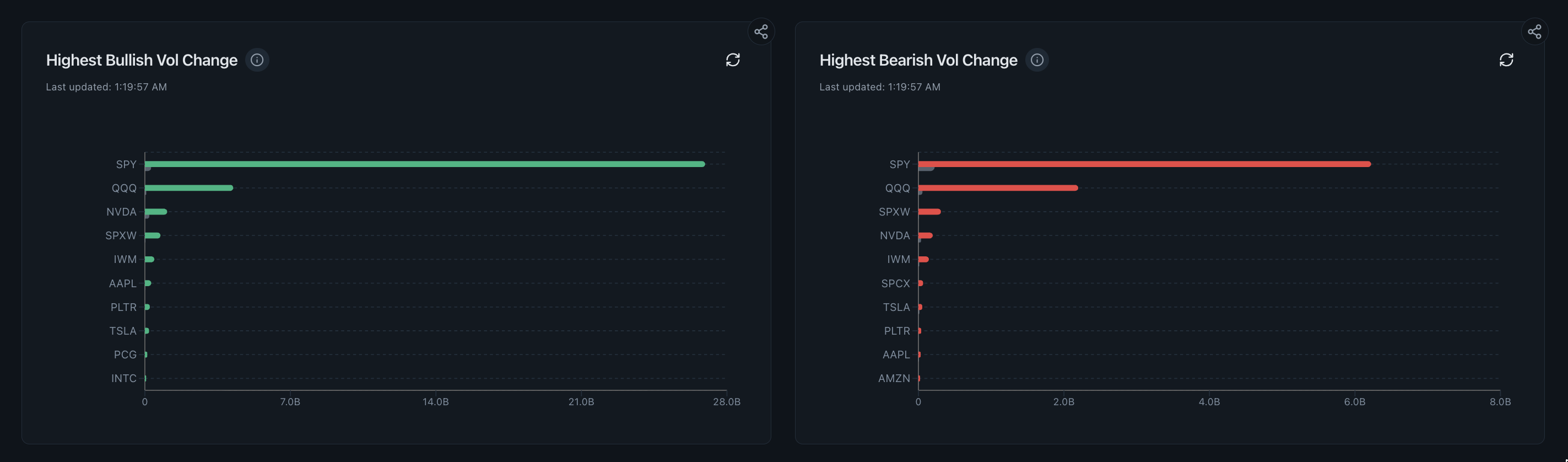
- Weighted Net Flow, Algo Flow, Volume Change, 0DTE GEX
- Data timing
- Near-real-time on Pro; 15-minute delayed during the trial
- Not an execution feed
- No order entry, no broker connectivity, no alerts as advice
- Keep in mind
- Aggressor side and intent are estimates, never confirmed
- Cost
- $29/month after a 3-day trial with no card
Before the open: establish the backdrop in ten minutes
The pre-open job is to arrive at the bell with a written expectation rather than an empty screen. Read yesterday's closing flow direction, the overnight news timeline and the scheduled events for the session, then write one sentence describing the backdrop you expect and one describing what would contradict it.
Read the supporting context
This step exists to slow down the first 30 minutes. A researcher with no prior expectation treats the first large print of the day as information; a researcher with a written expectation treats it as a test.
- Open Flow Trend to see whether recent sessions have been persistently call- or put-weighted, rather than judging from memory.
- Open Market News for timestamped company and macro headlines that could explain activity before it appears.
- Note scheduled events: economic releases, earnings before the open, and whether it is a monthly or quarterly expiration day.
- Write the expectation and its contradiction in one line each. Two sentences is enough.
The opening 30 minutes: where the day's flow concentrates
The opening window carries a disproportionate share of the session's options volume, and it is also the window in which classification is least reliable. Quotes are wide, the auction is still resolving overnight orders, and a great deal of early activity is closing or rolling rather than opening.
Read the supporting context
The routine here is deliberately narrow. Read market-wide direction once, then narrow to a small number of names and stop. The temptation to open twenty tickers in the first ten minutes is the single most common way an intraday routine stops being a routine.
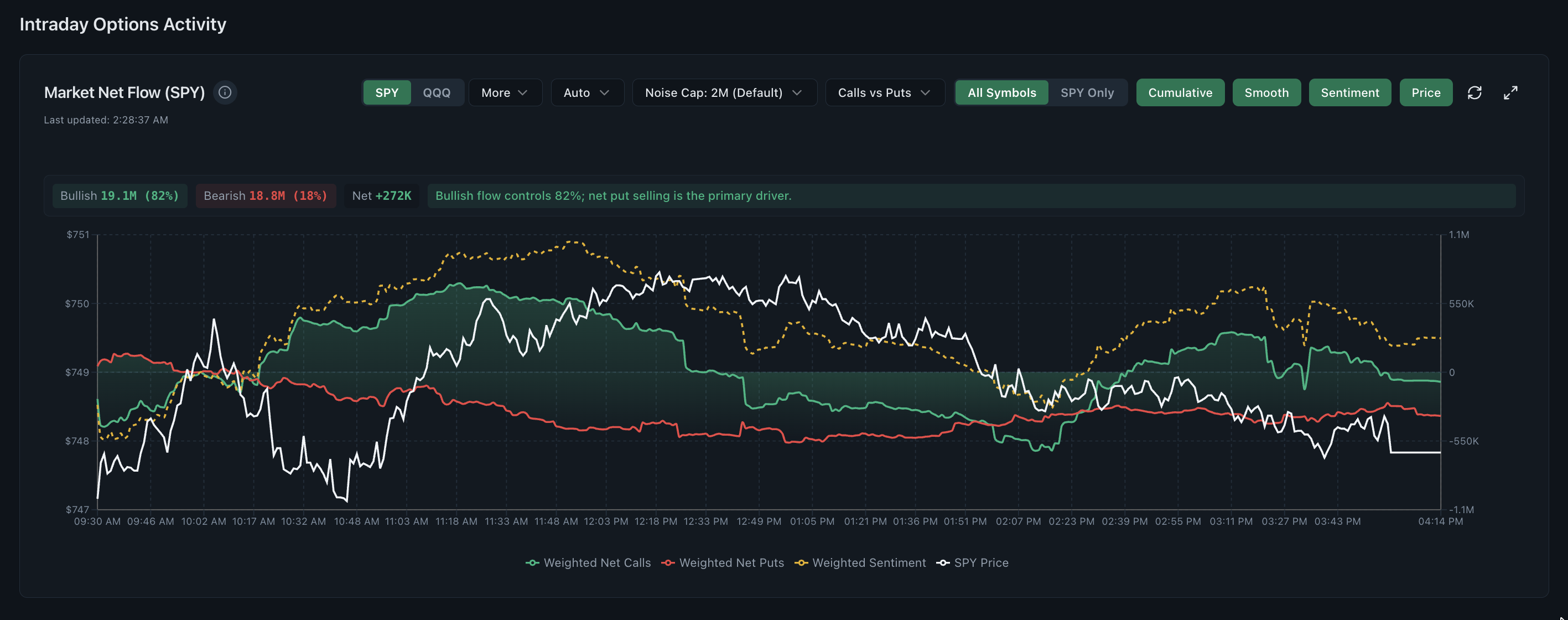
- Weighted Net Flow first: is call or put premium leading, and is price agreeing or disagreeing with it?
- Sector and Ticker Flow second: which groups carry that activity, so a single loud name does not define the read.
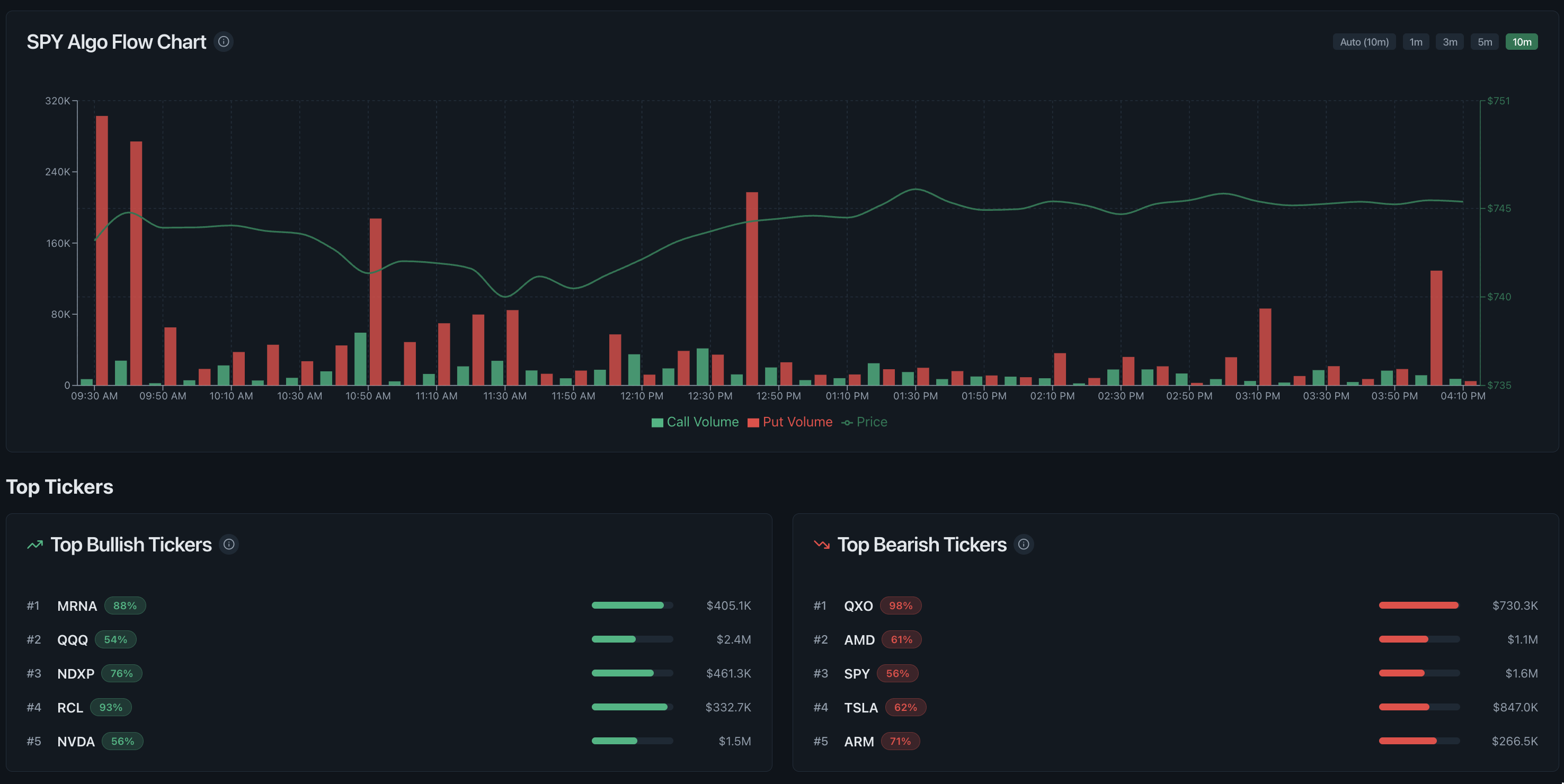
- Algo Flow and Top Tickers third: rank the active names and take the top three to five onto a list.
- Stop narrowing. Everything after this point is contract-level work on a fixed list, not further discovery.
Midday: the window most likely to mislead
Midday is when a thin tape makes ordinary activity look meaningful. Volume falls, spreads on less liquid names widen, and a single block can move a classified ranking enough to look like a development. The correct midday posture is to raise the evidence bar, not to lower it because less is happening.
Read the supporting context
Use the quiet window for the work that benefits from calm: checking whether a morning observation has held, comparing today's activity with history, and looking specifically for what would contradict the earlier read.
| Midday observation | What it can and cannot support |
|---|---|
| A ranking changes on one large print | Supports opening the contract for review; does not support treating the ranking as a shift in market direction |
| Classified volume keeps building in the same ticker across hours | Supports persistence as an observation; still cannot confirm whether it opened or closed positions |
| Premium concentrates at one strike and expiry | Supports checking modeled exposure at that strike; does not identify who is on either side |
| Activity stops entirely in a morning name | Supports removing it from the list; is not evidence that the earlier read was wrong or right |
Power hour: closing flow, rolls and same-day expiry
The closing hour reintroduces volume, and much of it is mechanical. Positions are closed, contracts are rolled to later expiries, and same-day options are either exercised, closed or left to expire. That mix means late-session volume is the least clean directional evidence of the whole day, even though it is the largest.
Read the supporting context
For same-day expiry names, the closing hour is also when modeled gamma is at its most concentrated and its most fragile. The 0DTE research routine covers that in detail; within an intraday routine, the practical step is to note where same-day exposure sits relative to spot and then watch whether price interacts with it at all.
- Re-read Weighted Net Flow: did the day's direction hold into the close or reverse in the final hour?
- Open 0DTE GEX for index products to see where same-day exposure concentrated around spot.
- Treat large late prints as ambiguous by default: closing and rolling activity looks identical to opening activity in volume data.
- Write the closing observation before the market shuts, while the screens still show what you are describing.
Latency: what near-real-time means and what it does not
Realtime Options uses licensed third-party market data, not a direct exchange feed. Pro is near-real-time; the trial is 15-minute delayed. Neither is execution infrastructure, and no part of the platform places, routes or manages an order.
Read the supporting context
This matters because the honest use of an intraday routine is research, not a speed advantage. A retail flow dashboard cannot out-time a market maker, and any product implying otherwise is selling something the market structure does not permit. What the routine can do is make an intraday session reviewable in a consistent order so your observations are comparable across days.
| Access level | Timing and what it honestly supports |
|---|---|
| 3-day trial | 15-minute delayed data; supports learning the sequence and reviewing completed windows |
| Pro, $29/month | Near-real-time analytics; supports monitoring activity as it develops during the session |
| Neither | Order entry, routing, execution timing or any broker connectivity |
| Open interest, both levels | Updated once daily after the close from OCC; never available intraday from any vendor |
What this routine cannot tell you
Flow is observed activity. The exchange reports that a contract traded, at what price, in what size and when. Everything that makes a print feel like a story, who bought it, why, whether it opened a position, whether it was one leg of a spread, is either estimated or absent.
Read the supporting context
Aggressor side is the estimate people most often mistake for a fact. Execution near the ask suggests a buyer was more aggressive, but multi-leg orders, hedges against stock or futures, and market-maker inventory management all print into the same tape without carrying a directional opinion.
- It cannot confirm whether a trade was a buy or a sell, only where it executed relative to the quote.
- It cannot confirm whether a position was opened or closed; open interest answers that the next morning, not intraday.
- It cannot identify the trader, the fund or the intent behind any print.
- It cannot show whether a print was one leg of a spread, a roll or a hedge on an equity or futures position.
- It cannot predict the direction, size or timing of the next price move.
A written record beats a remembered one
The output of an intraday routine is a short written record, not a feeling about the session. Four lines is sufficient, and the value appears after a few weeks when you can compare what you expected with what the tape actually did.
Read the supporting context
Recording the contradiction is the part most people skip and the part that does the work. An observation with no stated falsifier cannot be wrong, which also means it cannot teach you anything.
- Backdrop expected at the open, in one sentence.
- What the first 30 minutes showed and which names survived the narrowing.
- The midday check: did the morning observation hold, weaken or reverse?
- The closing read, plus the specific evidence that would have contradicted it.
Common questions
Can you day trade using options flow data?
Options flow is research input, not an execution tool. It shows activity that has already printed, side is an estimate, and Realtime Options has no broker connectivity or order entry. Treat it as a structured way to review a session, not as a timing edge over market makers.
Is 15-minute delayed data usable for an intraday routine?
It is usable for learning the sequence and reviewing windows after they close, which is why the 3-day trial runs on it. It is not usable for judging timing within a window. Near-real-time analytics require the $29 per month Pro plan.
Which dashboard should I open first each morning?
Weighted Net Flow, because it answers the broadest question, whether call or put premium is leading and whether price agrees. Starting from an individual unusual contract makes every later screen a search for confirmation rather than a test.
Why is opening-30-minute flow hard to classify?
Quotes are wide while the opening auction resolves, and a large share of early volume closes or rolls positions carried overnight. Both make execution-location classification less reliable than it looks, even though the volume is high.
Does heavy call volume during the session mean the market is going up?
No. Calls can be sold for income, bought as a hedge against a short position, rolled from an expiring contract, or traded as one leg of a volatility position with no directional exposure. Volume records the contract, not the reason.
Can I set alerts that tell me when to enter a trade?
No. Realtime Options is dashboard-based research software. It does not issue buy or sell signals, entries, exits, price targets or position sizes, and it is not a registered investment adviser or broker-dealer.