

0DTE options research: same-day gamma and same-day risk
0DTE options research studies contracts expiring the same trading day, where gamma concentrates tightly around the current price and the entire position resolves within hours. The routine reads same-day gamma exposure around spot, checks modeled dealer-gamma levels, and watches whether price interacts with them at all. Two facts frame everything else: modeled gamma levels are model output rather than levels that must hold, and a same-day option can lose its full value inside a single session.
- Contract life
- Hours; the position resolves the same session
- Primary screens
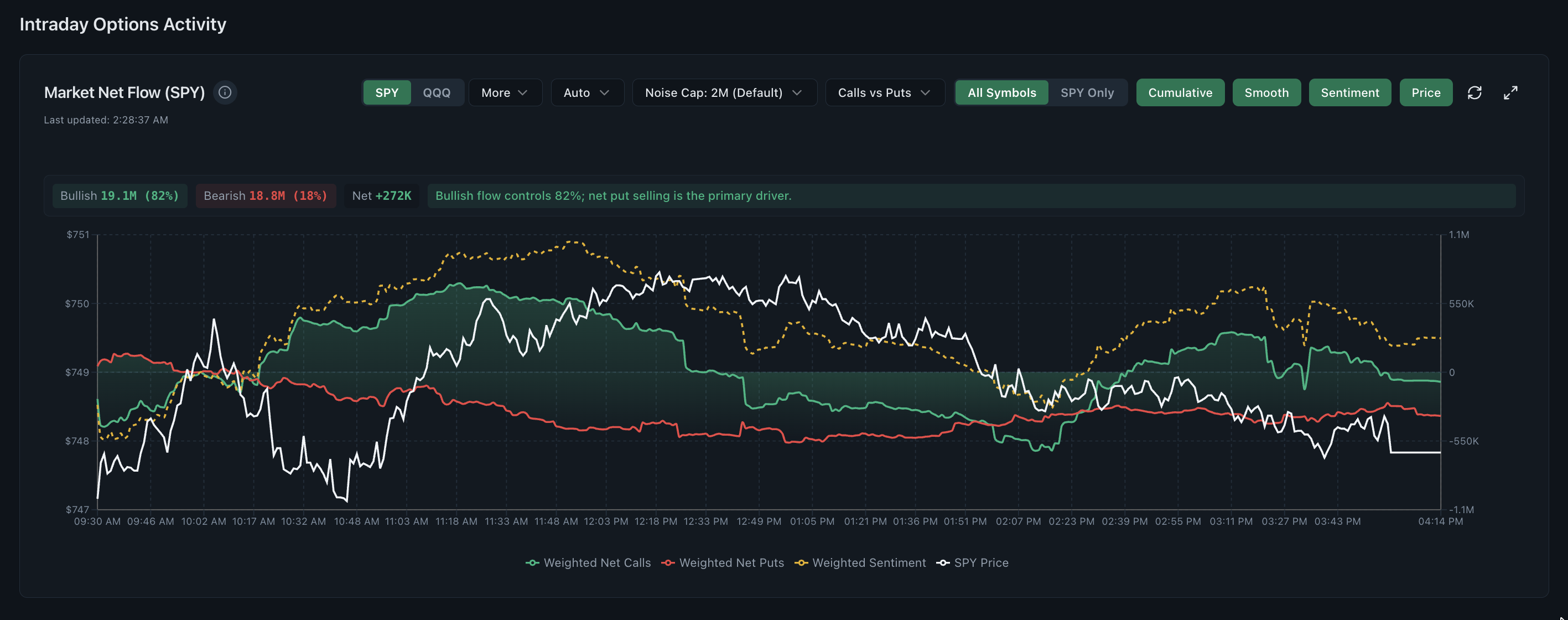
- 0DTE GEX, Magnet Levels, Weighted Net Flow, Underlying Pulse
- Concentration
- Highest in index and large ETF products
- Model status
- Gamma exposure is estimated, not an observed dealer position
- Risk
- Total loss of premium is a normal outcome, not an edge case
- Trial limitation
- A 15-minute delay is disqualifying for same-day timing
What same-day expiry research is actually asking
The question in 0DTE research is not which direction the market will go. It is where same-day contract exposure has concentrated relative to the current price, and whether price is interacting with those areas as the session runs down. That is a description of positioning, and it stops well short of a forecast.
Read the supporting context
0DTE activity concentrates in index and large ETF products, where daily expirations exist and liquidity supports them. Cboe has published extensively on how that share of volume has grown and what it does and does not imply about market structure. Single names with weekly expirations behave differently and generally do not support the same routine.
- Where is same-day gamma concentrated relative to spot right now?
- Is that concentration above the price, below it, or straddling it?
- As the session progresses, does price approach those areas, stall near them or ignore them?
- What would falsify the reading, and is it being written down before or after price moves?
Gamma concentration around spot
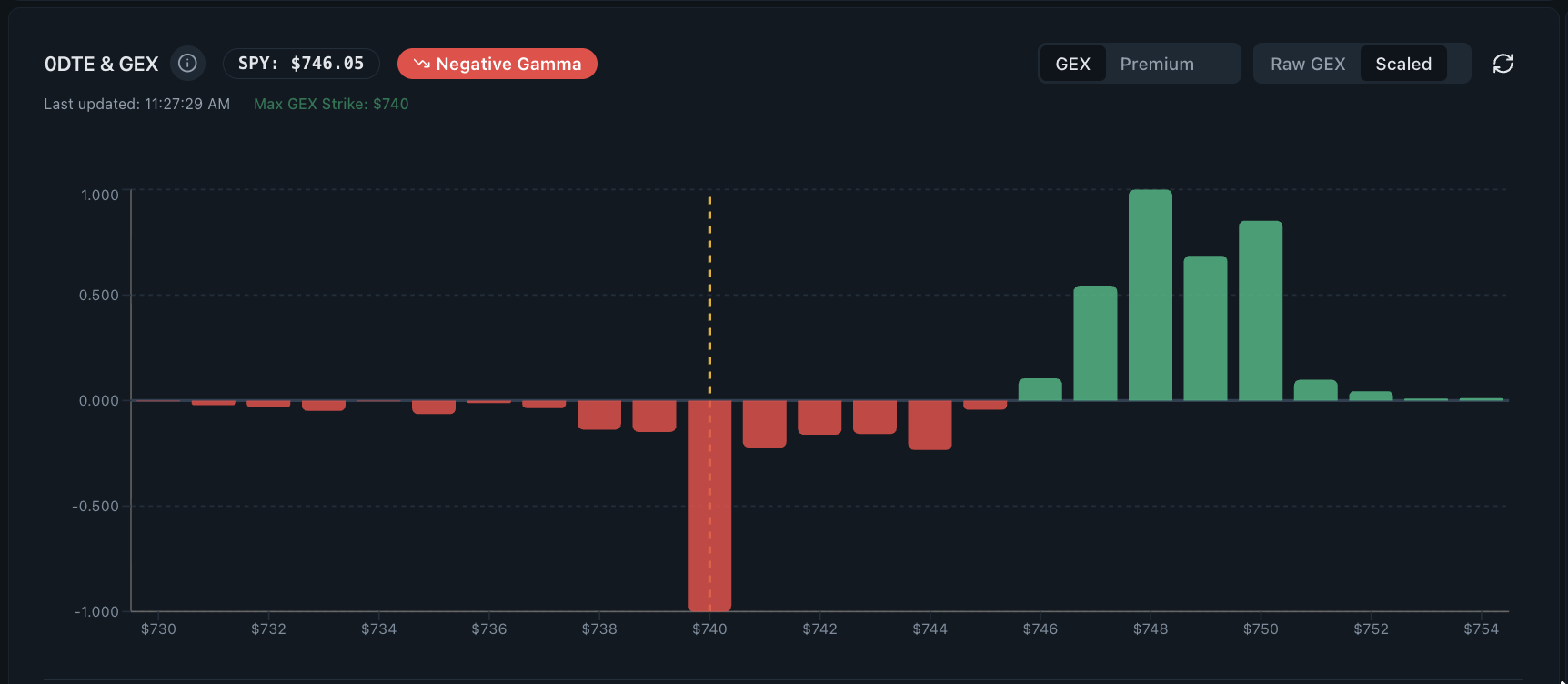
Gamma exposure estimates how sensitive hedging requirements are to a change in the underlying price at each strike. The 0DTE GEX view shows that estimate for same-day contracts around the current price, which is where same-day gamma is largest and where it changes fastest.
Read the supporting context
The reason it concentrates is arithmetic rather than sentiment. An option expiring in hours has almost no time value away from the money, so its delta changes very sharply as price crosses the strike. That sharpness is what gamma measures, and it is why a same-day chart looks like a spike near spot rather than a broad curve across the chain.
- Identify the largest same-day concentrations above and below the current price.
- Note whether the concentration is call-heavy, put-heavy or balanced around spot.
- Check how far each concentration sits from spot in points, not in visual distance on a chart.
- Re-check after any material move: same-day gamma redistributes quickly when price crosses a strike.
Magnet Levels: model output, not a level that must hold
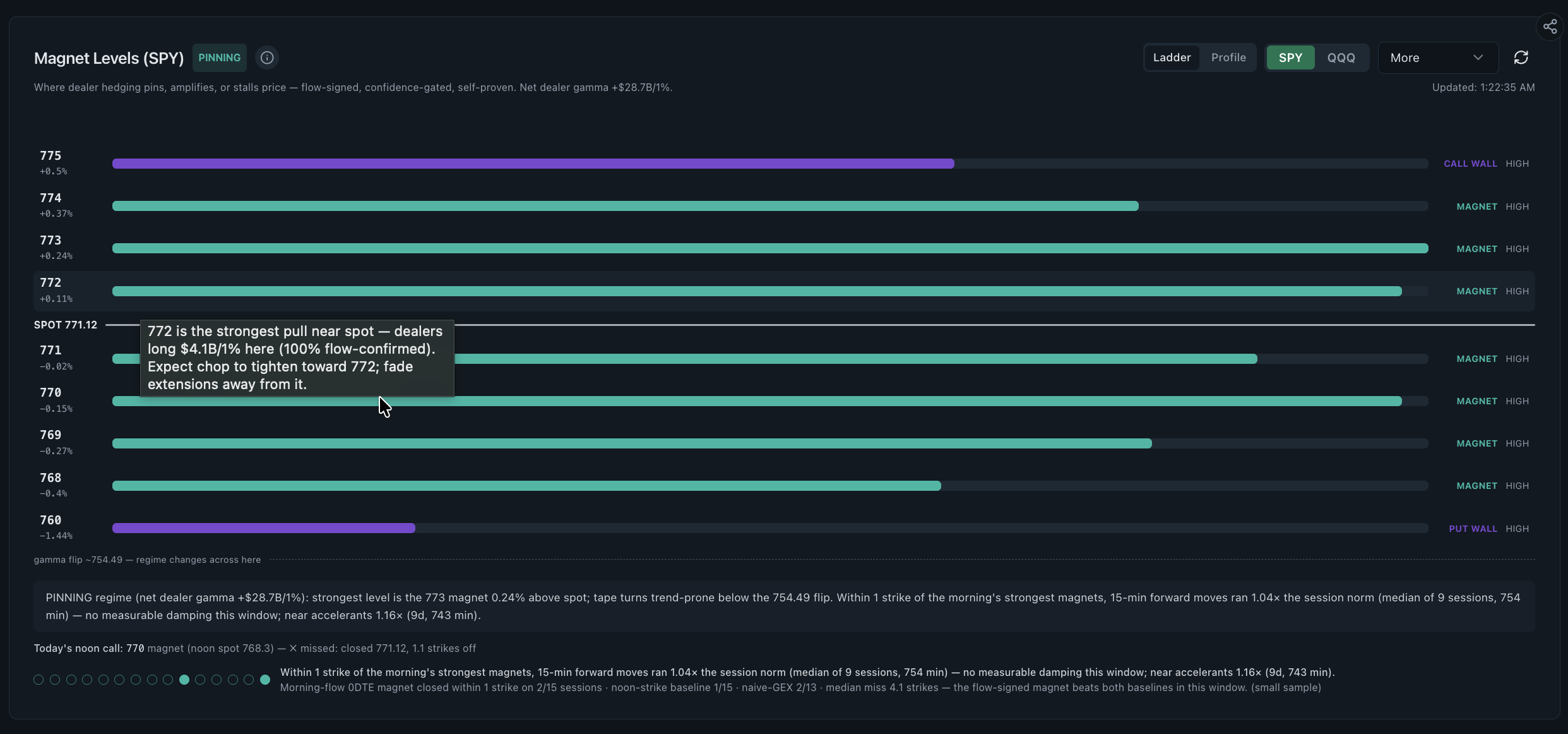
Magnet Levels ranks strikes by a flow-signed estimate of dealer gamma and labels call walls, put walls, modeled magnets and the gamma-flip area. Every one of those labels describes a model, computed from public data, about positions that are never publicly disclosed.
Read the supporting context
The correct use is comparative and provisional: this strike carries more estimated sensitivity than that one, so it is worth watching whether price behaves differently there. The incorrect use is treating a wall as support or a magnet as a target. Price ignoring a modeled level is not a malfunction; it is evidence that the model's assumptions did not hold today, and it deserves to be recorded as such.
- Read the confidence gate and sample notes before using any relative ranking.
- Treat wall, magnet and flip as model vocabulary, not as market guarantees.
- Watch price, execution pressure and volume as spot approaches a level rather than assuming reaction.
- Record when price passes straight through a level: invalidation is the most useful observation available.
Why same-day gamma decays through the session
Same-day exposure is not stable across the session. As the close approaches, contracts far from spot lose essentially all of their sensitivity, while contracts near spot become extraordinarily sensitive to small price changes. The overall gamma profile therefore narrows and intensifies rather than simply shrinking.
Read the supporting context
The practical consequence is that a 0DTE read taken at the open describes a different exposure landscape from one taken in the final hour, even if price has not moved much. A routine that reads the chart once in the morning and refers back to it at three o'clock is describing something that no longer exists.
| Session phase | How same-day exposure typically behaves |
|---|---|
| Opening period | Exposure spread across a wider band of strikes; overnight positioning and opening auction still resolving |
| Mid-session | Strikes far from spot lose sensitivity as time value drains; the profile narrows toward the current price |
| Final hour | Sensitivity concentrates sharply at strikes closest to spot; small price moves change exposure disproportionately |
| Into the close | Contracts away from the money approach zero value; expiry, exercise and closing activity dominate the tape |
Risk: how fast a same-day option reaches zero
This section is deliberately blunt. A 0DTE option has hours to live. If the underlying does not reach the strike by the close, a long position expires worthless and the entire premium is lost. This is not an unusual outcome that careful analysis avoids; it is the ordinary outcome for out-of-the-money contracts, and no dashboard changes it.
Read the supporting context
The short side carries a different and larger problem. Selling same-day options can produce losses far exceeding the premium received, uncovered call writing carries theoretically unlimited risk, and assignment can occur on in-the-money contracts. Options involve significant risk and are not suitable for all investors. Read the OCC Characteristics and Risks of Standardized Options document before trading any of this, and note that Realtime Options provides research software rather than advice.
- A long 0DTE option that finishes out of the money expires worthless: the loss is the full premium.
- Time value drains fastest on the final day, so a directionally correct view can still lose if it arrives late.
- Gaps and fast moves can change a same-day position's value within minutes, in either direction.
- Short same-day options can lose substantially more than the premium received; uncovered calls are theoretically unlimited.
- Assignment risk applies to in-the-money short contracts, including on expiry day.
- Realtime Options issues no signals, entries, exits or position sizes, and is not a broker-dealer or investment adviser.
Why the trial cannot test this routine properly
The 3-day trial runs on 15-minute delayed data. For a contract with only hours left, that delay describes a state that may already have changed. The trial can show the workflow, but it cannot reproduce near-real-time timing.
Read the supporting context
Near-real-time analytics are on the $29 per month Pro plan. Near-real-time still means licensed third-party market data, not a direct exchange feed, and it is still research infrastructure rather than execution infrastructure.
- Trial, 15-minute delayed: usable for learning the screens and reviewing a completed session afterwards.
- Pro, near-real-time: usable for watching same-day exposure change as the session runs.
- Neither: order entry, routing, or any claim of speed advantage over professional participants.
What 0DTE research cannot tell you
Gamma exposure is a model built on public data. It does not know any dealer's actual inventory, the hedges held against it, or the offsetting exposure sitting in a different product entirely. Two reasonable models using the same public data can produce different level rankings.
Read the supporting context
Same-day flow inherits every limitation of ordinary flow and adds speed. Side remains an estimate, opening and closing remain indistinguishable in volume, and open interest, which would settle the question, is published once daily after the close, which is after every same-day contract has already expired.
- It cannot confirm dealer positioning, only estimate it from publicly available data.
- It cannot guarantee that price will react at, stop at or be drawn to any modeled level.
- It cannot distinguish same-day opening activity from closing activity in real time.
- It cannot use open-interest confirmation, because same-day contracts expire before the update publishes.
- It cannot make a same-day position less risky. The routine describes exposure; it does not manage it.
Common questions
What is 0DTE options research?
It is the study of options expiring on the current trading day: where same-day gamma concentrates around spot, how that concentration changes as the session runs down, and whether price interacts with those areas. It describes positioning; it does not forecast direction.
Why does same-day gamma concentrate so tightly around the current price?
An option expiring in hours has almost no time value away from the money, so its delta changes very sharply as price crosses the strike. Gamma measures that rate of change, which is why the same-day profile spikes near spot rather than spreading across the chain.
Are gamma walls and magnet levels reliable support and resistance?
No. They are model outputs estimated from public data about positions that are never disclosed. Price frequently passes straight through them. Treat them as areas worth watching and record when the model is contradicted.
How quickly can a 0DTE option lose all its value?
Within a single session. A long same-day option that finishes out of the money expires worthless and the full premium is lost. That is the ordinary outcome for out-of-the-money contracts, not an unusual one.
Can I research 0DTE properly on the free trial?
Not for timing. The trial uses 15-minute delayed data, which is disqualifying for a contract with hours of life. The trial is useful for learning the screens and reviewing completed sessions; near-real-time requires the $29 per month plan.
Does open interest help with same-day contracts?
Rarely. Open interest publishes once daily after the close from OCC, by which point every same-day contract has already expired. Same-day research therefore has no open-interest confirmation step at all.
Which products carry the most 0DTE activity?
Index and large ETF products, where daily expirations exist and liquidity supports them. Single names with weekly expirations do not generally support the same routine, because the same-day chain is thin or absent.