

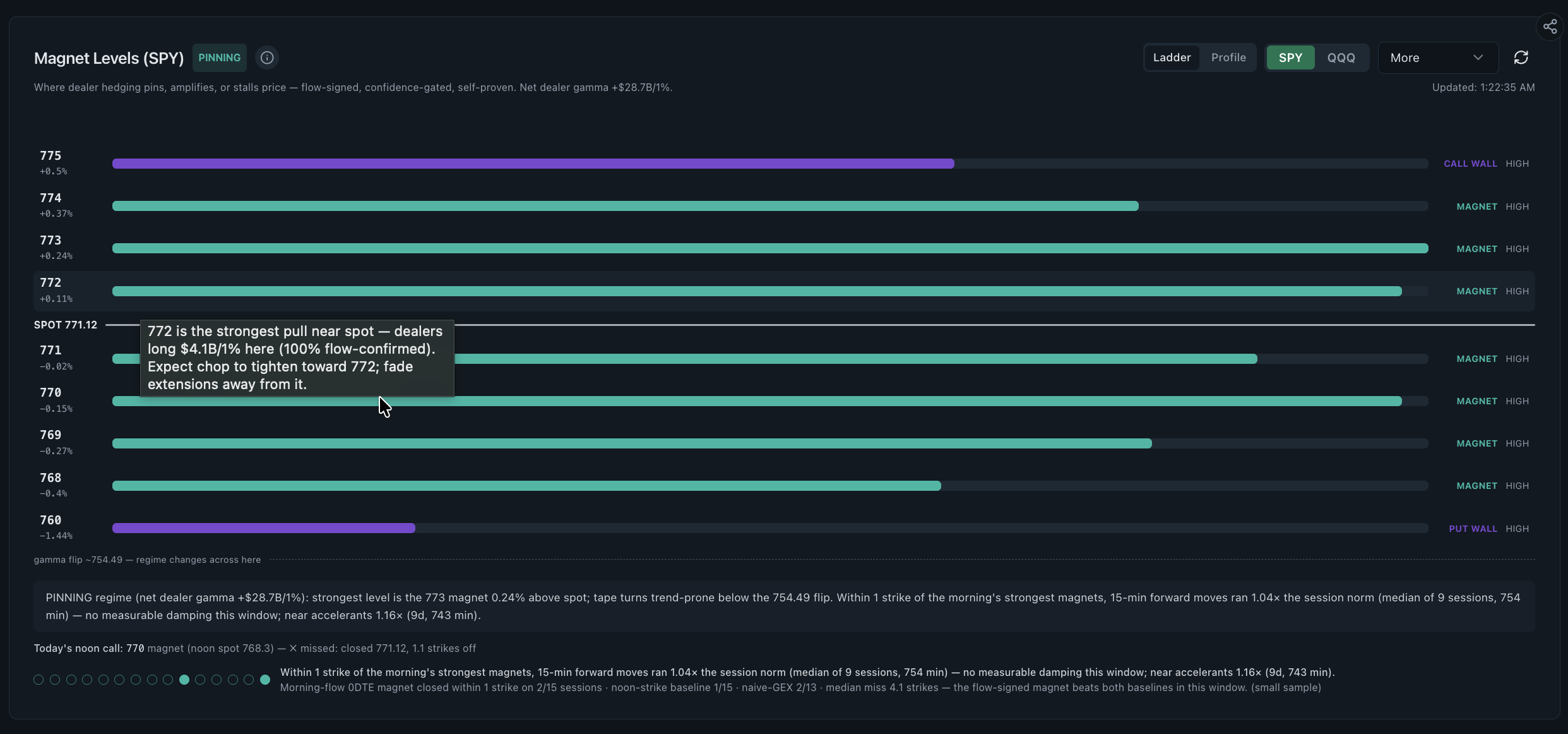
Magnet Levels dealer-gamma view
Magnet Levels ranks strikes using a flow-signed estimate of dealer gamma and labels call walls, put walls, modeled magnets and the gamma-flip area around spot. These are scenario references for monitoring price interaction, not guaranteed support, resistance, pinning or reversal levels.
- Research question
- Which modeled gamma levels deserve monitoring around spot?
- Best used for
- Scenario mapping around spot with explicit model caveats
- Data timing
- Near-real-time Pro; 15-minute delayed trial
- Product access
- Included in the single $29/month plan
What the magnet levels dealer-gamma view shows
The ladder makes a complex exposure model easy to compare around spot while preserving its inputs and historical sample notes. Relative strength is more defensible than claiming that one strike must pin, repel or attract price.
Read the supporting context
The screenshot above is from the working product, not a mockup. The visible controls and fields are the same ones trial and Pro users research with; only the market-data timing changes between the two access levels.
- Ranked strikes above and below the current underlying price.
- Flow-signed modeled dealer gamma and confidence labels.
- Call-wall, put-wall, magnet and gamma-flip annotations.
- Historical sample notes showing observations, misses and small-sample limits.
How to read this dashboard
Read the dashboard as one step in a sequence. Record what it directly shows first, then use the next view to test the interpretation rather than turning a color or ranking into a conclusion.
- Check the selected symbol, expiry scope, spot and gamma regime.
- Identify the strongest levels above and below spot without assigning certainty.
- Read the confidence gate and sample size before using the relative ranking.
- Compare actual price, execution pressure and volume as spot approaches a level.
- Record when price ignores the model; invalidation is evidence, not a failure to hide.
What this view cannot establish
Public data does not reveal every dealer's inventory, hedge or offsetting exposure. Gamma estimates change with price, volatility, time and model assumptions, and small historical samples can be unstable.
Read the supporting context
Realtime Options organises observed and derived market data for independent research. Read each view with its stated method, assumptions and surrounding context.
Common questions
What is a magnet level in options analytics?
It is a model-derived strike where estimated positioning and hedging sensitivity are relatively concentrated. It is not a guaranteed price target.
Are call walls and put walls support and resistance?
They can be monitored as scenario references, but public positioning estimates cannot guarantee support, resistance, pinning or reversal behaviour.
Does Magnet Levels know dealer positions?
No. Dealer positioning is estimated from public options data and model assumptions; complete inventories and hedges are not publicly observable.