

SPY and QQQ options flow: index context before single names
SPY and QQQ options flow reads differently from single-stock flow because a large share of it is hedging rather than speculation, same-day expiries take a much larger share of volume, there is no company-specific catalyst, and dealer positioning in these products is unusually concentrated. The practical use is as market backdrop: establish what index and ETF activity is doing before opening any individual name, so a single-stock read is not mistaken for a market-wide one.
- Products
- SPY, QQQ and other large US-listed index ETFs
- Primary screens
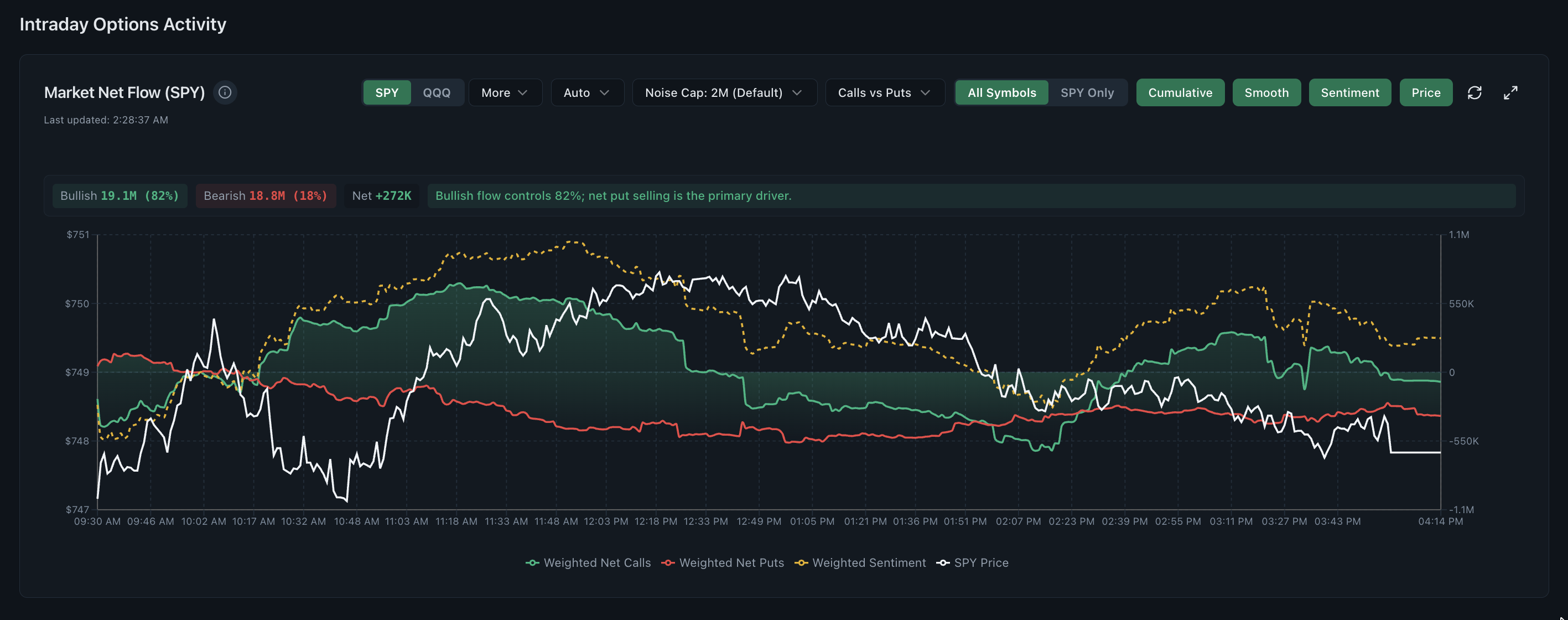
- Weighted Net Flow, 0DTE GEX, Magnet Levels, Sector and Ticker Flow
- Structural difference
- High hedging share and a large same-day expiry share
- No earnings
- The catalyst calendar is macro, not company-specific
- Keep in mind
- An ETF option can hedge exposure held anywhere in a portfolio
- Use
- Market backdrop before single-name research, not a standalone read
Why index and ETF flow reads differently
SPY and QQQ options are the market's default hedging instruments. A fund reducing risk across a diversified equity book, an institution offsetting futures exposure, and a desk managing inventory can all express that in index ETF options without holding any view about the ETF itself. Single-stock options carry hedging too, but nowhere near the same proportion.
Read the supporting context
That changes what a large print means. In a single name, size at least narrows the question to one company. In SPY, size may be about a portfolio you cannot see, in positions the options data never references. The correct default is that index flow describes broad demand for exposure or protection, not a directional opinion about the index.
- Hedging share: a large portion of index option volume offsets exposure held elsewhere.
- Relative value: index options are used as one leg against futures, sector ETFs or single names.
- No single issuer: there is no company-specific news that can explain a print in isolation.
- Liquidity: tight quotes and deep chains make index options the cheapest place to express almost anything.
The same-day expiry share
Index and large ETF products carry daily expirations, and a substantial share of their volume sits in contracts expiring the same session. Cboe has published on how that share has grown and what it does and does not imply. For a reader, the operational consequence is that a large fraction of what appears in an index flow view will be gone by the close.
Read the supporting context
This is why index flow should be read with the expiry visible at all times. Same-day contracts and contracts expiring in a month are answering different questions, and averaging them into one sentiment number produces a reading that is dominated by the shortest-dated activity without saying so.
- Separate same-day activity from later expiries before reading any directional classification.
- Same-day exposure concentrates near spot and reshapes through the session, so re-check it rather than relying on a morning read.
- Large same-day volume is not evidence of conviction: the position expires within hours by design.
- For same-day work specifically, follow the dedicated 0DTE routine rather than a general flow read.
No earnings, but a calendar all the same
Index ETFs have no earnings report, so the catalysts that concentrate single-stock positioning do not apply. What replaces them is a macro and structural calendar that is equally scheduled and equally capable of concentrating activity around specific dates.
Read the supporting context
Checking that calendar before interpreting an index build is the equivalent of checking an earnings date before interpreting a single-stock build. A large position ahead of a scheduled macro release is ordinary behaviour, not a discovery.
| Index catalyst type | How it typically shows in options activity |
|---|---|
| Scheduled macro releases | Positioning concentrates in the expiry covering the date; activity often unwinds immediately afterwards |
| Central bank meetings | Elevated interest across a wider band of strikes as a range of outcomes is priced |
| Monthly and quarterly expirations | Large volume from rolling and closing rather than fresh directional positioning |
| Index rebalancing dates | Mechanical flow tied to index construction rather than to any market view |
Dealer positioning and modeled gamma in index products
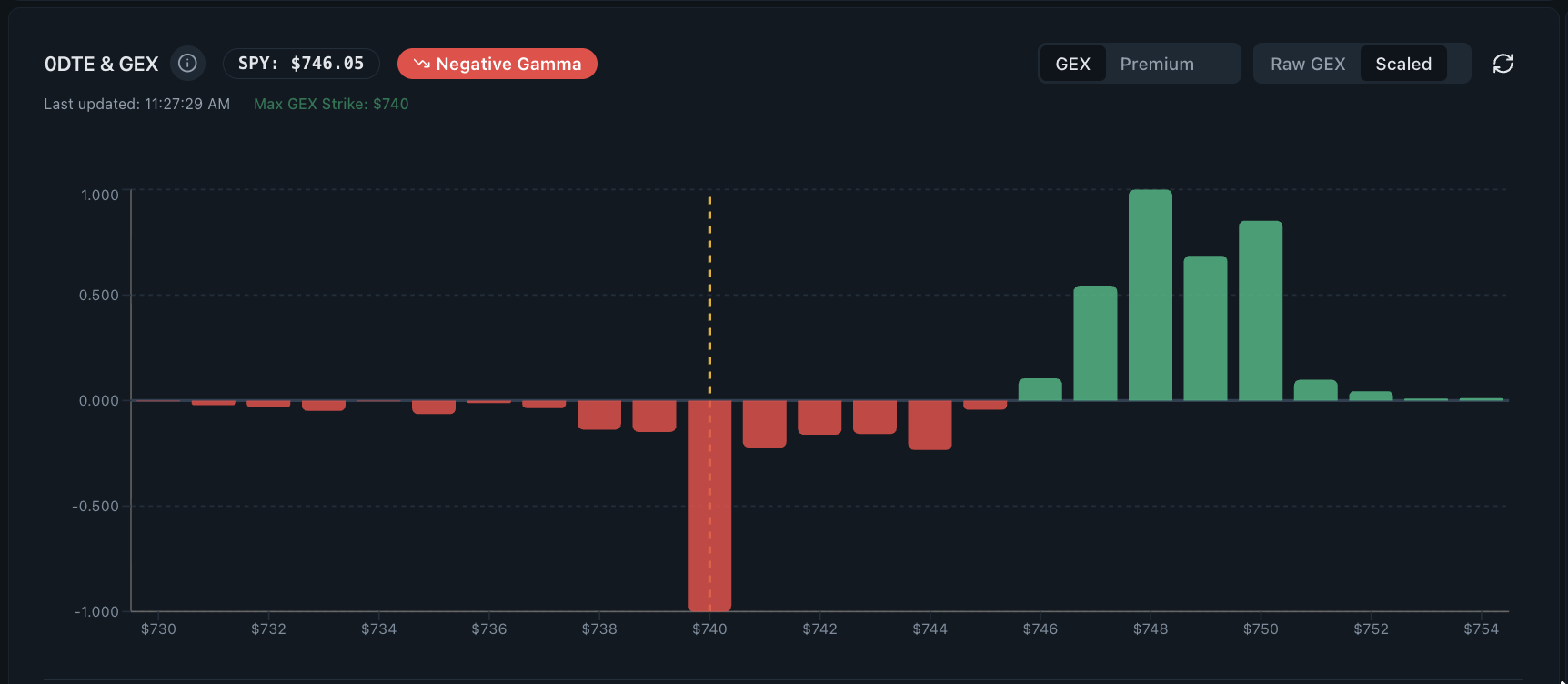
Because index option volume is so concentrated, modeled dealer gamma in SPY and QQQ is discussed more than in any other product. The models estimate how sensitive hedging requirements are around each strike, and 0DTE GEX and Magnet Levels present that estimate around the current price.
Read the supporting context
The status of these numbers must stay clear. They are estimates computed from public data about positions that are never publicly disclosed. Two reasonable models can rank the same strikes differently. Watching whether price interacts with a modeled level is a legitimate observation; assuming a level will hold, pin or repel price is not supported by the data behind it.
- Read the confidence and sample notes before treating any level ranking as meaningful.
- Compare above-spot and below-spot concentrations rather than fixating on one number.
- Record when price passes through a modeled level: contradiction is the most informative outcome.
- Never treat wall, magnet or flip labels as support, resistance, targets or recommendations.
Using index flow as context before a single name
The most defensible use of index flow is sequencing. Establish the market backdrop first, then narrow to sectors, then to names. A single-stock read taken without that backdrop routinely mistakes a market-wide move for a company-specific one, and the error is invisible from inside the single name.
Read the supporting context
In practice this takes a few minutes and changes how much weight a single-name observation deserves. Activity that runs against a clear index backdrop is more interesting than activity that merely matches it, and neither is possible to judge without looking at the index first.
- Weighted Net Flow on the index products: is call or put premium leading, and does price agree?
- Sector and Ticker Flow: is the activity broad across sectors or concentrated in one?
- Only then open individual names, carrying the backdrop with you.
- Ask explicitly whether the single-name read is independent of the index or simply an echo of it.
- Where the name is a large index constituent, expect its flow and the index flow to interact in both directions.
SPY and QQQ are not interchangeable
SPY tracks a broad large-cap benchmark; QQQ tracks a technology- and growth-weighted index with far higher concentration in its largest constituents. Flow in QQQ therefore responds more directly to a handful of mega-cap names, and heavy activity there can reflect positioning around individual constituents rather than a broad market view.
Read the supporting context
That asymmetry is worth checking rather than assuming. When QQQ activity builds, look at whether its largest constituents show related or opposing single-name activity, because the ETF option may be the cheaper way to express a view about a small number of companies.
| Product | What its flow tends to reflect |
|---|---|
| SPY | Broad large-cap exposure and portfolio-level hedging across many sectors |
| QQQ | Technology and growth weighting with heavy sensitivity to a few mega-cap constituents |
| Both | Substantial same-day expiry volume and heavy use as hedging instruments |
| Neither | Company-specific catalysts, earnings dates or single-issuer news |
What index flow cannot establish
Index flow describes activity in a product that thousands of participants use for unrelated reasons. It cannot separate a directional view on the index from a hedge on an equity portfolio, an offset against futures, or one leg of a relative-value position between the ETF and something else entirely.
Read the supporting context
It also cannot be read as market prediction. A call-heavy session in SPY is consistent with bullish positioning, with call writing against long stock, and with dealers hedging inventory. Volume records the contract, not the reason, and no dashboard on this platform claims otherwise.
- It cannot distinguish a directional index view from a portfolio hedge.
- It cannot identify which underlying exposure an ETF option is offsetting.
- It cannot confirm side or intent; execution location is an estimate.
- It cannot predict index direction, and Realtime Options issues no signals or targets.
- It cannot substitute for company-level research when the question is about a single stock.
Common questions
Why does SPY options flow read differently from single-stock flow?
A much larger share of SPY volume is hedging exposure held elsewhere, a large share expires the same day, and there is no company-specific catalyst to explain any print. Size in SPY narrows the question far less than size in a single name.
Is heavy SPY call flow bullish for the market?
Not on its own. Calls in index products are sold against long portfolios, bought as hedges against short exposure, rolled from expiring contracts and used as legs in volatility positions. All of those add to call volume without expressing a bullish view.
How is QQQ options flow different from SPY options flow?
QQQ tracks a technology- and growth-weighted index with much higher concentration in its largest constituents, so its flow responds more directly to a handful of mega-cap names. SPY flow reflects broader large-cap exposure and portfolio-level hedging.
Should I look at index flow before single stocks?
It is the more defensible order. Establishing the index backdrop first prevents a market-wide move from being read as company-specific news, and it changes how much weight a single-name observation deserves.
Why is same-day expiry volume so high in index products?
Index and large ETF products carry daily expirations and deep liquidity, which supports a large share of volume in contracts expiring the same session. Cboe has published research on how that share has grown and what it does and does not imply.
Are dealer gamma levels in SPY more reliable than in single names?
They are computed on far more volume, but they remain estimates from public data about positions that are never disclosed. More data does not make a model an observation, and price passes through modeled levels regularly.
Does Realtime Options cover index ETFs other than SPY and QQQ?
The platform covers US-listed stock and ETF options generally, so other large index ETFs appear in the same dashboards. It does not cover cash-settled index products outside that scope, futures options or non-US markets.