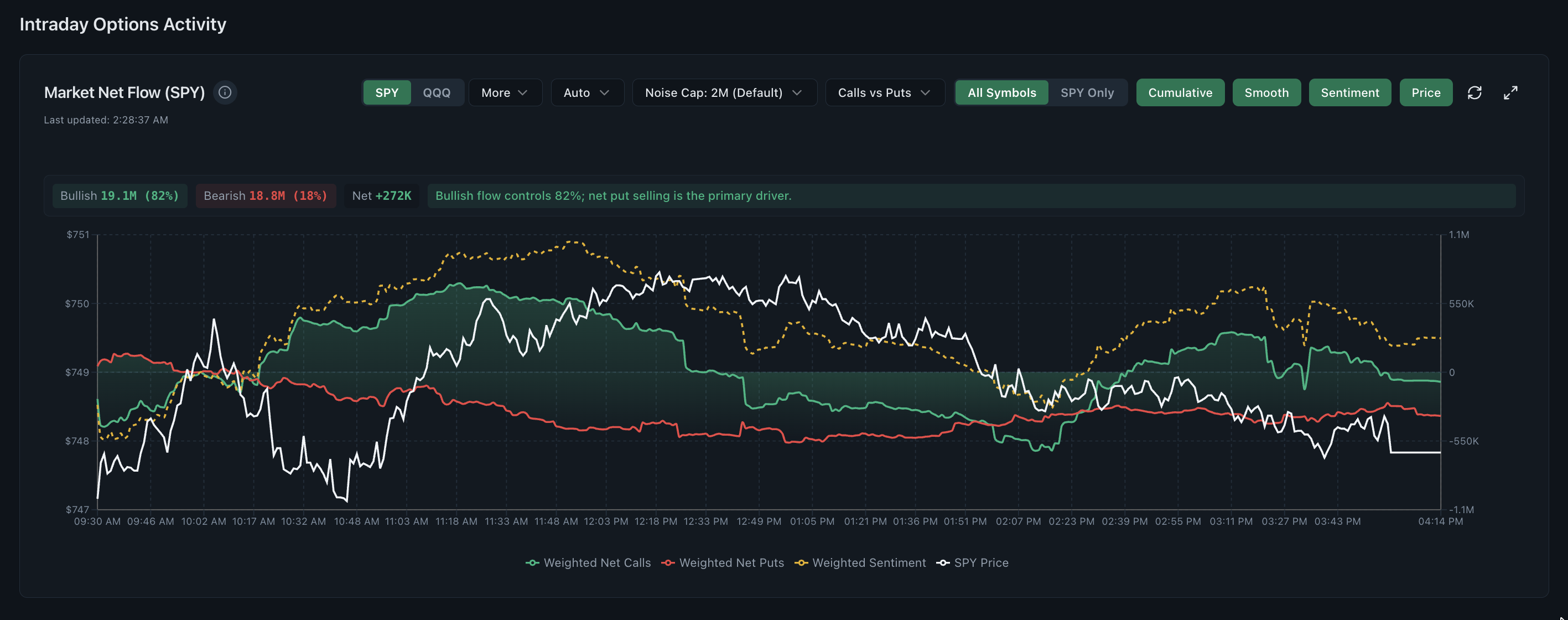


Free options tools and data sources, checked August 2026
Genuinely free options tools fall into four groups: public market data published by the OCC and Cboe, free education from the Options Industry Council and FINRA, analytics bundled into a funded brokerage account, and free calculators or delayed chain views published by vendors. Each covers a specific job and fails in a specific way. This list is a snapshot checked in August 2026; free tiers and entitlements change without notice, so verify terms on the provider's own site before depending on one.
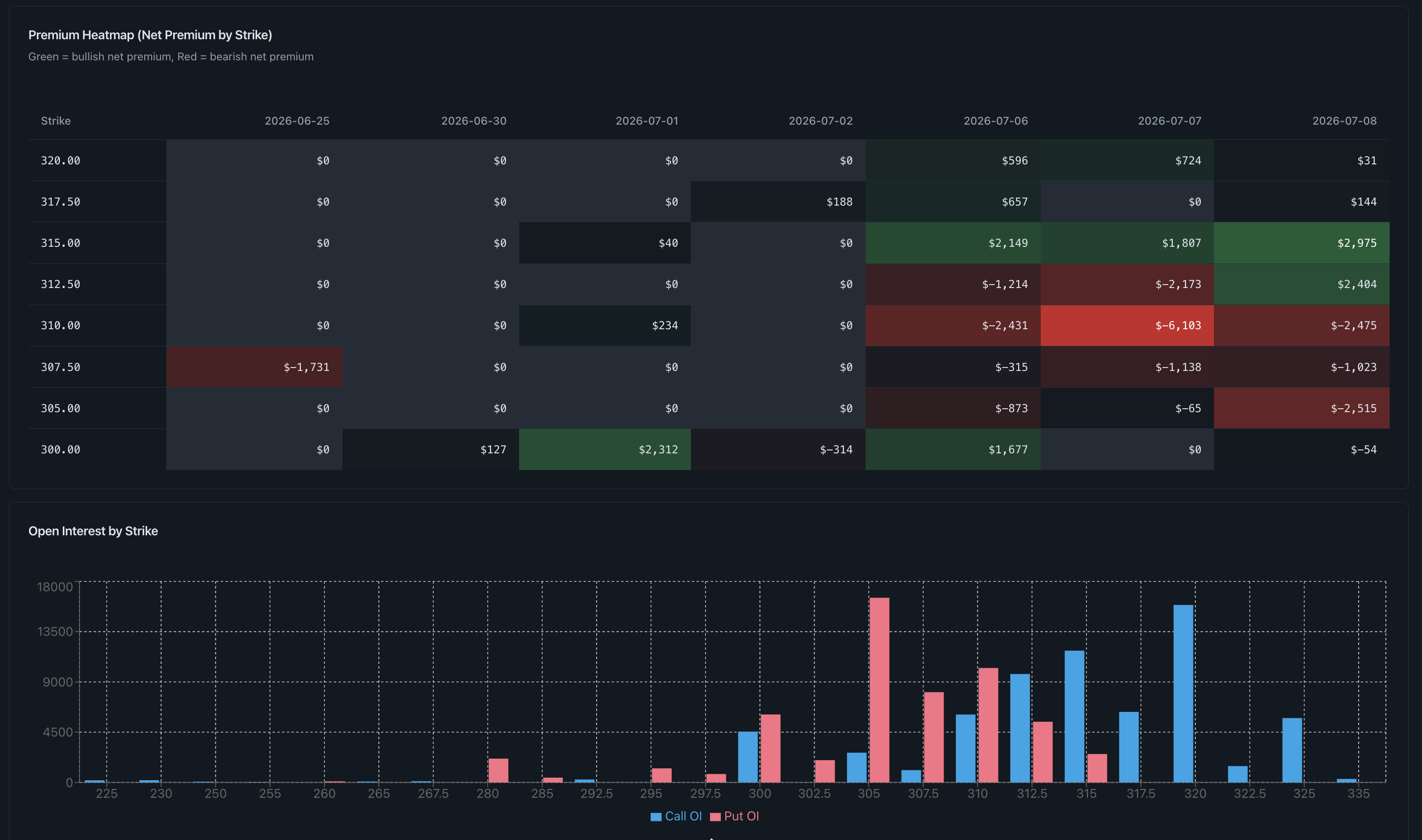
- Snapshot date
- August 2026
- Truly free
- OCC and Cboe public data, OIC and FINRA education
- Free with an account
- Broker-bundled chains, scanners and entitled quotes
- Usual limits
- Delay, aggregation, shallow history, no market-wide flow
- Never free anywhere
- Intraday open interest; the OCC publishes it once daily
- Realtime Options
- 3-day no-card trial, then $29/month
What counts as free, and what each kind gives you
Four distinct things are described as free options tools, and mixing them up is the reason most lists are useless. The table separates them by what the provider is actually giving away.
Read the supporting context
Everything below was checked in August 2026. Treat it as a starting point for your own verification rather than a permanent state of the world.
| Kind of free | What you get and who pays |
|---|---|
| Public exchange and clearing data | Official statistics published as a market utility; free to read, usually end of day and aggregated |
| Investor education | Definitions, risk disclosure and course material from industry bodies; free by mandate and mission |
| Broker-bundled analytics | Chains, scanners and entitled quotes; free once you have funded an account |
| Vendor free tiers and calculators | Delayed chains, payoff and Greeks calculators; free as a route into a paid product |
Public data from the OCC and Cboe
The Options Clearing Corporation publishes volume and open-interest statistics for the whole cleared US options market, and Cboe publishes market statistics including volume and put/call ratios. Both are free, authoritative and updated on a published schedule, and both are the primary source that most commercial products are ultimately derived from.
Read the supporting context
The limit is granularity and timing, not credibility. These are official aggregate statistics published on a daily rhythm. They will tell you what the market did; they will not show you a strike-level tape as it develops, and open interest in particular is a once-daily post-close figure at every vendor precisely because that is when the OCC publishes it.
- Good for: total market and per-class volume, cleared open interest, long-run context.
- Good for: put/call ratio history, which is the honest way to check whether today is actually unusual.
- Not good for: intraday flow, strike-level premium as it prints, or estimated trade side.
- Keep in mind: a put/call ratio counts contracts, not intent. Put selling and put buying add to the same number.
Free education from OIC, FINRA and the OCC
The best free options resources are educational rather than analytical. The Options Industry Council publishes definitions, Greeks explanations, open-interest material and structured courses. FINRA publishes plain-language investor insights on options basics and risk. The OCC publishes Characteristics and Risks of Standardized Options, the disclosure document you are meant to read before trading options at all.
Read the supporting context
None of these costs anything, none of them sells you a subscription, and all three are more reliable on definitions than any vendor page, including this one. Read them first and treat any commercial explanation that contradicts them as the thing to question.
- Options Industry Council: Greeks, open interest, bid and ask, structured courses.
- FINRA investor insights: options basics, risk and common misunderstandings.
- OCC disclosure document: the formal statement of what can go wrong, including that selling uncovered calls carries theoretically unlimited risk.
- Limit: education explains concepts and does not supply market data.
Analytics bundled with a funded brokerage account
If you already have a funded US brokerage account, you probably have more free options tooling than you are using. Entitled real-time quotes, full option chains, scanners, probability calculators and payoff analysis are standard inclusions at several large brokers, and for many researchers they close three of the seven toolkit jobs at once.
Read the supporting context
The trade-offs are structural. You need an account, entitlements can depend on activity or balance, coverage is oriented to the chain and your own positions rather than to the whole market, and historical depth at strike level is usually shallow. Terms also vary by firm and change, so check with the broker rather than with a list.
- Good for: chains, entitled real-time quotes, basic scanning, payoff modelling and order staging.
- Not good for: market-wide premium ranking across all optionable names.
- Not good for: strike-level history spanning months, or dealer-exposure modelling.
- Practical check: confirm what your existing broker already includes before paying for anything.
Free calculators and delayed chain pages
The last group is the vendor free tier: a payoff calculator, a Greeks or theoretical-value calculator, a delayed option chain, or a limited scan. Cboe publishes a free options calculator, and several analytics vendors publish delayed chain and screening pages as an entry point to a paid tier.
Read the supporting context
These are genuinely useful for a narrow job, and the standard caveat applies twice over. The data is a delayed snapshot rather than a tape, so it cannot support same-day work, and a free screen shows you contract attributes without telling you whether the volume behind them was bought or sold.
| Free tool type | What it is good for, and where it stops |
|---|---|
| Payoff and profit calculators | Understanding structure and breakevens; no live data and no market context |
| Theoretical value and Greeks calculators | Learning how inputs move an option's value; model output, not a market price |
| Delayed option chain pages | Casual checks and after-the-close review; useless for 0DTE or intraday work |
| Limited free screens | Producing a shortlist by contract attribute; silent on side, intent and whether a position opened |
What no free tool can do, and what none can do at any price
It is worth separating two different limits. Some things are missing from free tools because the underlying data is licensed and expensive. Other things are missing from every tool at every price because the information does not exist in public market data.
Read the supporting context
Anyone selling you the second category is selling a claim rather than a dataset, and that distinction is the most useful thing on this page.
- Missing from free tools because of licensing: continuous market-wide near-real-time flow and deep strike-level history.
- Missing from every tool: the identity of the party behind a print.
- Missing from every tool: certainty about whether a trade opened or closed a position, until open interest updates.
- Missing from every tool: intraday open interest, because the OCC publishes it once daily after the close.
- Missing from every tool: a reliable statement of intent. A large call purchase can be a directional bet, a hedge against short stock, a roll, or one leg of a volatility trade.
When a paid research layer starts to make sense
Free covers more ground than most vendor pages admit. A paid research layer starts to make sense at a narrow point: when you are repeatedly trying to see where premium is concentrating across the whole market during the session, and to compare that against the same ticker's own history at strike level. That is the job licensing costs money to do.
Read the supporting context
If your questions are about a single name you already follow, about what a structure pays off, or about learning the mechanics, free tools plus your broker will serve you better than a subscription. Realtime Options is $29 a month with a 3-day no-card trial on delayed data, which exists so you can find out which of those two descriptions fits you before paying anything.
- Stay free if: you research one or two familiar names and your broker's chain answers your questions.
- Stay free if: your main need is strategy payoff modelling, which this product does not do.
- Consider paid if: you need market-wide flow ranking every session rather than a single-name view.
- Consider paid if: you need strike-level premium and open-interest history to judge whether a session is unusual.
- Either way: no tool free or paid removes the risk in an options position.
Common questions
Are there genuinely free options tools?
Yes. Public statistics from the OCC and Cboe, education from the Options Industry Council and FINRA, and the chains, scanners and calculators bundled with a funded brokerage account are all genuinely free. What is rarely free is continuous market-wide near-real-time options flow, because that data is licensed.
Where can I get free options data?
The OCC publishes cleared volume and open-interest statistics, and Cboe publishes market statistics including volume and put/call ratios. Both are free and authoritative. They are aggregate and published on a daily schedule rather than being a live strike-level tape.
Is free options data delayed?
Publicly accessible options data is typically delayed 15 minutes or more, and official statistics are usually end of day. The main exception is the entitled real-time quote stream inside a funded brokerage account.
Can I get free intraday open interest?
No, and neither can anyone paying for it. Open interest is calculated by the OCC after clearing and published once daily after the close. Any product implying live intraday open interest is describing something the clearing process does not produce.
Is free options education worth using?
Yes. The Options Industry Council, FINRA and the OCC publish material that is more reliable on definitions and risk than most commercial content. The OCC's Characteristics and Risks of Standardized Options is the document to read before trading options at all.
Do I need a paid options tool?
Often not. If you follow a small number of names and your broker's chain answers your questions, free tools plus your existing account will cover you. A paid research layer earns its place mainly when you need market-wide flow ranking and strike-level history every session.
Is Realtime Options free?
There is a 3-day trial with no credit card, covering every dashboard on 15-minute delayed data. After that Pro is $29 per month with near-real-time data and no contract. There is no permanent free tier, and the product does not execute trades.