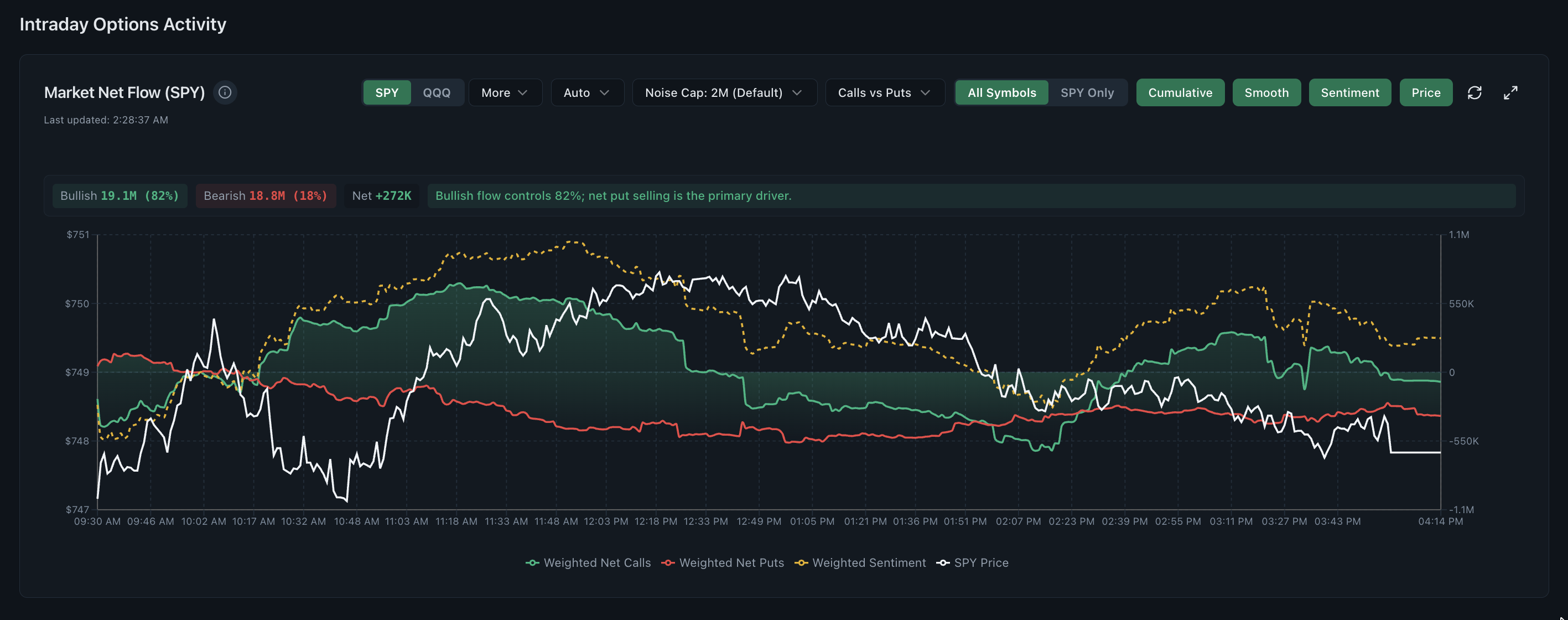


Free options trading platform: four different meanings of free
A free options trading platform usually means one of four things: a commission-free broker whose revenue comes from payment for order flow, interest and other fees rather than a per-trade commission; a free tier of paid software with delayed or reduced data; analytics bundled into a brokerage account you have already funded; or a time-limited trial. None of them is costless, and the difference is who pays and how. Realtime Options is the trial case, not a broker: every dashboard for 3 days on 15-minute delayed data with no credit card, then $29 per month.
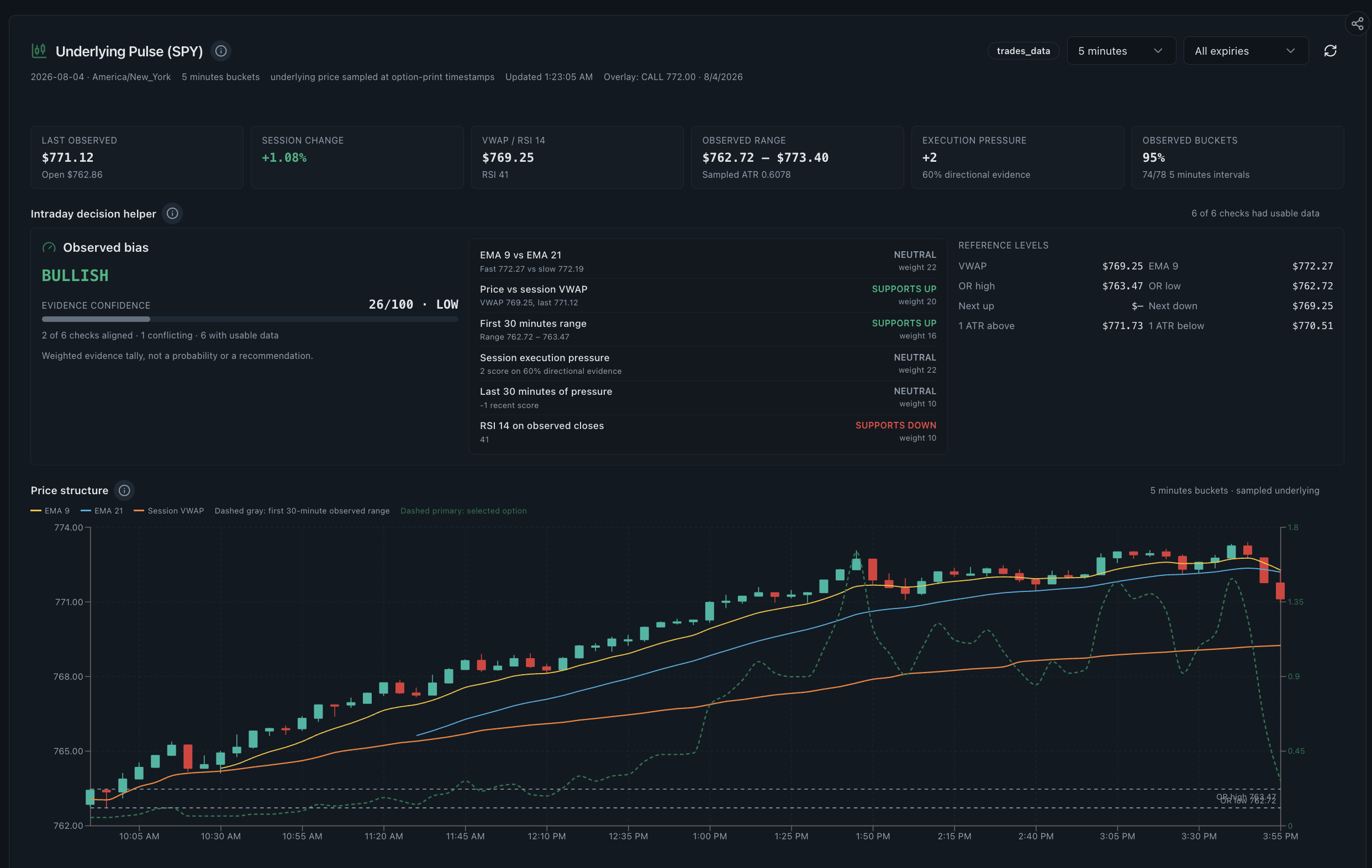
- Trial price
- $0 for 3 days, no card required
- Trial data
- 15-minute delayed
- After trial
- $29/month, cancel anytime
- Commission-free brokers
- Paid through order flow, spreads, fees and interest
- Not offered here
- Order execution or a permanent free real-time tier
Four things the word free means in this market
Free is doing four different jobs in the phrase free options trading platform, and the four have almost nothing in common. Identify which one a product means before you compare it with anything else.
Read the supporting context
Only the first is a trading platform in the strict sense. The other three are research or software products that sit beside a broker rather than replacing one.
| Kind of free | What you actually get, and what pays for it |
|---|---|
| Commission-free broker | Real order execution at $0 stated commission; revenue comes from order-flow payments, per-contract and regulatory fees, spreads, margin and cash interest |
| Broker-bundled analytics | Scanners and chains inside a funded account; paid for by your presence as a customer and sometimes by activity or balance minimums |
| Free tier of paid software | A reduced feature set, usually on delayed data with shallow history; paid for by the subscribers who upgrade |
| Time-limited trial | The full product for a fixed window; paid for by conversion afterwards. Check the card requirement and the cancellation terms |
How commission-free brokers are actually paid
Zero commission is not zero revenue. In US equity options the most-discussed mechanism is payment for order flow, in which a broker receives compensation for routing customer orders to a particular market maker or venue. The SEC describes it plainly in its investor glossary, and brokers are required to publish order-routing disclosures showing where orders go and what they receive.
Read the supporting context
Payment for order flow is legal and disclosed, and it is not the only revenue line. Options orders also carry per-contract charges at many brokers, plus exchange and regulatory fees, and brokers earn on uninvested cash, margin lending and securities lending. Whether a given routing arrangement produces better or worse execution than an alternative is contested and depends on the order; the honest summary is that the cost has moved rather than disappeared.
- Payment for order flow: compensation for routing orders to a specific venue or market maker.
- Per-contract charges: many commission-free brokers still bill per options contract.
- Exchange and regulatory fees: passed through on options transactions.
- Interest on uninvested cash and margin lending: often the largest single line.
- Ancillary charges: assignment, exercise, paper statements, data upgrades and transfers.
Free tiers, delayed data and what the delay costs you
Free tiers of paid options software almost always trade freshness for price. A 15- to 30-minute delay is the common arrangement, and it is workable for some research jobs and disqualifying for others.
Read the supporting context
The rule is proportion, not principle. A delay of 20 minutes against a 30-day expiry is background noise. The same delay against a 0DTE contract with three hours of life is most of the contract's remaining existence, which is why delayed data cannot support same-day gamma or flow work.
| Research job | Is delayed data enough? |
|---|---|
| Learning an interface and testing a workflow | Yes |
| Reviewing a completed session after the close | Yes |
| Comparing this session's premium with prior sessions | Yes |
| Reading swing-horizon positioning at 20 to 45 days | Usually |
| Following intraday flow as it develops | No |
| 0DTE gamma and same-day expiry work | No |
| Any execution timing decision | No, and it should never be used that way |
Analytics that come free with a funded brokerage account
The most underrated free option is the analytics already bundled with a broker you have funded. Scanners, option chains, entitled real-time quotes, probability tools and payoff diagrams are standard inclusions at several large US brokers, and for many researchers they cover more ground than a subscription would.
Read the supporting context
The limits are structural rather than a criticism. Broker tools show the chain and your account well; they are generally not built to rank market-wide premium concentration across every optionable name, to compare a session against months of history at strike level, or to expose dealer-gamma modelling.
- You need a funded account, and entitlements may depend on activity or balance.
- Coverage is oriented to the chain and your positions rather than to market-wide flow.
- Historical depth at strike level is usually shallow or unavailable.
- Terms, entitlements and tool availability change without notice; check with the broker.
Where the Realtime Options trial fits
Realtime Options is not a broker and has no free forever tier. What it has is a 3-day trial with no credit card, covering all 10 core dashboards and all 8 specialist research views on 15-minute delayed data, after which Pro is $29 per month with near-real-time data and no contract.
Read the supporting context
The trial exists to answer a fit question, not to demonstrate a result. Judge it on whether the sequence from market-wide flow to ticker to strike to context is faster than what you do now, on several ordinary sessions rather than one dramatic one.
- Can you get from market-wide flow to two or three tickers without chasing every print?
- Does the strike and expiry view explain concentration faster than your current chain screen?
- Can you reach open interest, price and news before assigning direction to a large trade?
- Does the historical view make an isolated print easier to place in context?
- Would the near-real-time version save enough research time to be worth $29 a month?
The costs that never become free
Some costs sit underneath every product in this category and cannot be discounted away. US options market data is licensed, which is why permanently free market-wide near-real-time flow is rare. Open interest is published by the OCC once daily after the close, so no vendor at any price offers an intraday open-interest feed.
Read the supporting context
The largest cost is not the subscription at all. Options carry significant risk, positions can expire worthless, and selling uncovered calls carries theoretically unlimited risk. Read the OCC Characteristics and Risks of Standardized Options before trading, and treat any free platform that leads with outcomes rather than risks with corresponding suspicion.
Common questions
Is there a genuinely free options trading platform?
There are brokers with $0 stated commissions on options in the US, though most still charge per contract plus exchange and regulatory fees. There is no free lunch in the underlying economics: order-flow payments, spreads, fees and interest on cash fund the service instead of a commission line.
What is payment for order flow?
Payment for order flow is compensation a broker receives for routing customer orders to a particular market maker or trading venue. It is legal, disclosed in broker order-routing reports, and one of the main reasons a broker can advertise zero commissions. Its effect on execution quality is debated and varies by order type and size.
Do commission-free brokers charge anything on options?
Usually yes. Zero commission commonly means zero base commission, with a per-contract charge still applied, plus exchange and regulatory fees, and sometimes assignment or exercise fees. Check the fee schedule rather than the headline.
Is free options data always delayed?
Not always, but usually. Entitled real-time quotes are the normal exception, provided through a funded brokerage account. Publicly accessible free options data is typically delayed 15 minutes or more, and licensing is the reason rather than product design.
Does the Realtime Options trial need a credit card?
No. The 3-day trial requires no card and ends on its own. If you continue, Pro is $29 per month and can be cancelled at any time.
Can I trade options through Realtime Options?
No. Realtime Options is analytics software with no order entry and no broker connectivity. It is not a broker-dealer or a registered investment adviser, and it holds no client funds. You trade through your own broker.
Is a free platform good enough for 0DTE research?
Generally not, if the free version is delayed. A 15- to 30-minute delay removes most of the useful window on a same-day contract. For 0DTE work the freshness of the data is the constraint that matters more than the feature list.