

Covered call screener: what it screens and how to read it
A covered call screener ranks call options you could sell against shares you already own, usually by premium received, return if the stock is unchanged, return if the shares are called away, an annualised equivalent of those returns, and the downside buffer the premium provides. The highest-yielding rows are almost always the highest-risk underlyings, because option premium is priced from the market's expected range and a wide expected range is exactly what produces a large premium. Realtime Options does not screen covered calls by yield; it shows where open interest and premium are concentrated by strike, which answers a different question.
- The position
- Long 100 shares plus one short call per 100 shares
- Screened fields
- Premium, static and if-called return, buffer, delta, liquidity
- The main trap
- A yield sort is a risk ranking, not an opportunity ranking
- Not in Realtime Options
- Yield screening, IV rank filters, payoff diagrams
- What this platform adds
- Open interest and premium concentration by strike
- Open interest timing
- Updates once daily after the close, never intraday
What a covered call is, in position terms
A covered call is 100 shares of an underlying held long together with one short call option on that underlying. Selling the call collects premium immediately and creates an obligation: if the call is exercised, the shares are sold at the strike price regardless of where the stock is trading. The shares are what makes the short call covered, which is why the position is a stock position with a modified payoff rather than an income product.
Read the supporting context
Four numbers describe the whole position, and a screener is only useful once you can compute them yourself. Options carry significant risk and are not suitable for every investor; read the OCC options disclosure document before trading, and treat everything here as education rather than advice.
- Net cost basis: what you paid for the shares, reduced by the premium received.
- Break-even: the share price at which the position stops making money, which is the net cost basis.
- Capped upside: gains above the strike belong to the option buyer, so the premium is the ceiling on extra return.
- Downside exposure: the full downside of owning the shares, reduced only by the premium collected.
- Assignment obligation: the shares can be called away at any time the option is in the money, not only at expiration.
What a covered call screener actually screens for
A covered call screener filters a snapshot of the option chain by contract attributes and computes derived return figures for each candidate. It is a screener, not a scanner: it works from quoted prices at a point in time, not from executed trades as they print. Free tiers usually run on delayed data, which is workable at 30 to 45 days to expiry and unreliable at very short expiries.
Read the supporting context
The columns below are the ones that carry information. Anything presented as a single composite score should be treated as a filter weight whose method you cannot see, not as an assessment of the trade.
| Screened field | What it actually tells you |
|---|---|
| Premium received | The cash collected today, before any outcome is known |
| Static or if-unchanged return | Return if the share price does not move by expiration |
| If-called return | Return if the shares are assigned away at the strike |
| Annualised equivalent | The same return scaled to a year, assuming repetition that may not happen |
| Downside buffer | How far the stock can fall before the position loses money |
| Delta or moneyness | A rough sense of how close the strike is; not a probability of assignment |
| IV rank or percentile | Where current implied volatility sits against that name's own history |
| Earnings date inside the expiry | Whether a scheduled event is the reason the premium is large |
| Ex-dividend date inside the expiry | Whether early assignment incentives change before expiration |
| Open interest and bid-ask width | Whether you can realistically open and close the position |
How to read the yield numbers without being misled by them
Annualised return on a covered call is a comparison unit, not an expectation. A 2% return over 30 days annualises to roughly 24%, but only if you repeat the identical trade twelve times, are never assigned early, never have to roll at a loss, and the shares are still worth holding each time. None of those conditions is a prediction, and the screener does not claim they are.
Read the supporting context
Two other choices quietly change every number in the table. The denominator matters: return computed on the strike, on the current share price, or on the net cost basis produces three different percentages for the same trade. And static return and if-called return describe two different futures, so comparing one candidate's static return with another's if-called return is meaningless.
| Metric | The assumption hidden inside it |
|---|---|
| Annualised return | That the same trade repeats for a year at the same terms |
| Static return | That the share price is unchanged at expiration |
| If-called return | That the shares are assigned at the strike, ending the stock position |
| Downside buffer | That premium offsets losses one-for-one, which stops at the break-even |
| Return on strike versus on cost | Different denominators, so cross-tool comparisons often are not like-for-like |
Why the highest-yield results are usually the highest-risk names
Sorting a covered call screener by yield sorts the market by expected range. Option premium is a function of implied volatility, and implied volatility is high when the market prices a wide distribution of outcomes for that underlying. So the top of a yield sort is a list of the names where the market thinks a large move is most likely, which is the opposite of what most people believe they are selecting for.
Read the supporting context
Applying a handful of filters removes the most obvious cases. It does not make the remaining positions safe, and no filter list converts a stock position into a low-risk one.
- Exclude expiries that contain a scheduled earnings report unless the event is the reason you are there.
- Exclude names with a known binary catalyst inside the expiry, such as a trial readout, a court date or a deal vote.
- Exclude contracts with thin open interest or a bid-ask spread that consumes a meaningful share of the premium.
- Be sceptical of names that have already gapped, where high implied volatility is a memory of a move rather than a forecast.
- Check the share price: on low-priced stocks a fixed spread is a large percentage of the premium.
- Apply the simplest test last: would you hold these shares without the call? If not, the premium is not the reason to hold them.
Assignment, dividends and the parts a yield column hides
American-style equity options can be exercised on any business day, so a short call can be assigned before expiration. OCC assigns exercise notices to clearing members using a random procedure, and member firms then allocate to customer accounts by their own approved method, typically random selection or first-in-first-out. You cannot know in advance whether you are the account that gets picked.
Read the supporting context
The Options Industry Council notes that assignment risk rises as time premium disappears and as an option moves deeper in the money, and that for short calls the risk is elevated just before the ex-dividend date, because a call holder who wants the dividend has an incentive to exercise early. OIC also notes that roughly 7% of options are exercised overall, with most exercises occurring near expiration. Delta is a sensitivity measure and a rough proxy for finishing in the money; it is not a probability of assignment and it says nothing about early exercise.
Being called away also closes the underlying stock position, which can have tax consequences depending on your jurisdiction and holding period. That is a question for a qualified tax adviser, not for a screener column.
- Early assignment is possible on any business day the option is short.
- Short calls face elevated assignment risk just before the ex-dividend date.
- OCC allocates assignments randomly; your broker then allocates by its own approved method.
- Delta approximates moneyness at expiration, not the chance of being assigned early.
- Assignment ends the stock position, which is a tax event in most jurisdictions.
What Realtime Options does not do here, and what does
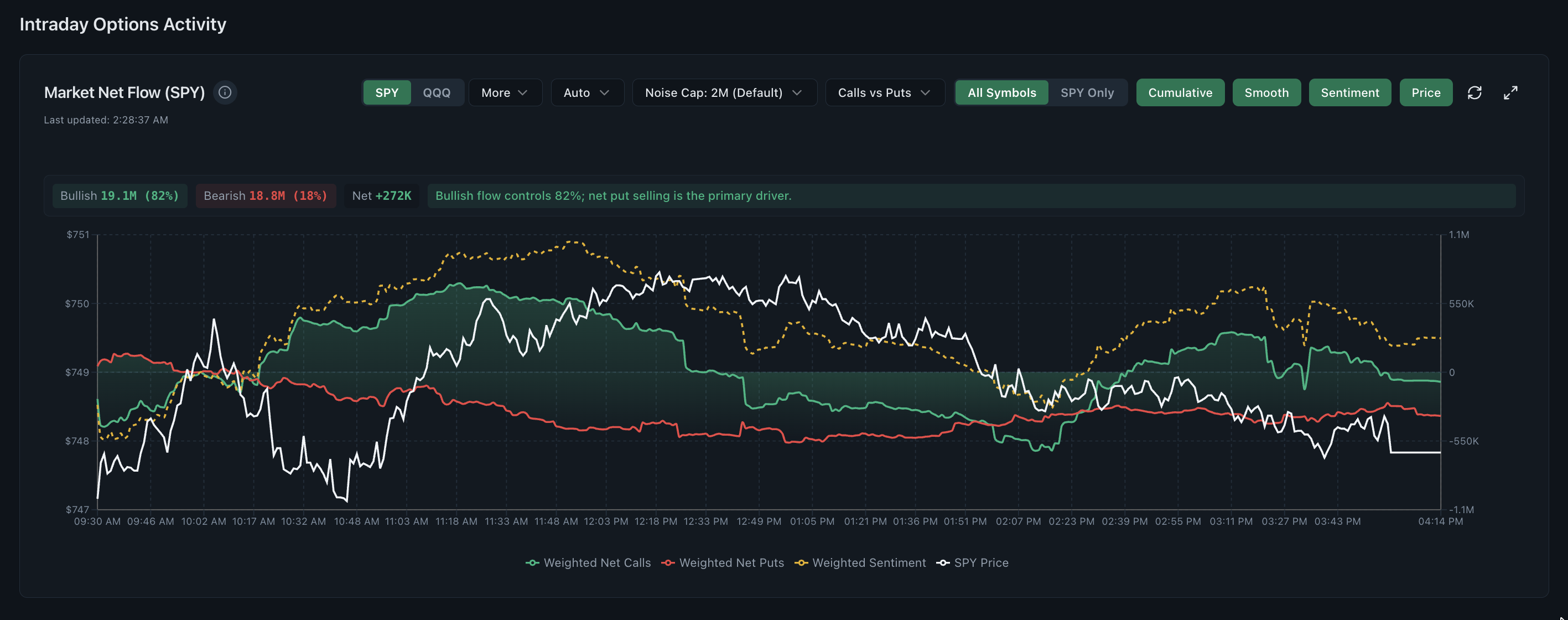
Realtime Options does not screen covered calls. There is no yield ranking, no annualised return column, no IV rank or percentile screening, no assignment-probability estimate, no payoff-diagram builder and no broker connection, so the platform does not know which shares you hold. Stating that is more useful than stretching a flow product to fit a premium-yield question.
Read the supporting context
The tools that do this job well are easy to name. Choose one on data freshness and filter depth rather than on marketing language, and check what the free tier actually includes before entering an email address.
| What you need | Where to do it |
|---|---|
| Yield-ranked covered call candidates | Barchart's covered call screener, free tier on delayed data |
| Deeper filters and backtest comparisons | Market Chameleon's covered call screener, paid |
| Screening inside the account holding the shares | Your broker: Fidelity, Schwab thinkorswim or Interactive Brokers |
| Wheel-focused ranking and scoring | Independents such as optionDash, Born To Sell, VolRadar or Option Samurai |
| Where a strike is crowded and how flow behaved there | Realtime Options |
The one thing this platform adds: where a strike is crowded
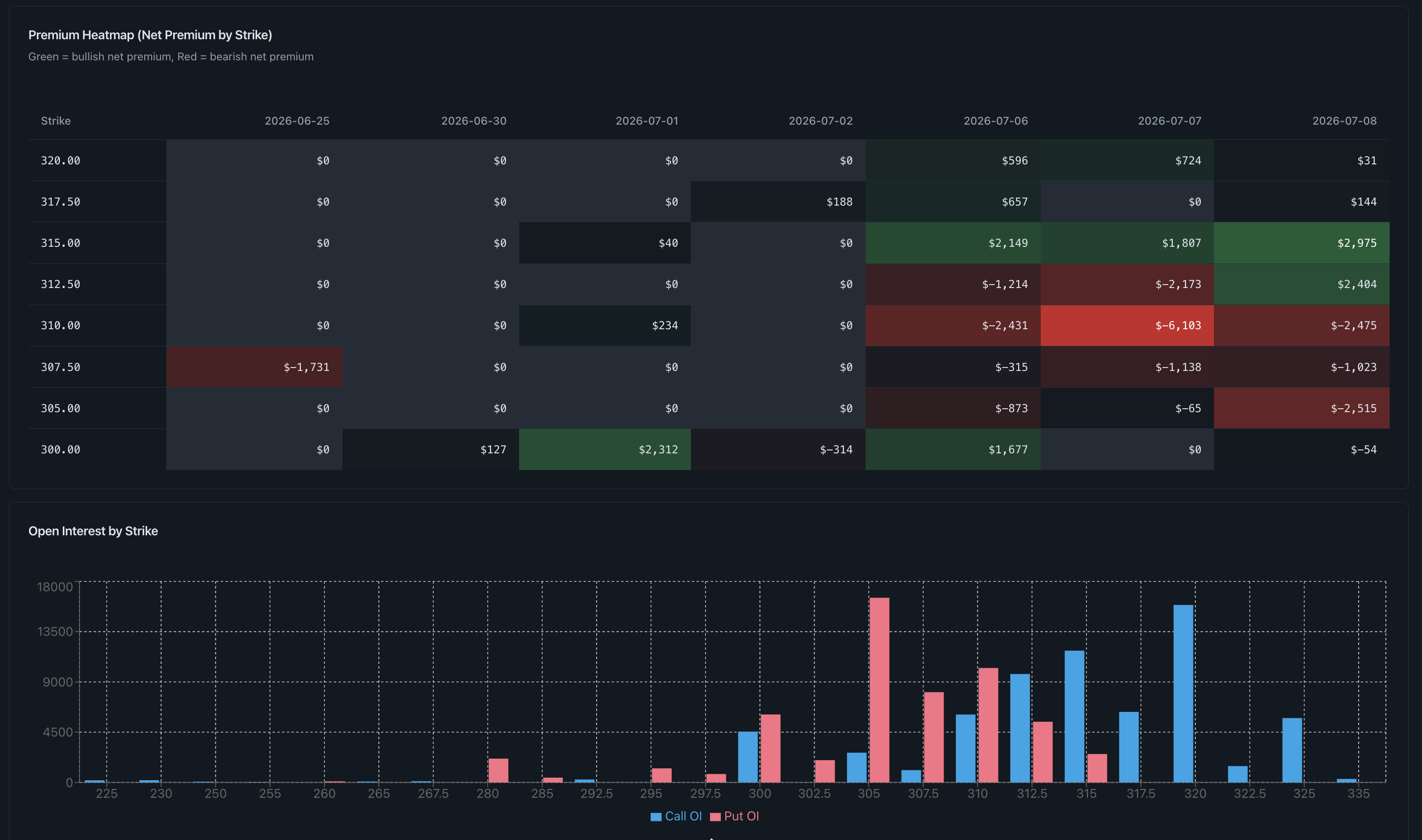
Once a screener has produced a shortlist, the question a yield column cannot answer is whether the strike you intend to sell is a busy part of the chain or an empty one. Realtime Options shows open interest and premium concentration by strike and expiry, so you can see whether your candidate strike carries the largest outstanding position on the chain, whether today's premium is clustering there, and whether that has been true for weeks or only since this morning.
Read the supporting context
This is context, not a verdict. Heavy open interest at a strike tells you the contract is widely held and usually easier to trade; it does not tell you which side those holders are on, whether the positions are opening or closing, or whether the strike will act as any kind of level. Open interest arrives once daily after the close through OCC, so it describes yesterday's positioning, and gamma exposure views are model outputs rather than guaranteed levels.
Flow analytics is also the honest correction to a common assumption. A crowded call strike is not evidence of bullish conviction: covered-call writing, hedging and market-maker inventory all print as call volume, and side and intent are estimates rather than observed facts.
- Open interest by strike: whether your candidate contract is widely held or thin.
- Premium concentration by strike and expiry: where money went today, not where yield is highest.
- Historical flow: whether the strike is persistently active or a one-session artefact.
- Keep in mind: crowding describes participation, not direction, intent or outcome.
Common questions
What is a covered call screener?
A covered call screener filters a snapshot of the option chain for calls you could sell against shares you own, and computes derived figures such as premium, static return, if-called return, an annualised equivalent and the downside buffer. It produces a shortlist to research, not a recommendation to trade.
What is a good annualised return on a covered call?
There is no single number, and treating a higher figure as better inverts the risk. Premium is priced from implied volatility, so the highest annualised returns cluster in the names where the market expects the widest price range. Use annualised return to compare candidates of similar risk, not to rank the market.
Does Realtime Options have a covered call screener?
No. Realtime Options does not screen covered calls by premium yield, does not compute annualised return and has no IV rank or percentile screening. It analyses executed US options flow, open interest and strike-level context on 10 core dashboards and 8 specialist research views.
Which covered call screeners are free?
Barchart offers a covered call screener with a free tier on delayed data. Broker screeners at Fidelity, Schwab thinkorswim and Interactive Brokers are free with a funded account. Market Chameleon, Option Samurai and several independents are trial-then-paid. Check the delay and the filter depth of any free tier before relying on it.
Does delta tell me the probability of assignment?
No. Delta is a sensitivity measure that loosely approximates the chance of finishing in the money at expiration. It says nothing about early exercise, which can happen on any business day and is allocated randomly by OCC to clearing members before your broker allocates it to accounts.
Can I be assigned before expiration?
Yes. American-style equity options can be exercised any business day, and assignment risk rises as time premium decays and as the option moves deeper in the money. For short calls the risk is elevated just before the ex-dividend date, because a call holder who wants the dividend has an incentive to exercise early.
Should I avoid selling covered calls over earnings?
That is a decision only you can make, and this is education rather than advice. The relevant facts are that an expiry containing earnings carries a larger premium precisely because of the event, that the extra premium is compensation for a wider range of outcomes, and that a screener sorted by yield will surface those expiries first without saying why.