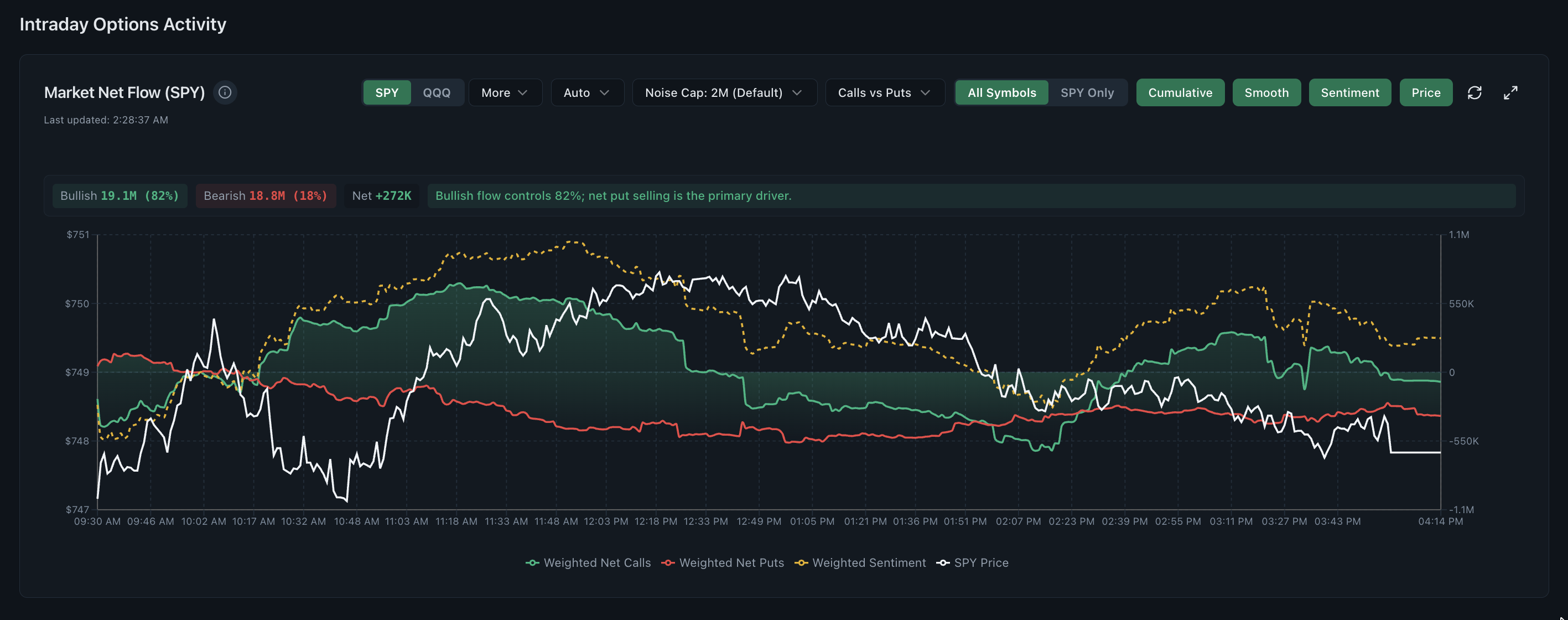


Calls and puts
A call gives its buyer the right to buy 100 shares at the strike before expiry; a put gives its buyer the right to sell. Every contract has a seller carrying the opposite obligation, which is the fact most call-versus-put explanations skip and the reason directional readings of raw call and put volume so often fail.
- Pages on this topic
- 11
- Where to start
- Start with the call-versus-put comparison, then the individual call and put guides, then the flow-classification guide that explains how these contracts appear in market data.
- Applies to
- US-listed stock and ETF options
- Purpose
- Independent research and education
Why call volume is not bullish and put volume is not bearish
Every option trade has two sides. Heavy call volume can be buyers opening long calls, or it can be covered-call writing against stock, or a closing trade unwinding an old position. Heavy put volume is frequently protective hedging by holders who are long the underlying and have no bearish view at all.
Read the supporting context
This is why the pages below separate the contract mechanics from the flow interpretation. Understanding the payoff is arithmetic; inferring intent from the tape is estimation, and it stays estimation no matter how large the print.
Concept guides
- Call options vs put optionsA call option gives its buyer the right, not the obligation, to buy 100 shares of the underlying at the strike price on or before expiration.
- Call options explainedA call option gives its buyer the right, not the obligation, to buy 100 shares of the underlying at a fixed strike price on or before expiration, in exchange for a premium paid to the seller.
- Put options explainedA put option gives its buyer the right, not the obligation, to sell 100 shares of the underlying at a fixed strike price on or before expiration; the seller takes the matching obligation to buy those shares if assigned.
- Buy calls or puts: a decision framework, not a recommendationNo page, dataset or dashboard can tell you whether to buy calls or puts, because the answer depends on a view about direction, timing and volatility that only you hold, and on a financial situation that a website cannot see.
- Options trading strategies, organised by what they expressAn options trading strategy is a defined combination of long and short calls and puts chosen to express one specific view, with a maximum loss and a maximum gain that can be calculated before entry.
- Best options strategies: matching a structure to a viewThere is no best options strategy.
- Covered call screener: what it screens and how to read itA covered call screener ranks call options you could sell against shares you already own, usually by premium received, return if the stock is unchanged, return if the shares are called away, an annualised equivalent of those returns, and the downside buffer the premium provides.
- Cash-secured put screener: collateral, yield and assignmentA cash-secured put screener ranks put options you could sell while holding the full strike value in cash, usually by premium, return on that collateral, an annualised equivalent and the effective purchase price if you are assigned.
- Call versus put options flowCall flow records activity in call options and put flow records activity in put options; the contract type is not the trade direction.
- How to read an option chainAn option chain lists available call and put contracts for an underlying across strikes and expiration dates.
Applied workflows and method posts
Common questions
Should I buy calls or puts?
That is not a question this site answers. Realtime Options is analytics software, not an adviser, and the honest answer depends on a view, an account size and a risk tolerance that only you have. The guides explain what has to be true for each position to profit and what the data can and cannot tell you.
Does a high put/call ratio mean the market is bearish?
Not on its own. The ratio counts contracts without knowing which side initiated them or whether the puts are hedges against long stock. It is a useful relative measure across time on the same underlying, and a poor absolute sentiment reading.