

Call options vs put options
A call option gives its buyer the right, not the obligation, to buy 100 shares of the underlying at the strike price on or before expiration. A put option gives its buyer the right to sell 100 shares at the strike. The seller of each contract takes the matching obligation in exchange for the premium received. Contract type alone does not establish direction: whether the contract was bought or sold, and whether the trade opened or closed exposure, decides what the position actually expresses.
- Call buyer
- Right to buy 100 shares at the strike
- Put buyer
- Right to sell 100 shares at the strike
- Positions
- Four, not two: long and short call, long and short put
- Buyer's maximum loss
- The premium paid, on either contract type
- Uncovered call writer
- Theoretically unlimited loss
- Data caveat
- Volume records the contract, not the initiator's intent
What a call option and a put option are
A call option is a standardized contract giving its buyer the right, not the obligation, to buy a fixed quantity of the underlying, normally 100 shares for a US listed equity or ETF option, at the strike price on or before the expiration date. A put option gives its buyer the right to sell that same quantity at the strike.
Read the supporting context
The buyer pays a premium to the seller at the outset, and that premium is the only cash the buyer commits. Every payoff, breakeven and risk statement further down this page follows from those two sentences.
- Underlying: the stock or ETF the contract references.
- Strike price: the fixed price at which shares would change hands on exercise.
- Expiration: the last date on which the right can be exercised.
- Multiplier: 100 shares per standard US contract, so a $5.00 quoted premium costs $500.
- Premium: paid by the buyer, received by the seller, and not refundable to either side.
Rights and obligations on both sides of the contract
Every option has a buyer and a seller, so there are four positions rather than two directions. Most comparison articles describe only the buyer's side. The writer carries the mirror obligation and a materially different risk profile, and the writer's trade is recorded in exactly the same volume figure as the buyer's.
Read the supporting context
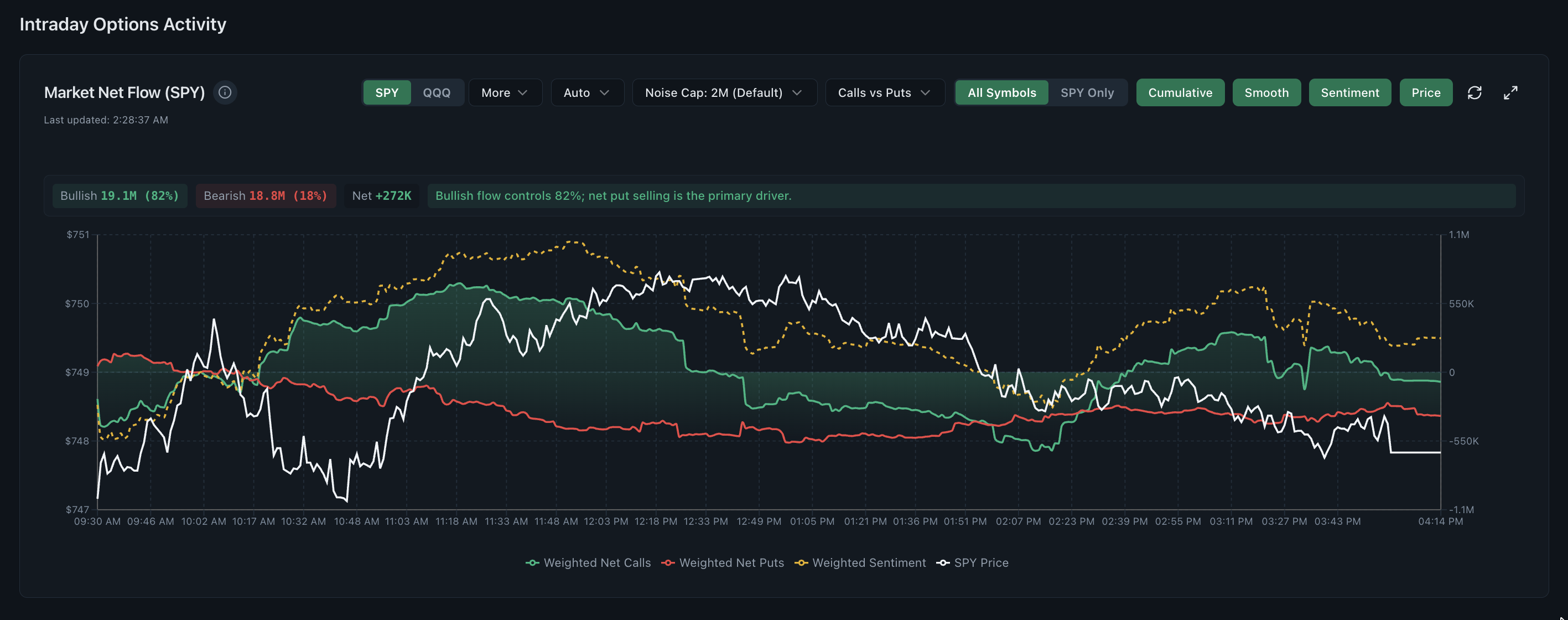
That is why reported call and put volume cannot be read as sentiment on its own. A session of heavy put volume can be dominated by put sellers, whose position is closer to bullish than bearish.
| Position | Right or obligation |
|---|---|
| Long call (bought) | Right to buy 100 shares at the strike; no obligation to do so |
| Short call (written) | Obligation to deliver 100 shares at the strike if assigned |
| Long put (bought) | Right to sell 100 shares at the strike; no obligation to do so |
| Short put (written) | Obligation to buy 100 shares at the strike if assigned |
Payoff and maximum loss for all four positions
A long call and a long put have identical loss structure: the most either buyer can lose is the premium paid, and losing all of it is a common outcome rather than an edge case. The asymmetry sits on the short side, where a writer's loss can far exceed the premium received.
Read the supporting context
Uncovered call writing carries theoretically unlimited risk because there is no ceiling on the underlying price. Options involve significant risk and are not suitable for every investor; the OCC's Characteristics and Risks of Standardized Options is the disclosure document to read before taking any of these positions.
| Position | Maximum gain and maximum loss |
|---|---|
| Long call | Gain unbounded in theory; loss capped at the premium paid |
| Short call, uncovered | Gain capped at the premium received; loss theoretically unlimited |
| Long put | Gain capped at strike minus premium; loss capped at the premium paid |
| Short put, cash-secured | Gain capped at the premium received; loss up to strike minus premium |
Breakeven arithmetic, worked with round numbers
Breakeven at expiration for a long call is the strike plus the premium paid; for a long put it is the strike minus the premium paid. Both figures ignore commissions and fees, and both must be reached before the contract expires rather than eventually.
Read the supporting context
The worked example below uses one stock price, one strike and one premium so the call and the put can be compared line for line.
- The stock trades at $100. A $100-strike call is quoted at $5.00, so one contract costs $500.
- Call breakeven at expiration is $105. At $103 the call is worth $3.00 and the buyer is down $200; at $110 it is worth $10.00 and the buyer is up $500.
- The same expiration's $100-strike put is also quoted at $5.00, so it also costs $500.
- Put breakeven at expiration is $95. At $97 the put is worth $3.00 and the buyer is down $200; at $90 it is worth $10.00 and the buyer is up $500.
- If the stock closes at exactly $100 on the expiration date, both contracts expire worthless and both buyers lose the full $500.
How the Greeks differ in sign between calls and puts
Delta is positive for a long call and negative for a long put. Gamma and vega are positive for both long positions, and theta is normally negative for both, which is why time passing hurts a buyer regardless of which contract type was bought. Each sign flips for the corresponding short position.
Read the supporting context
The Greeks are outputs of an option pricing model, not observed market facts. They measure sensitivity under model assumptions, they change continuously with price, volatility and time, and delta in particular is not a probability even though it is often described as one.
| Greek | Long call versus long put |
|---|---|
| Delta | Positive for a long call, negative for a long put |
| Gamma | Positive for both; largest near the money and close to expiration |
| Theta | Normally negative for both; decay works against the buyer either way |
| Vega | Positive for both; a fall in implied volatility hurts both buyers |
| Rho | Positive for a long call, negative for a long put |
Why call volume is not a synonym for bullish
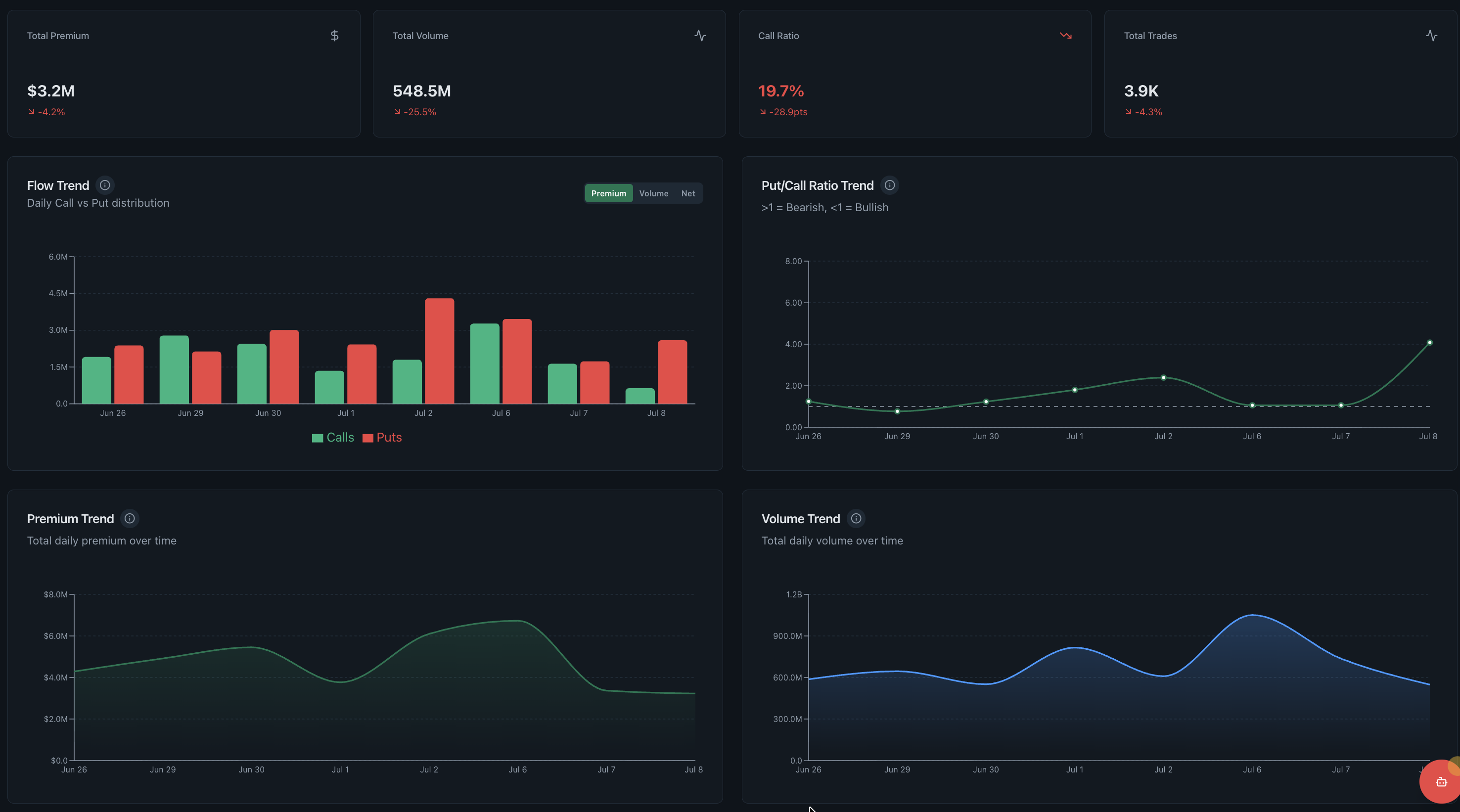
Aggregate call volume routinely exceeds aggregate put volume in US equity options, in rising and falling markets alike. Cboe publishes daily total, equity and index put/call ratios, and the equity ratio has generally printed below 1.0 in recent years, meaning fewer put contracts trade than call contracts on an ordinary day. Read the current figure from Cboe's daily statistics rather than a number quoted in an article, because the series moves.
Read the supporting context
If calls out-trade puts as the resting state of the market, then a session with more call volume than put volume describes normality, not optimism. What can carry information is a deviation from a ticker's own recent range, and even that is diluted by transactions with no directional content whatsoever.
- A bought call can hedge a short stock or short futures position and express no upside view at all.
- A bought call can be a roll: closing an expiring series and opening a later one, which prints as new volume twice.
- Covered-call writing adds to call volume while expressing a neutral to mildly bullish income view.
- Cash-secured put selling adds to put volume while expressing willingness to own the shares.
- Market-maker inventory management adds volume on both sides with no directional opinion attached.
What this guide does not cover
This page covers the contracts themselves. It does not tell you which one to buy, and it does not classify individual executed prints. Realtime Options is research and education software for US-listed stock and ETF options: there is no order entry or broker connectivity, no strategy builder or payoff-diagram tool, no raw or unrestricted chain-data API, no dark-pool equity data and no buy-or-sell signal output. Pro API access is limited to read-only aggregated Buy/Sell Pressure, Algo Flow, 0DTE Flow & Gamma Exposure, and Greeks by Strike analytics.
Read the supporting context
The separate call versus put options flow guide explains how a print is labelled buyer-aggressive or seller-aggressive from its position relative to the bid and ask. It also explains why that label remains an estimate. Use this page for contract mechanics and that guide for reading the tape.
- Contract mechanics, payoffs, breakeven and Greek signs: this page.
- How an executed print is classified, and why the side is an estimate: the call versus put options flow guide.
- Whether volume represents new positioning: the volume versus open interest guide, since open interest updates once daily after the close.
- What to do with a directional view: nothing here is advice, and no dataset removes the risk of losing the entire premium.
Common questions
What is the difference between a call option and a put option?
A call option gives its buyer the right to buy 100 shares at the strike price before expiration. A put option gives its buyer the right to sell 100 shares at the strike. The seller of either contract takes the matching obligation and keeps the premium.
Is it better to buy calls or puts?
Neither is better in general, because they answer different questions. A call expresses an upside view or hedges a short position; a put expresses a downside view or protects shares already owned. The right question is what you are trying to express and by when, not which contract type wins.
Why are puts often more expensive than calls?
Equity index options have carried a persistent negative volatility skew since the 1987 crash: downside strikes trade at higher implied volatility than equidistant upside strikes, driven largely by ongoing institutional hedging demand. Because the skew is a permanent structural feature, its existence is not a current bearish signal; only a change in skew relative to its own history carries information.
Are calls or puts safer for a beginner?
For a buyer, the maximum loss is the premium paid, whether the contract is a call or a put. That premium can be lost in full. Options are not suitable for all investors, regardless of which side is chosen.
If calls are bullish and puts are bearish, why does the market trade more calls than puts?
Because the textbook labels describe contractual rights, not aggregate positioning. Call volume includes hedges on short stock, rolls, covered-call writing and market-maker inventory; put volume includes protective hedging and cash-secured put selling. Persistent call-heavy volume is the market's normal state rather than a standing bullish reading.
Can I lose more than the premium I paid?
Not as a buyer. A long call or long put loses at most the premium paid. As a seller you can lose far more: an uncovered call writer faces theoretically unlimited loss, and a cash-secured put writer can lose up to the strike price minus the premium received per contract.
What happens to a call or a put at expiration?
An option that finishes out of the money expires worthless and the buyer loses the premium. An option that finishes in the money is generally subject to exercise and assignment procedures, which for standard US equity options means 100 shares change hands at the strike unless the position is closed beforehand. Check the OCC and your broker's specific exercise thresholds and cut-off times.