

Premium Edge
Premium Edge compares the move implied by an expiry's option pricing with the underlying's observed movement across comparable historical windows. It helps frame whether the market is charging more or less than the chosen historical sample delivered; it does not predict direction, volatility or profitability.
- Research question
- How does priced movement compare with the selected history?
- Best used for
- Comparing priced movement with a transparent historical sample
- Data timing
- Near-real-time Pro; 15-minute delayed trial
- Product access
- Included in the single $29/month plan
What the premium edge shows
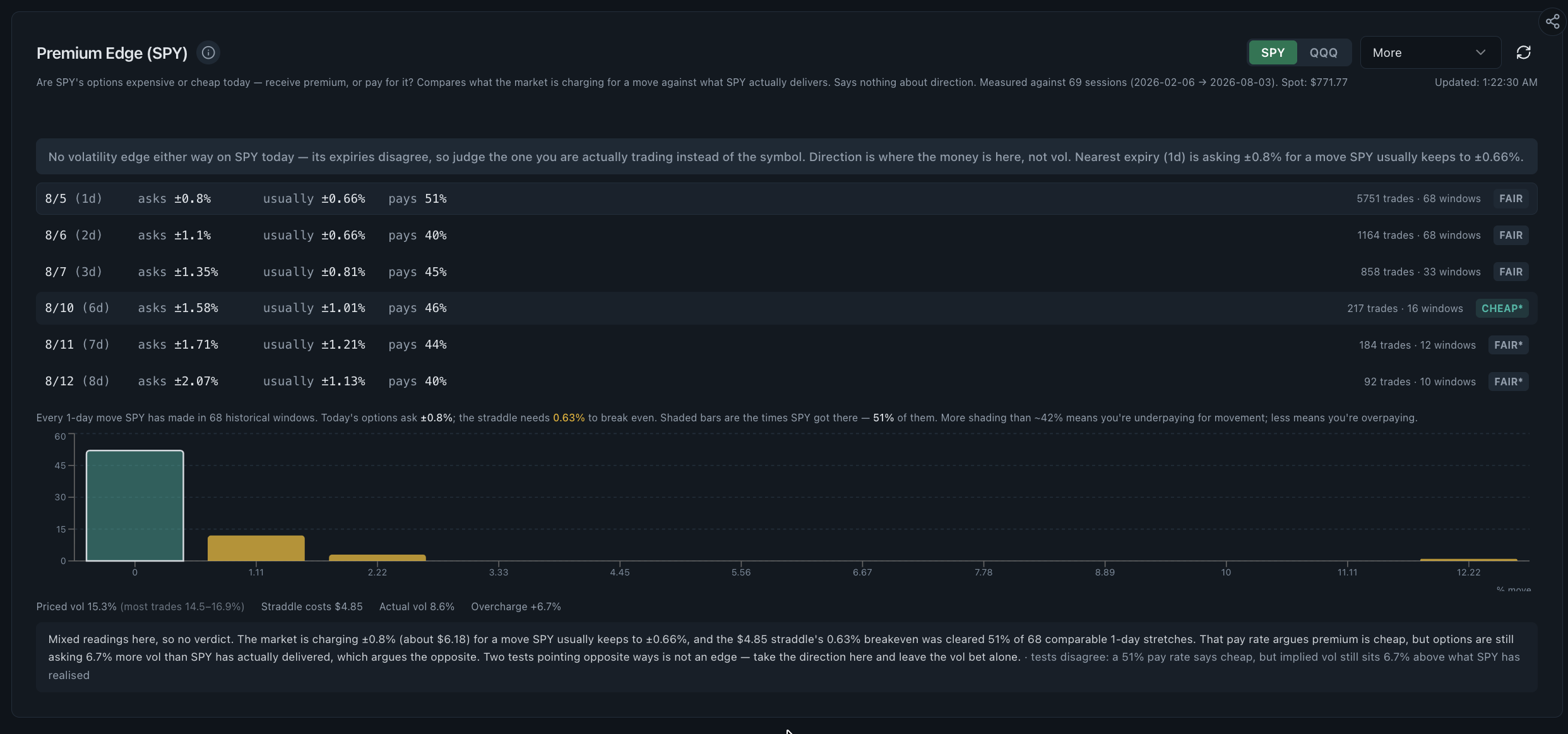
The tool turns an abstract volatility comparison into an auditable table. It shows what move the options market is pricing, what the underlying delivered in the selected historical sample and how often the chosen breakeven was cleared.
Read the supporting context
The screenshot above is from the working product, not a mockup. The visible controls and fields are the same ones trial and Pro users research with; only the market-data timing changes between the two access levels.
- Expiry and days-to-expiration rows with the market's priced percentage move.
- Observed movement and historical pay rate for comparable windows.
- Trade and window counts that expose sample depth.
- Straddle cost, breakeven and realised-movement comparison for the selected expiry.
How to read this dashboard
Read the dashboard as one step in a sequence. Record what it directly shows first, then use the next view to test the interpretation rather than turning a color or ranking into a conclusion.
- Select the ticker and expiry before comparing labels across rows.
- Check the number and regime of historical windows behind the observed move.
- Separate the priced magnitude of movement from any directional view.
- Review events, volatility regime, liquidity and transaction costs outside the chart.
- Treat disagreement between expiries as information rather than forcing one symbol-wide verdict.
What this view cannot establish
The result changes with the lookback, expiry, event calendar and volatility regime. A historical pay rate does not include every execution cost or portfolio outcome and cannot establish that premium is mispriced.
Read the supporting context
Realtime Options organises observed and derived market data for independent research. Read each view with its stated method, assumptions and surrounding context.
Common questions
What does Premium Edge compare?
It compares the move priced by an option expiry with underlying movement observed in comparable historical windows, along with sample and breakeven context.
Does a cheap-premium label mean I should buy options?
No. The label is relative to the selected model and historical sample. It does not account for every cost, risk, event or individual objective.
Does Premium Edge predict market direction?
No. It compares the magnitude of priced and observed movement. Direction must be researched separately, and neither measure guarantees a future result.