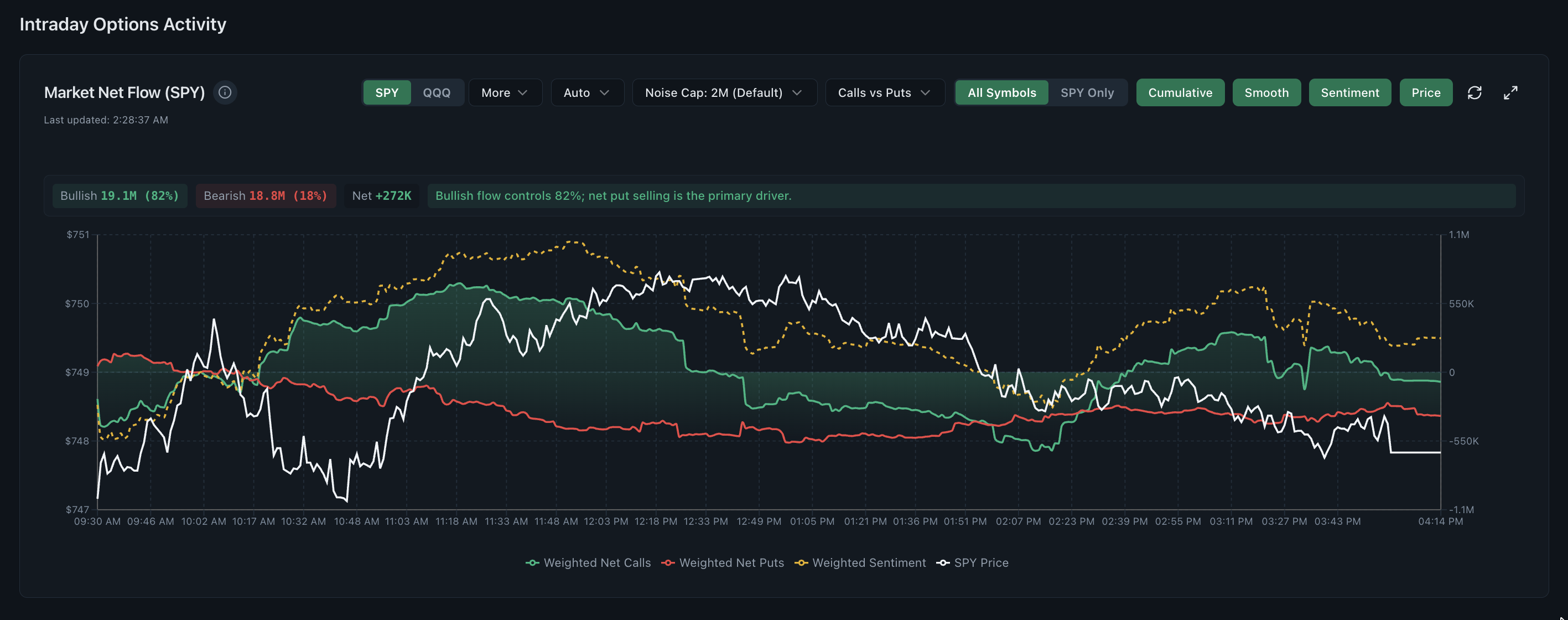


Best options flow data tools for trading decisions
The best options flow data tool is the one that matches your research job and exposes enough context to challenge its own alerts. For trading decisions, compare tape detail, bid-ask context, volume, open interest, strike and expiry, price, GEX, history, catalysts and data timing. No platform can identify trader intent or turn a print into a recommendation.

- Short answer
- There is no universal best tool; fit depends on the research job
- Minimum context
- Trade, quote, volume, open interest, strike, expiry and price
- Evaluation method
- Test the same tickers and sessions with a written scorecard
- Boundary
- Flow supports research; it does not make or validate a trade decision
Start with the research job, not the brand
The best options flow data tools for trading decisions are the tools that complete the missing part of your process. A full tape, a curated alert feed, an aggregate positioning dashboard, a strategy builder and a raw API may all use options data, but they solve different jobs.
Read the supporting context
Write the job in one sentence before comparing vendors. If the job is unclear, a long feature list makes every platform look necessary and encourages paying twice for quotes, charts or execution tools already included with a broker.
| Tool category | Research job it is designed to complete |
|---|---|
| Full tape and filters | Inspect individual prints, execution details and unusual activity across the market |
| Curated alerts | Interrupt only when a sweep, block, premium or repeat-activity rule is matched |
| Aggregate dashboards | Compare call and put pressure, strikes, expiries, positioning, price and history |
| Strategy modelling | Translate a market view into payoff, Greeks, breakeven and defined-risk structures |
| API or licensed feed | Build custom screens, research pipelines or programmatic analytics |
| Broker platform | Validate live quotes, define risk and place or manage the order |
Which data fields should an options-flow tool expose?
A useful flow tool preserves the observed trade fields and labels every derived field as an estimate or model. At minimum, the interface should let you move from a highlighted print back to its contract, quote, session activity and underlying price.
| Field | Question it helps answer, and its limit |
|---|---|
| Contract, strike and expiry | Which option actually traded; not whether it was the whole position |
| Timestamp, size and premium | When and how much traded; not who owned the order |
| Bid, midpoint and ask | Where execution occurred relative to the quote; not opening or closing intent |
| Volume and trade count | Whether activity was one block or many prints; not directional conviction |
| Published open interest | How much positioning survived the latest clearing cycle; not an intraday update |
| Underlying price and liquidity | Whether price confirms the first reading and whether the contract is tradable |
| GEX and other Greeks | How modeled sensitivity is distributed; not a guaranteed support, resistance or target |
| History and catalysts | Whether activity repeats and whether public events offer context; not causation |
Which seven options-flow tools fit the main workflows?
Seven commonly compared platforms cover the main product shapes. This is a routing guide based on official product pages reviewed September 9, 2026, not a performance ranking. Features, plans and data entitlements can change, so verify the linked source before subscribing.
| Platform | Strongest publicly described workflow |
|---|---|
| Realtime Options | Chart-led flow, strike, open-interest, GEX, price, history and news context |
| Tradytics | Broad live-flow, scanner, AI, portfolio, mobile and Discord toolkit |
| Unusual Whales | Full options tape, alerts, screeners, GEX, dark pools, mobile access and API products |
| Flowtopia | Real-time flow, WAVE, GEX, rankings, contract tape, history and chain filtering |
| Cheddar Flow | Options-order-flow, sweep, dark-pool, gamma and alert-led research |
| FlowAlgo | Algorithmically curated sweeps, option blocks, equity blocks, dark-pool prints and voice alerts |
| OptionStrat | Live flow connected to strategy building, payoff analysis, optimization and saved-trade review |
How do you compare options-flow tools without guessing?
Run the same ordinary sessions, tickers and questions through each trial. A memorable alert that worked once is not evidence that the tool improves a repeatable process; the useful test is whether it exposes relevant facts, contradictions and missing information with less friction.
- Define one repeated job, such as building a market-wide research queue or checking a single contract in context.
- Use the same two liquid tickers, one index ETF and the same session window in every product.
- Record data timing, timestamp clarity and whether the trial differs from the paid plan.
- Count the extra tabs required for price, open interest, neighboring strikes, history, news and risk modelling.
- Check whether side, sentiment, opening status and exposure are visibly labelled as observed, estimated or modeled.
- Test a quiet session as well as an active one; noisy products can look useful only when the tape is busy.
- Compare the plan that contains the required feature, renewal terms and total cost only after the workflow passes.
How should options flow enter a trading decision?
Options flow should enter a decision as one research input, after the market backdrop and before contract selection, risk and execution. The sequence is designed to make a conflicting observation visible before an isolated print becomes a thesis.
| Decision stage | Evidence to record |
|---|---|
| 1. Market backdrop | Index price, market-wide call and put pressure, volatility regime and scheduled events |
| 2. Research queue | Sector and ticker concentration, breadth, repeat activity and underlying price response |
| 3. Contract context | Strike, expiry, premium, quote location, volume, trade count and neighboring legs |
| 4. Positioning context | Latest cleared open interest, day-over-day change when available and modeled exposure |
| 5. Independent confirmation | Price structure, liquidity, news, earnings, macro events and evidence that contradicts the flow |
| 6. Risk and execution | Maximum loss, position size, exit conditions and broker quotes; these are not supplied by a flow print |
Why can the same flow print support different conclusions?
A public option print shows a completed transaction with a buyer and a seller. It does not reveal whether either side opened or closed, whether the trade was one leg of a spread, whether stock or futures hedged it, or which portfolio objective produced it.
Read the supporting context
Ask-side and bid-side classifications estimate who crossed the spread, which narrows the execution story but does not solve the position story. The next open-interest update can show whether outstanding contracts changed after clearing, yet ownership and intent still remain unknown.
- A call purchase can be directional, a hedge, the long leg of a spread or a short-call close.
- A put purchase can express a bearish view, insure a long portfolio or form one leg of a volatility trade.
- A large midpoint print may be negotiated or multi-leg activity rather than an aggressive directional order.
- A sweep shows urgency across exchanges, but urgency does not prove information advantage or future price direction.
Do alerts, dashboards and APIs solve the same problem?
Alerts optimize interruption, dashboards optimize comparison, and APIs optimize control. Choose the delivery format that supports the behavior you want, because the same dataset can create a very different research habit in each interface.
| Choose this format | When it fits |
|---|---|
| Alert feed | Rules are stable, immediate awareness matters and you can pause before interpreting the event |
| Analytical dashboard | You need market-to-contract context, visual comparisons and completed-session review |
| API or data feed | You can maintain code, data rights, storage, filtering and your own validation layer |
| Strategy builder | The missing job is payoff, probability, Greeks or multi-leg structure rather than flow discovery |
Which timing and access questions matter before subscribing?
Real time, near real time and delayed are different service levels. Ask what timestamp the screen displays, what processing occurs before publication, which features are delayed during a trial and whether programmatic access provides raw data or only aggregated analytics.
- Is the product a direct exchange-entitled feed, a licensed aggregator, a dashboard or a broker-bundled screen?
- What delay applies to prints, quotes, alerts, history and free or trial access?
- Is open interest the latest cleared daily figure, and is its date visible beside intraday activity?
- Does an API expose raw records, aggregated outputs or only a limited set of endpoints?
- Do licensing terms permit the intended personal, business, publication or redistribution use?
- Can the research record be exported or revisited after the session without losing filters and timestamps?
Where does Realtime Options fit, and where does it not?
Realtime Options fits researchers who want near-real-time flow organized with strike and expiry, open interest, GEX, price, historical context and market news in connected browser dashboards. Its three-day no-card trial uses data delayed 20 minutes (15 minutes for Premium Heat Grid) so the workflow can be evaluated before paying.
Read the supporting context
It is not a broker, direct exchange feed, dark-pool product, strategy builder, broad raw-data API, mobile application or buy-and-sell signal service. A competing platform is the better choice when one of those jobs is required. Pro programmatic access is limited to authenticated, read-only aggregated Buy/Sell Pressure, Algo Flow, 0DTE Flow & Gamma Exposure, and Greeks by Strike analytics.
Use a decision note that prevents hindsight
The final output of a flow review should be a dated evidence note, not a confident label. A consistent note makes it possible to compare the original reasoning with what happened later without silently rewriting the thesis.
- Observed: the contract, timestamp, size, price, quote location, volume, trade count and underlying response.
- Estimated or modeled: aggressor side, sentiment, opening status, gamma exposure and possible hedging pressure.
- Supporting evidence: broader flow, related strikes, history, liquidity, price structure and public catalysts.
- Contradictory evidence: every fact that weakens the preferred explanation.
- Unknowns: ownership, other legs, portfolio context and intent.
- Risk plan: maximum acceptable loss, position size and invalidation conditions defined independently of the flow tool.
- Next update: the data that can change the note, including cleared open interest, later trades or new public information.
Common questions
What is the best options flow data tool for trading decisions?
There is no universal best tool. Choose a full tape for print-level inspection, alerts for monitoring stable rules, an aggregate dashboard for market-to-contract context, an API for custom research or a strategy builder for payoff and risk modelling. The best fit completes the missing job and makes uncertainty visible.
Can options flow data make a trading decision for me?
No. Options flow can show executed activity and help organize a research queue, but it cannot establish beneficial ownership, complete strategy, intent, suitability or future price. Risk, position size and execution remain separate decisions.
Which fields matter most in an options-flow tool?
Start with contract, strike, expiry, timestamp, size, premium and bid-ask context. Then add volume, trade count, the latest dated open interest, underlying price, liquidity, related strikes, historical activity and public catalysts.
Do I need real-time options flow for every workflow?
No. Intraday monitoring needs current data, while education, product evaluation and completed-session review can use delayed or historical data. Confirm the actual latency and timestamp rather than relying on the word real-time.
Are options-flow alerts better than dashboards?
Alerts are better for immediate monitoring of known conditions; dashboards are better for comparison, context and review. A combined workflow can use an alert to open the relevant dashboard, but neither format converts the event into a recommendation.
How should I test an options-flow platform before subscribing?
Use the same liquid tickers and session window in every trial, include both active and quiet periods, compare timestamp clarity and required context, record missing features and only then compare the total price and renewal terms of the plan that passes.
Sources and further reading
- Options Industry Council: Understanding Bid and Ask Prices for Options
- Options Industry Council: Open Interest, Why It Matters
- OCC: Characteristics and Risks of Standardized Options
- Tradytics: Product, features and pricing
- Unusual Whales: Dashboard and tools plans
- Flowtopia: Options-flow features
- Cheddar Flow: Options order-flow platform
- FlowAlgo: Realtime option-flow product
- OptionStrat: Options flow and strategy tools