

Options flow alerts versus analytical dashboards
Options flow alerts surface a predefined event immediately; analytical dashboards organize the broader market, ticker, strike and contract context around many events. Alerts are useful for interruption and monitoring, while dashboards are better for comparison and verification. The strongest workflow may use both, but neither turns a print into a recommendation.

- Alert strength
- Immediate notification for a predefined event
- Dashboard strength
- Comparison, context and repeatable review
- Shared risk
- Classification can create false directional certainty
- Realtime Options
- In-app matches plus optional low-frequency email
What options-flow alerts are good at
An alert watches continuously and interrupts when a rule is met: premium above a threshold, volume greater than open interest, repeat contracts, a sweep label or activity near the ask. It reduces the need to stare at a tape.
Read the supporting context
The tradeoff is selection pressure. Every threshold favors some structures and excludes others, while the notification itself creates urgency before the context has been reviewed.
What options-flow dashboards are good at
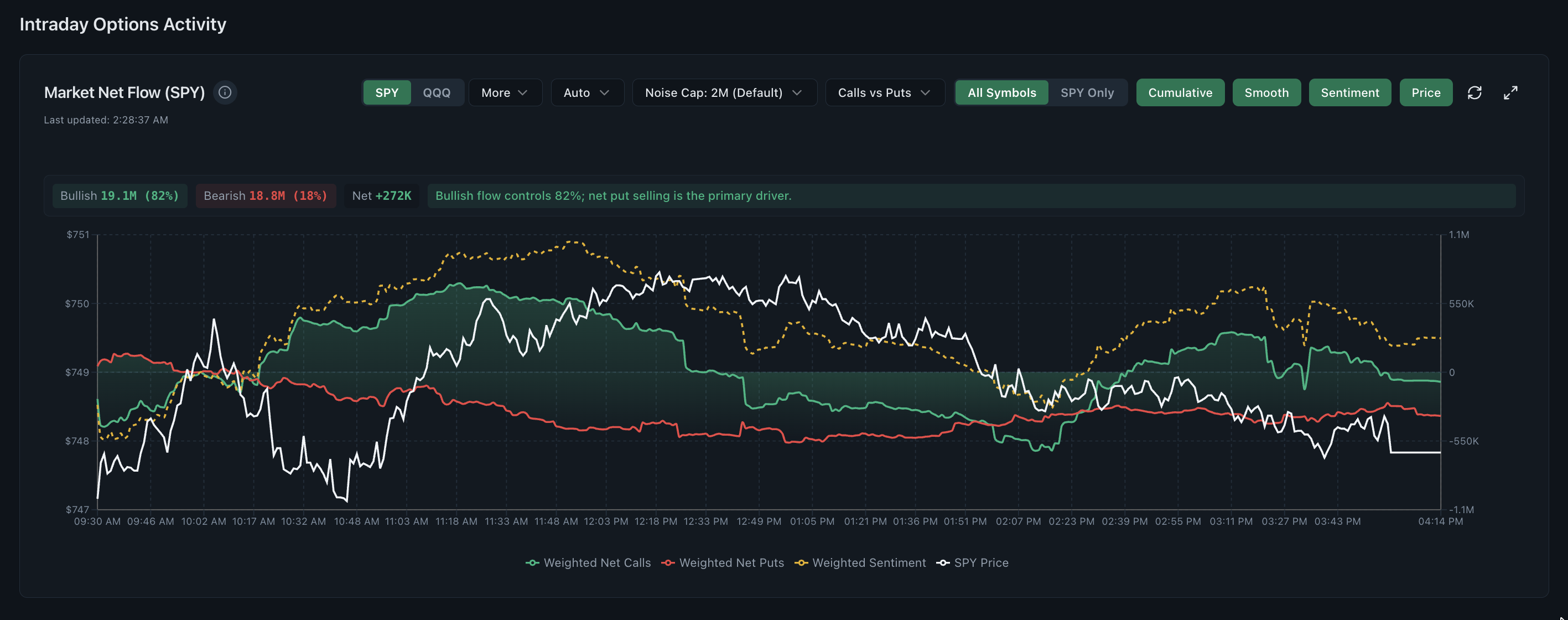
A dashboard keeps many observations on one screen: net call and put pressure, price, premium by strike and expiry, GEX, open interest, historical flow and relevant news. It is slower than an interruptive alert but better at exposing contradictions.
Choose by the behavior you want to encourage
The interface shapes the habit. An alert-led workflow rewards reaction speed; a dashboard-led workflow rewards comparison and note-taking. Neither is inherently superior.
| Choose alerts when | Choose dashboards when |
|---|---|
| A narrow event must be monitored continuously | You need market and ticker context before contract detail |
| Your filters are stable and well understood | You are still testing which variables matter |
| You can pause before acting on an interruption | You want to review completed sessions systematically |
| Missing non-alerted activity is acceptable | Contradictory flow and price should remain visible |
Where Realtime Options fits
Realtime Options remains dashboard-led, but Pro users can save up to ten server-side flow alerts for any symbol or a specific ticker. Qualified realtime prints that match appear in the notification bell; optional email is restricted to hourly, four-hour or daily cooldowns with a separate daily cap.
Read the supporting context
The public offer is not a signal or trade-call service. Each alert records that user-defined observed-data conditions matched so the print can be reviewed in the connected dashboard workflow.
Common questions
Are options-flow alerts trading signals?
No. An alert states that a predefined event occurred. It does not establish beneficial ownership, full strategy, future price direction or suitability for your account.
Is an options-flow dashboard slower than an alert feed?
A dashboard usually requires more active review, but it preserves the context needed to evaluate whether an event is isolated, repeated, confirmed or contradicted.
Does Realtime Options send buy and sell alerts?
No. Realtime Options provides analytics and configurable notifications, not buy-or-sell calls, copy trades or recommendation alerts.
Can a saved flow alert be delivered by email?
Yes. Pro users can optionally enable email for a saved rule. Email is intentionally lower frequency than in-app delivery and is limited to hourly, four-hour or daily cooldowns plus a per-rule daily cap.