

Options scanner: the four types and which one you need
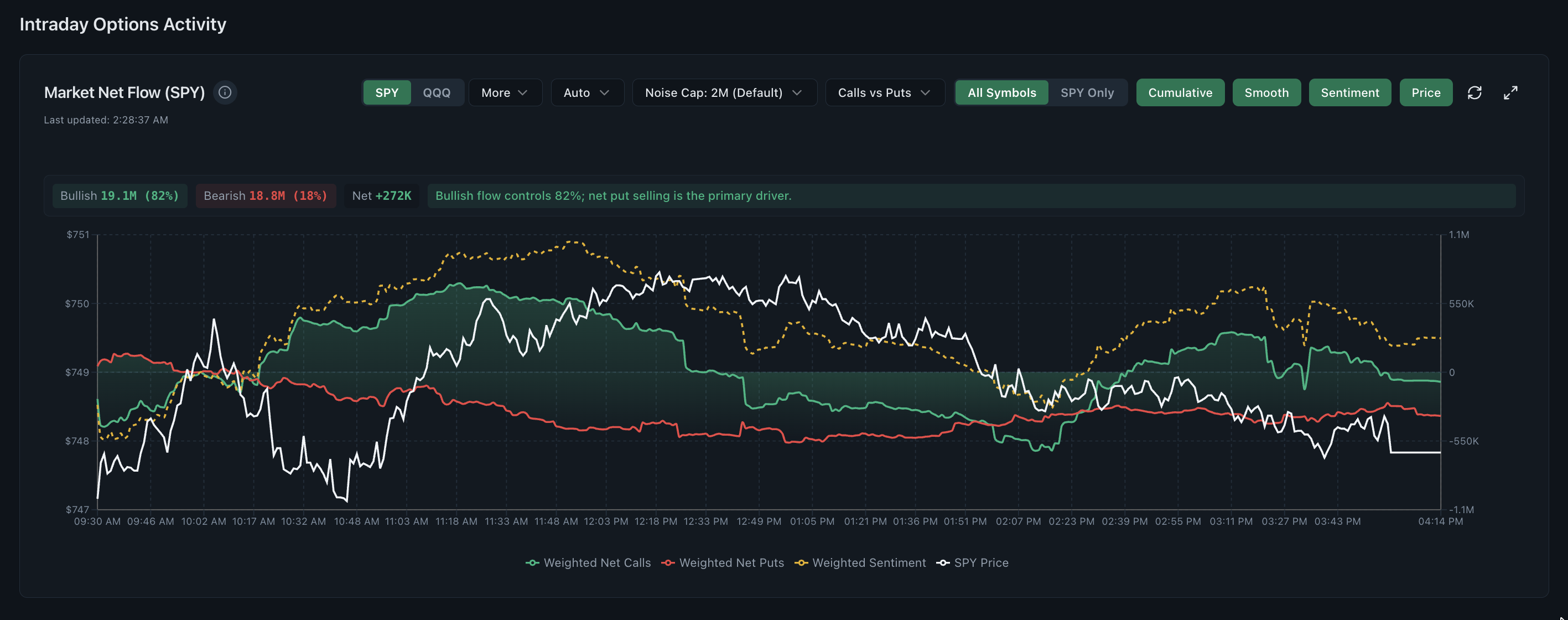
An options scanner is software that watches the US options market and surfaces contracts or tickers that meet a condition, so activity worth reviewing appears without reading the chain by hand. Four distinct products share the name: flow scanners that read executed trades, chain scanners that filter contract attributes, volume and open-interest change scanners, and volatility scanners. Realtime Options runs the first and third kinds. It does not filter a static option chain by delta, implied volatility rank or spread width.
- Category
- Four different products share the name
- Realtime Options scans
- Executed flow plus volume and premium change
- Coverage
- US-listed stock and ETF options
- Does not scan
- Chain parameters, IV rank, spread width or yield
- Data timing
- Near-real-time on Pro; 15-minute delayed during the trial
- Price
- $29/month after a 3-day no-card trial
What an options scanner does, and how it differs from a screener
An options scanner monitors activity continuously and raises results when a preset condition occurs. An options screener applies filters you choose to a snapshot and returns a list. The distinction is rarely drawn in practice, but it matters: a scanner is organised around events as they print, while a screener is organised around contract characteristics that already exist in the chain.
Read the supporting context
Almost every vendor uses the two words interchangeably, which is why searches for options scanner, option scanner and stock option scanner all return the same mixed set of products. Before comparing tools, decide whether you are looking for something that happens or something that is true.
- Event-shaped question: which strikes just traded unusual size, and how aggressively?
- Attribute-shaped question: which contracts sit at 30 delta, 45 days out, with a tight spread?
- Change-shaped question: which contracts traded far above their own recent average volume?
- Pricing-shaped question: which names carry implied volatility high relative to their own history?
The four kinds of options scanner
Each of the four answers a different question, and none substitutes for the others. Reading the table by the question rather than the label is the fastest way to work out which product you are actually shopping for.
| Scanner type | The question it answers |
|---|---|
| Flow or order-flow scanner | Which executed trades were large, repeated or aggressive, and where? |
| Chain or parameter screener | Which contracts match delta, days to expiry, IV, open interest or spread rules? |
| Volume and open-interest change scanner | Which contracts traded far above their normal activity, and did positioning grow? |
| Volatility scanner | Where is implied volatility high or low relative to its own history? |
| Realtime Options | Flow, premium concentration and volume change, with strike, GEX and open-interest context |
Which options scanner fits which research job
The correct scanner follows from the horizon and the question, not from feature count. A premium seller and an intraday index researcher looking at the same screen will disagree about whether it is useful, and both can be right.
| What you are trying to do | Scanner type that fits |
|---|---|
| Study same-day index and ETF activity | Flow scanner with intraday timing, plus gamma context |
| Find candidates for a 30 to 45 day position | Chain screener with delta, DTE and liquidity filters |
| Notice a name behaving unusually today | Volume and open-interest change scanner |
| Judge whether options look expensive in a name | Volatility scanner using IV against its own history |
| Understand where money concentrated after the close | Historical flow review at strike and expiry level |
Which page covers which scanner on this site
Realtime Options keeps one page per job rather than one page per wording variant, so the routes below do not duplicate each other. If a page here is not the right one, the correct one is named.
Read the supporting context
This page is the category explainer. It defines the four scanner types and routes you to the specific one you need. It is not itself a product page.
- Options flow scanner covers executed prints, sweeps, blocks and unusual premium as they occur.
- Options screener covers filtering activity down to a research list and the four-step workflow afterwards.
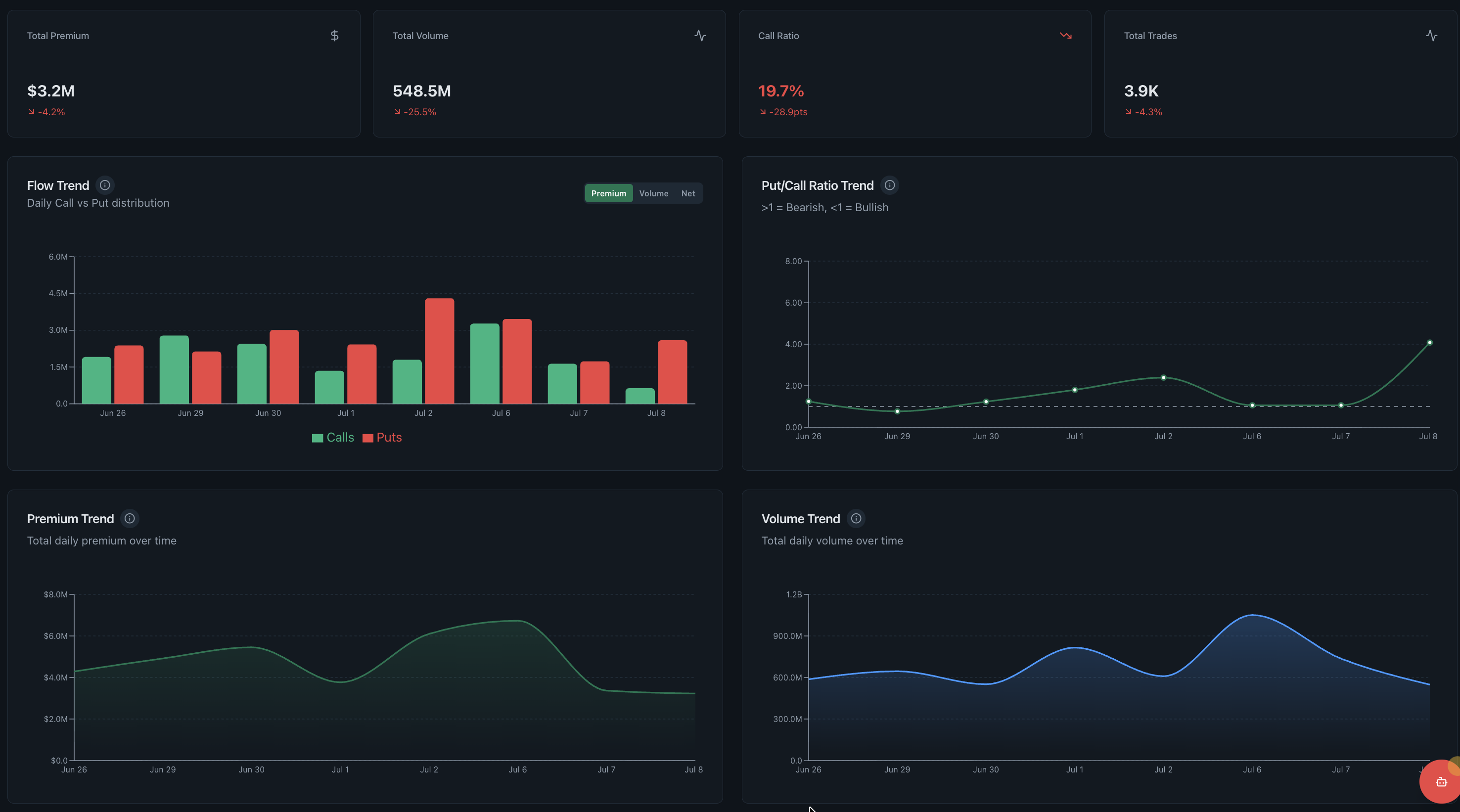
- Options volume scanner covers volume change, trade count and the volume-versus-open-interest read.
- Free options screener covers what free means across broker, delayed, freemium, trial and free-forever tools.
- Best options screener covers a dated comparison of named products and where Realtime Options is the wrong pick.
What no options scanner can tell you
Every scanner in every category shares the same four blind spots, because the public trade record does not contain the answers. A scan result is a research prompt; it is not evidence of intent, and it is not a signal.
Read the supporting context
Execution location relative to the bid and ask supports an estimate of which side was aggressive. That estimate is probabilistic and it fails routinely on multi-leg orders, hedges and rolls.
- Whether the contract was bought or sold to open: side is estimated, never reported.
- Whether the transaction opened a position or closed one already held.
- Whether the print was one leg of a spread, a roll or a delta-neutral structure.
- Who the counterparty was, and whether the position hedges stock or futures held elsewhere.
- What happens next; observed activity carries no forecast.
Data timing changes which scanner types still work
Delay affects scanner types unevenly. A 15 to 30 minute delay is workable for a chain screen aimed at a 30 to 45 day position, because the filters barely move in half an hour. The same delay is disqualifying for 0DTE work, where the contract has hours of life and the gamma profile changes inside the window.
Read the supporting context
Realtime Options runs the 3-day trial on 15-minute delayed data and near-real-time data on Pro at $29 per month. The delay is stated rather than described away, because a delayed scan is still useful for learning a workflow and reviewing completed sessions.
| Scan type | Effect of a 15 to 30 minute delay |
|---|---|
| Chain screen for 30 to 45 day positions | Minimal; filter values move slowly |
| Volume change and end-of-day review | Minimal; the comparison is against a session total |
| Intraday flow reading | Material; execution context is stale |
| 0DTE gamma and same-day research | Disqualifying; the contract can expire inside the delay |
Common questions
What is an options scanner?
An options scanner is software that monitors options market activity and surfaces contracts or tickers meeting conditions you set, such as unusual premium, a volume spike, a specific delta range or high implied volatility. It produces a shortlist to research, not a decision.
Is an options scanner the same as an options screener?
Most vendors use the terms interchangeably. Where a distinction is drawn, a screener filters a snapshot by contract attributes and a scanner watches for events as they print. They answer different questions and neither replaces the other.
Which type of options scanner does Realtime Options run?
Realtime Options runs flow scanning and volume and premium change scanning across US-listed stock and ETF options, then adds strike, expiry, open interest, gamma exposure, price and news context. It does not run a chain-parameter screener, an IV rank screen or a premium-yield screen.
Can an options scanner tell me whether a trade was a buy or a sell?
No. Exchange data reports the transaction, not the initiator. Where the trade printed relative to the bid and ask supports an estimate of which side was aggressive, and that estimate is unreliable for spread legs, rolls and hedges.
Is an options scanner the same as an options trading platform?
No. An options trading platform is where orders are entered and positions are held, which means a broker. Realtime Options is analytics software with no order entry, no broker connectivity and no execution of any kind.
Does a stock option scanner cover the whole US market?
Realtime Options covers US-listed stock and ETF options using licensed third-party market data rather than a direct exchange feed. Coverage of listed options is broad, but no scanner sees over-the-counter activity or the positions behind a print.
Do I need a real-time scanner to start?
Not necessarily. Delayed data is adequate for learning an interface, reviewing completed sessions and testing whether a workflow suits you. It is not adequate for same-day expiration research, where the contract can expire inside the delay window.