

High premium options screener: two opposite meanings
High premium options screener describes two opposite searches. Buyers use it to find the largest premium dollars committed in a single transaction, measured as option price multiplied by contracts and the 100-share multiplier. Sellers use it to find contracts whose premium is rich relative to the risk taken, measured as implied volatility against the name's own history or credit per unit of collateral. Realtime Options ranks the first: dollar premium by ticker, strike and expiry. It does not screen the second, and this page names the tool categories that do.
- Meaning one
- Largest premium dollars committed in one transaction
- Meaning two
- Richest premium relative to risk or collateral
- Realtime Options ranks
- Dollar premium by ticker, strike and expiry
- Realtime Options does not
- Screen IV rank, yield or credit per collateral
- Premium formula
- Option price x contracts x 100
- Keep in mind
- Size is observed; intent and side are estimates
Two readers, one keyword
The phrase splits cleanly along which side of the trade you expect to be on. A buyer scanning for high premium wants to see where large money moved, because size is a prompt to investigate a name. A seller scanning for high premium wants contracts that pay well for the risk assumed, because their edge is priced, not directional.
Read the supporting context
Nothing about the two screens overlaps. A list of the biggest premium prints of the day tells a premium seller nothing about yield, and a list of the highest annualised yields tells a flow reader nothing about who moved size today.
| What high premium means to you | The screen you actually need |
|---|---|
| Biggest dollars in one transaction | Flow ranking by premium, with trade count and strike |
| Premium rich relative to risk | IV rank or percentile plus credit per unit of collateral |
| Most expensive contract by price | Chain sorted by option price, which is mostly a strike artefact |
| Highest yield on capital held aside | Covered-call or cash-secured-put yield screener |
Premium dollars: how the buyer's screen works
Premium is option price multiplied by contract count multiplied by the 100-share multiplier. A $2.40 contract traded 5,000 times is $1.2 million of premium. That figure describes money that changed hands in the transaction; it does not describe profit, exposure or conviction.
Read the supporting context
The number that matters more than the headline total is how the total was assembled. One block of 5,000 contracts and 900 separate prints summing to the same premium are different events, and only trade count separates them.
- Premium total: the dollar size of the activity at that contract.
- Trade count: whether the total came from one transaction or many.
- Execution location: whether prints landed near the bid, the mid or the ask.
- Strike and expiry concentration: whether money clustered at one strike or spread along the chain.
- Repetition across sessions: whether the same strike keeps attracting premium.
Premium richness: how the seller's screen works, and where to get it
A premium-yield screen ranks contracts by what you are paid relative to what you risk. The standard filter set is implied volatility rank or percentile against the name's own history, credit divided by collateral or capital at risk, an annualised equivalent, delta as a rough proximity measure, days to expiry, open interest and bid-ask width for liquidity, and an earnings filter that excludes expiries containing a scheduled report.
Read the supporting context
Realtime Options does not run this screen. It has no IV rank or percentile screening, no yield calculation and no covered-call or cash-secured-put candidate list. The tools that do this well are broker scanners on a funded account and the dedicated wheel-strategy screeners built for exactly this job.
- Implied volatility rank or percentile against the name's own recent range.
- Credit received divided by collateral or capital at risk.
- Annualised equivalent, which flatters short expiries and should be read carefully.
- Delta, days to expiry and open interest at the candidate strike.
- Bid-ask width, because a wide spread can remove the yield before the position starts.
- Whether a scheduled earnings report falls inside the expiry.
Why the highest premium is usually high for a reason
In any premium-yield screen, the top of the list is where the risk is. Options are priced by participants who can see the same calendar you can, so an unusually rich premium normally reflects an identifiable reason rather than an oversight.
Read the supporting context
Working down the list of reasons before working down the list of candidates is the difference between a screen and a trap. None of this is advice about whether to take a position; it is a description of what the number contains.
- A scheduled earnings report or other binary event falls inside the expiry.
- The underlying is thinly traded, so quoted premium is not reliably obtainable.
- The bid-ask spread is wide enough to consume the credit on entry and exit.
- A corporate action, dividend or borrow cost is embedded in the pricing.
- The annualised figure is inflated by a very short expiry rather than by real richness.
Reading a large premium print without over-reading it
A large premium transaction is an observed fact. Everything usually said about it is an estimate. Whether it was a buy or a sell is inferred from where it printed relative to the bid and ask. Whether it opened or closed a position is not visible until open interest updates the following day.
Read the supporting context
Open interest is reported once daily after the close by OCC and never updates intraday, from any vendor. That single fact governs how quickly any premium print can be confirmed as new positioning.
- Side is estimated from execution location, not reported by the exchange.
- Opening versus closing is only testable against the next open-interest update.
- The print may be one leg of a spread, collar or roll rather than a standalone view.
- The position may hedge stock, futures or another option held elsewhere.
- Large size is not evidence of accuracy, information or institutional conviction.
Where dollar premium appears in Realtime Options
Four screens in the product deal directly with premium in dollar terms, each answering a different part of the question. They rank and organise observed activity; none of them produces a candidate list, a score or a recommendation.
| Screen | What it shows about premium |
|---|---|
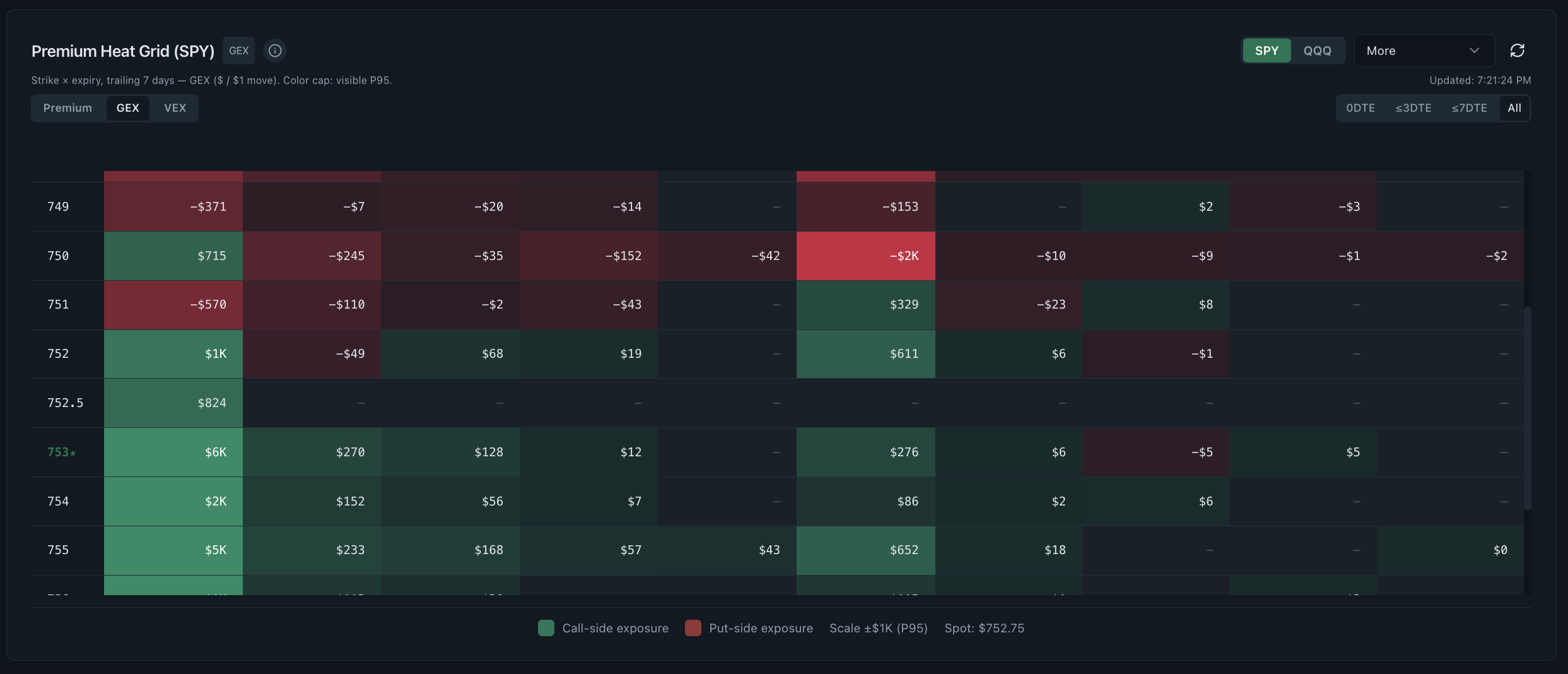
| Premium Heat Grid | Where premium concentrated across strikes and expiries |
| Premium Heatmap and Open Interest | Premium concentration set against outstanding contracts |
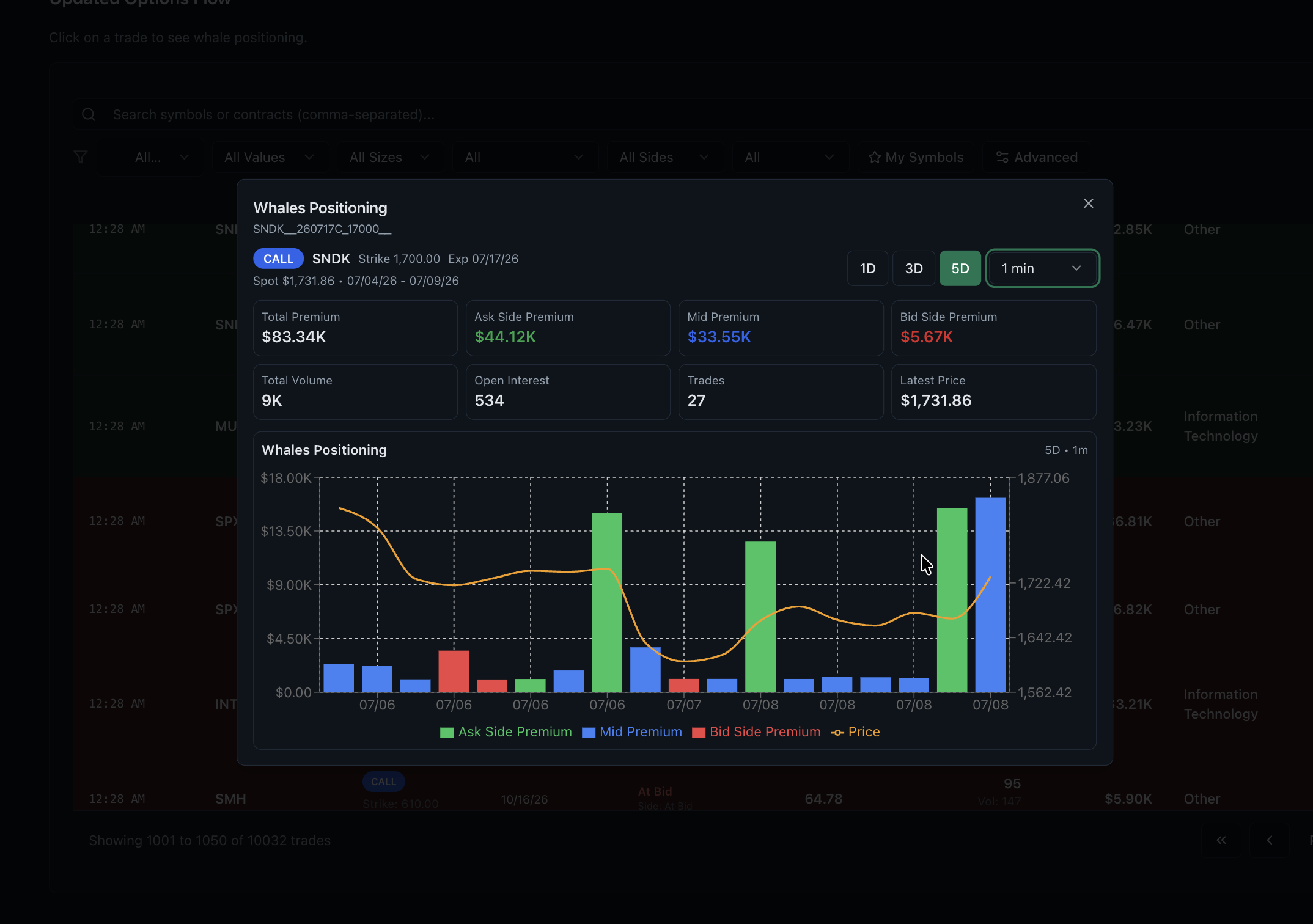
| Contract Positioning | Individual large transactions with contract, size and premium |
| Premium Edge | How much movement the market is pricing into the premium |
Common questions
What is a high premium options screener?
It is either a ranking of the largest premium dollars committed in single transactions, or a filter for contracts whose premium is rich relative to the risk taken. The two are unrelated screens and most tools only do one of them.
How is options premium calculated?
Premium in dollar terms is the option price multiplied by the number of contracts multiplied by the 100-share multiplier. A $1.50 contract traded 2,000 times represents $300,000 of premium.
Does high premium mean a good trade?
No. High dollar premium means size was involved and nothing more. High premium relative to risk usually means the market has priced a reason, such as an earnings report inside the expiry, thin liquidity or a wide spread. Neither is a recommendation and neither predicts an outcome.
Does Realtime Options screen for high implied volatility or IV rank?
No. There is no implied volatility rank or percentile screening, and no premium-yield screening by credit per unit of collateral. Realtime Options ranks and organises observed dollar premium across strikes, expiries and tickers.
Why is the premium on this contract so high?
The common causes are a scheduled catalyst inside the expiry, a thin underlying, a wide bid-ask spread, an embedded dividend or borrow cost, or a very short expiry inflating an annualised figure. Checking those four or five reasons is faster than debating the number itself.
Is a large premium print evidence of institutional conviction?
It is not. Size can come from a hedge against stock or futures, a roll of an expiring position, one leg of a spread or market-maker inventory management. The public record does not identify the owner or the purpose.
Where do covered-call and cash-secured-put premium screens fit?
They belong to the premium-richness side of this page and sit outside the Realtime Options product. The dedicated guides to covered-call and cash-secured-put screening explain the filter set and which tool categories provide it.