

Swing Contract Compass
Swing Contract Compass combines a multi-session price structure, moving-average slopes, RSI, execution pressure, expiry participation and a contract shortlist. It publishes a directional scenario only when its defined checks align; mixed evidence remains mixed instead of being converted into a forced trade plan.
- Research question
- Do price, flow and contract evidence align across sessions?
- Best used for
- Structured multi-session review without forced conclusions
- Data timing
- Near-real-time Pro; 15-minute delayed trial
- Product access
- Included in the single $29/month plan
What the swing contract compass shows
The Compass is designed to reward consistency rather than activity. It places price, flow and contract evidence on a shared lookback and shows which checks support, oppose or remain neutral, making a low-confidence or no-plan result a valid outcome.
Read the supporting context
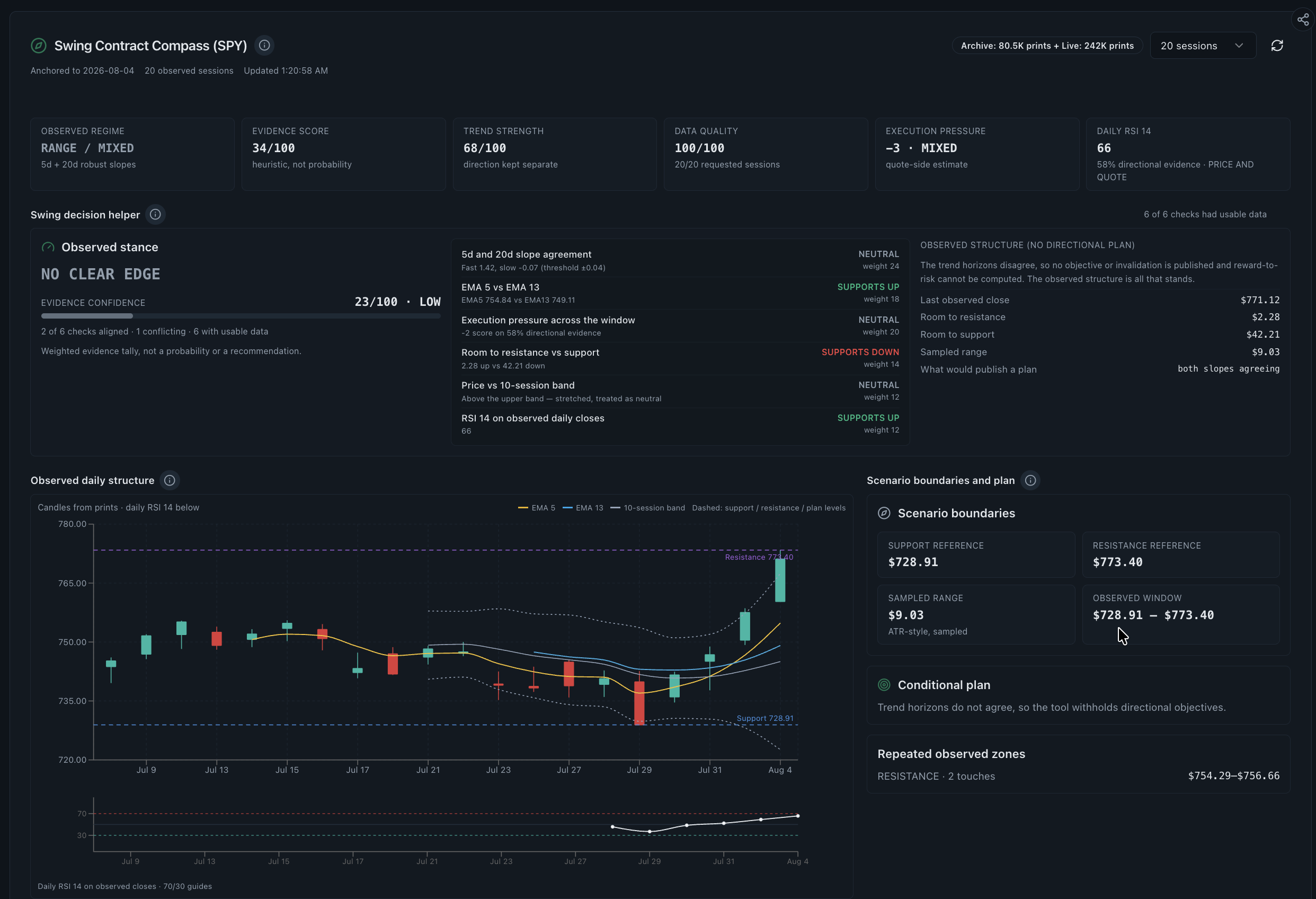
The screenshot above is from the working product, not a mockup. The visible controls and fields are the same ones trial and Pro users research with; only the market-data timing changes between the two access levels.
- Observed regime, evidence score, trend strength, data quality and execution pressure.
- Daily candles with moving averages, sampled range, RSI and scenario references.
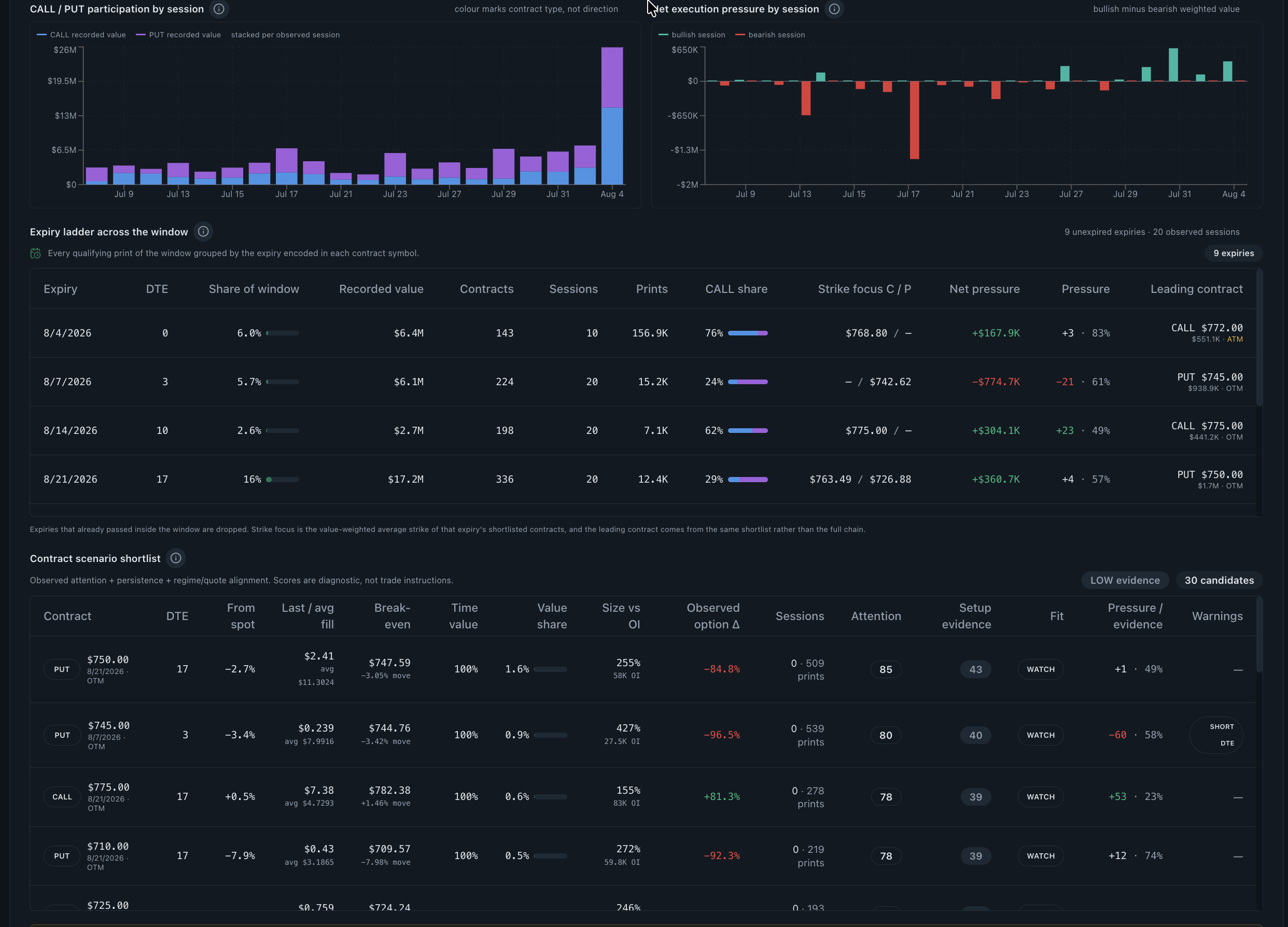
- Call and put participation plus net execution pressure by observed session.
- Expiry ladder with share of window, recorded value, sessions and pressure evidence.
- Contract shortlist with attention, persistence, fit and warning fields.
How to read this dashboard
Read the dashboard as one step in a sequence. Record what it directly shows first, then use the next view to test the interpretation rather than turning a color or ranking into a conclusion.
- Confirm that the requested sessions have usable data before reading a score.
- Separate fast and slow trend horizons instead of averaging disagreement away.
- Compare price structure with execution pressure across the same window.
- Inspect expiry participation before narrowing to an individual contract.
- Record both confirmation and invalidation conditions; accept no-plan output when checks conflict.
What this view cannot establish
Historical slopes, RSI, sampled support and resistance, and execution-pressure estimates can change with the window and data quality. A contract shortlist ranks evidence for further review; it does not determine suitability or forecast performance.
Read the supporting context
Realtime Options organises observed and derived market data for independent research. Read each view with its stated method, assumptions and surrounding context.
Common questions
What is Swing Contract Compass used for?
It organises multi-session price, flow, expiry and contract evidence into a repeatable swing-research review with visible confirmation and invalidation conditions.
Why can Swing Contract Compass show no clear edge?
The tool preserves disagreement between its checks. When trend horizons, pressure or structure do not align, withholding a directional scenario is more accurate than forcing one.
Is the contract shortlist a recommendation list?
No. It is a diagnostic ranking based on observed attention, persistence and model fit. It does not account for an individual's objectives, risk or suitability.