

Free options trading strategies and free strategy education
Genuinely free options strategy education exists and it is good: the Options Industry Council, Cboe, FINRA and the OCC's disclosure document publish complete material on every common structure at no cost, and most brokers include paper trading so the mechanics can be practised without capital at risk. What is usually marketed as a free options strategy is something different, normally a signal group, a chat room or the free tier of a paid funnel, and the cost of that arrives later.
- Genuinely free
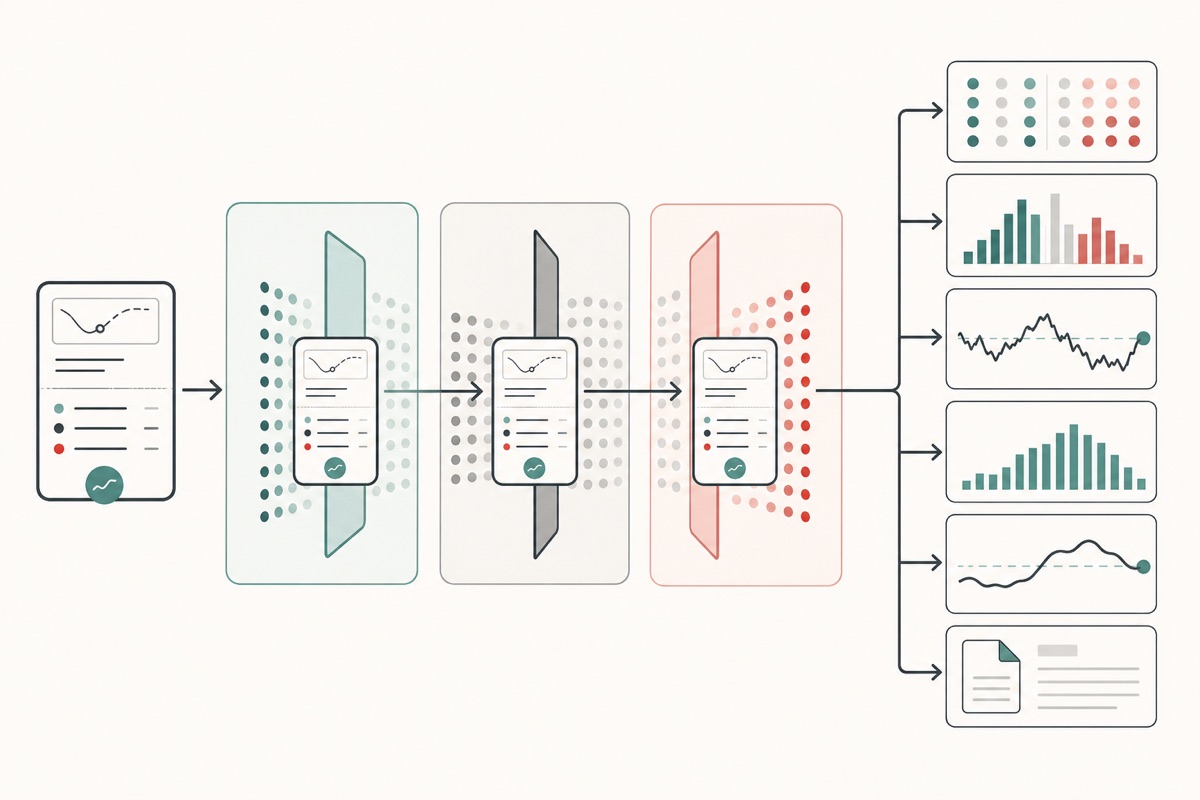
- OIC, Cboe, FINRA and OCC investor education
- Free practice
- Broker paper trading and delayed option chains
- Free here
- 3 days, every dashboard, 15-minute delayed data, no card
- Rarely free
- Signal rooms, alert groups and 'free' trade calls
- Never free
- Assignment risk, bid-ask spread and slippage
What is genuinely free and worth the time
The best free options strategy material is published by the bodies that have no product to sell you: the industry education council, the exchanges, the clearing corporation and the regulators. It covers every structure a retail account can access, in more detail than most paid courses.
Read the supporting context
Free in this sense means free forever, with no account, no card and no upsell. That is a different meaning of free from a trial, a delayed data tier or a chat room that opens onto a subscription.
| Free source | What it is good for, and its limit |
|---|---|
| Options Industry Council (optionseducation.org) | Structure definitions, mechanics, Greeks and worked examples from the industry's education body. Limit: it teaches structures, not current conditions. |
| Cboe education and its options calculator | Exchange-published material on pricing, volatility and index products. Limit: neutral by design, so it will never tell you what to do. |
| FINRA and SEC investor education | Approval levels, suitability, risk and fraud awareness. Limit: regulatory education rather than trading technique. |
| OCC disclosure document | The definitive statement of what a standardised option is, including exercise and assignment. Limit: long and formal, and worth reading anyway. |
| Broker paper trading | Order entry, multi-leg mechanics and margin behaviour with no capital at risk. Limit: no slippage, no partial fills, no emotional cost. |
| Delayed option chains | Strike structure, open interest and spread width at no cost, usually 15 minutes late. Limit: unusable for anything short-dated. |
| Realtime Options 3-day trial | All 10 dashboards and 8 specialist views on 15-minute delayed data, no card. Limit: flow and positioning research, with no strategy builder and no signals. |
What free options strategy usually means in practice
Search results for free options strategies are dominated by three things that are not education: signal groups, chat rooms and free tiers designed as the first step of a paid funnel. None of them is illegitimate by definition, but none of them is free in the way the word implies.
Read the supporting context
The economics are worth stating plainly. Free access has an acquisition cost for whoever offers it, and that cost is recovered somewhere: a subscription, a broker referral, a course, or the attention that makes the next offer land.
- Free entry room, paid room: the free tier delivers delayed or partial calls, and the paid tier is presented as the version that works.
- Free tool, paid data: the calculator or diagram is free and the current market data behind it is not.
- Free trial: full access for a set period, which is honest as long as the length, the data timing and the cancellation terms are stated up front.
- Free forever, limited: a real free tier with a narrow feature set, usually on delayed data.
- Free because you are the referral: the strategy content exists to move you into a brokerage account that pays for the introduction.
Why free trade calls are the most expensive thing a new options trader can accept
A free options call transfers a position to you without transferring any of the reasoning, the sizing or the exit. You receive the part that can be screenshotted and none of the part that makes it survivable, and you carry one hundred per cent of the loss.
Read the supporting context
This is a factual problem rather than a complaint about any particular group. The structure of the arrangement, not the character of the person, is what makes it unreliable.
- You cannot audit the record. Screenshots of profitable tickets are selected after the fact and are not a verifiable track record.
- A call without a position size, an exit rule and a stated reason is not a strategy, and it cannot be evaluated or repeated.
- The person calling it carries none of your loss, none of your assignment obligation and none of your tax consequence.
- Entry and exit timing rarely transfer. By the time a call is distributed and read, the premium that made it interesting has often already moved.
- Anyone compensated for giving individualised investment recommendations may be required to register. FINRA BrokerCheck and investor.gov let you check a firm or individual before you pay anything, and the SEC and FINRA both publish investor alerts on trading based on social media and online chatter.
- Following a position you cannot explain removes the one durable asset a new options trader has, which is a repeatable reason for every trade taken.
How to practise a strategy for free without risking capital
Paper trading is the most underrated free resource in options, because the mechanics are where most early losses actually come from. Entering a four-leg order correctly, rolling it, and closing it before expiry are skills that have nothing to do with market view.
Read the supporting context
Its limits are equally worth knowing, so that simulated results are not mistaken for evidence that a strategy works.
- Fills are theoretical. A mid-price fill in simulation is frequently unavailable in a live multi-leg order.
- Slippage and partial fills on spreads do not appear, and they are a real cost on wider structures.
- Early exercise and assignment are simulated inconsistently and rarely at the moments that matter.
- Position size is emotionally free in simulation, which is precisely the part that does not transfer to a funded account.
- Use it for mechanics: opening, adjusting, rolling and closing each structure correctly at least once before doing it with money.
What Realtime Options gives away, and what it does not
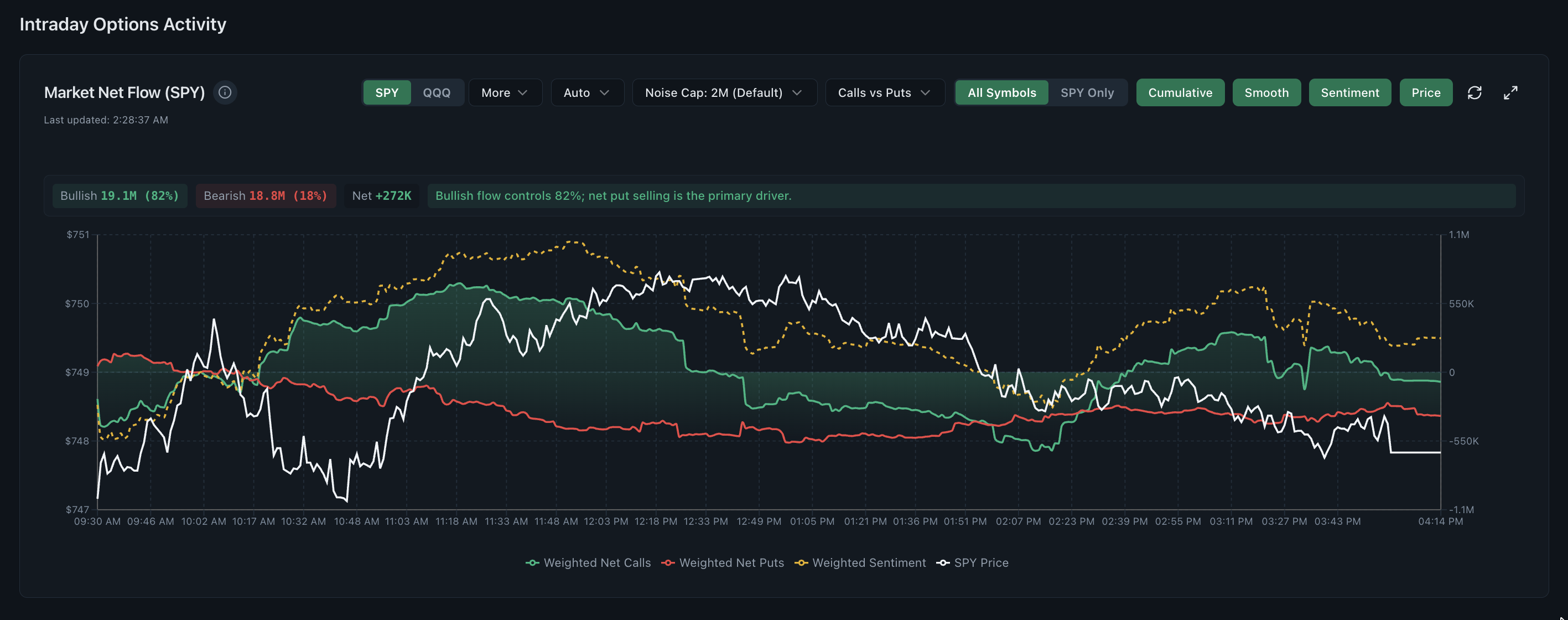
The trial is 3 days, covers every dashboard and specialist view, runs on 15-minute delayed market data and requires no credit card. After that, Pro is $29 per month for near-real-time analytics, one plan with no tiers, cancellable at any time.
Read the supporting context
What the trial does not include is anything strategy-shaped, because the product does not have it. There is no strategy builder, no payoff diagram, no backtesting, no trade ideas and no alerts framed as recommendations. It is research software for observed options activity, and it is not a registered investment adviser or broker-dealer.
- Free without an account: every guide and tool page on this site, including screenshots and reading methods.
- Free for 3 days with an email: all 10 dashboards and 8 specialist views on 15-minute delayed data.
- Paid: near-real-time data and authenticated, read-only Public API v1 access at $29 per month.
- Not available at any price here: strategy building, payoff modelling, backtesting, order entry, signals or a raw or unrestricted data API.
A free checklist before any strategy goes live
Every item on this list costs nothing and can be completed before a single contract is traded. Most of the avoidable damage in a new options account comes from skipping three or four of them.
- Read the OCC disclosure document your broker provides, particularly the sections on exercise and assignment.
- Confirm your options approval level and what it permits, since it sets your available structures.
- State the maximum loss of the intended position in currency, before entry.
- Write the exit rule for a loss and for a gain, before entry.
- Check whether an earnings date or another scheduled catalyst falls inside the expiry.
- Check the bid-ask spread and open interest on every leg, not only the one you care about most.
- Decide in advance what happens if a short leg is assigned, including whether the capital or the shares are available.
Common questions
Are there genuinely free options trading strategies?
The strategies themselves are public knowledge and always have been. Covered calls, verticals, straddles, condors and collars are documented in full by the Options Industry Council, Cboe, FINRA and the OCC at no cost. What is rarely free is current market data and the discipline to apply a structure consistently.
Is paper trading a good way to learn a strategy for free?
It is excellent for mechanics and unreliable for results. Simulators fill orders more generously than live markets, do not model slippage or partial fills well, and remove the emotional weight of size. Use it to learn how to open, roll and close a structure correctly, not to prove a strategy works.
Are free options signals or trade calls worth following?
A call arrives without a verifiable record, without position sizing, without an exit and without the reasoning that produced it, while you carry the whole loss. Free access is also usually the entry point to a paid product. Anyone compensated for individualised recommendations may need to be registered, which is checkable before you pay anything.
How do I check whether someone offering options calls is registered?
FINRA BrokerCheck covers brokers and brokerage firms, and investor.gov covers investment advisers and includes the SEC's investor education and alert material. Both are free, take a minute, and are worth doing before money or personal details change hands.
Is Realtime Options free?
There is a 3-day free trial with no credit card, covering every dashboard on 15-minute delayed market data. After that it is $29 per month for near-real-time analytics on one plan, cancellable at any time. There is no permanent free real-time tier.
Do you publish free trade ideas or a strategy of the day?
No. Realtime Options publishes analytics on observed options activity, never trade ideas, signals or recommendations. It has no strategy builder and no backtesting, and it is not a registered investment adviser or broker-dealer.
What is the cheapest way to learn options properly?
Read the OCC disclosure document and the Options Industry Council material end to end, practise the mechanics in a broker simulator, and study a small number of real chains rather than many opinions. That sequence costs nothing and covers more ground than most paid courses.